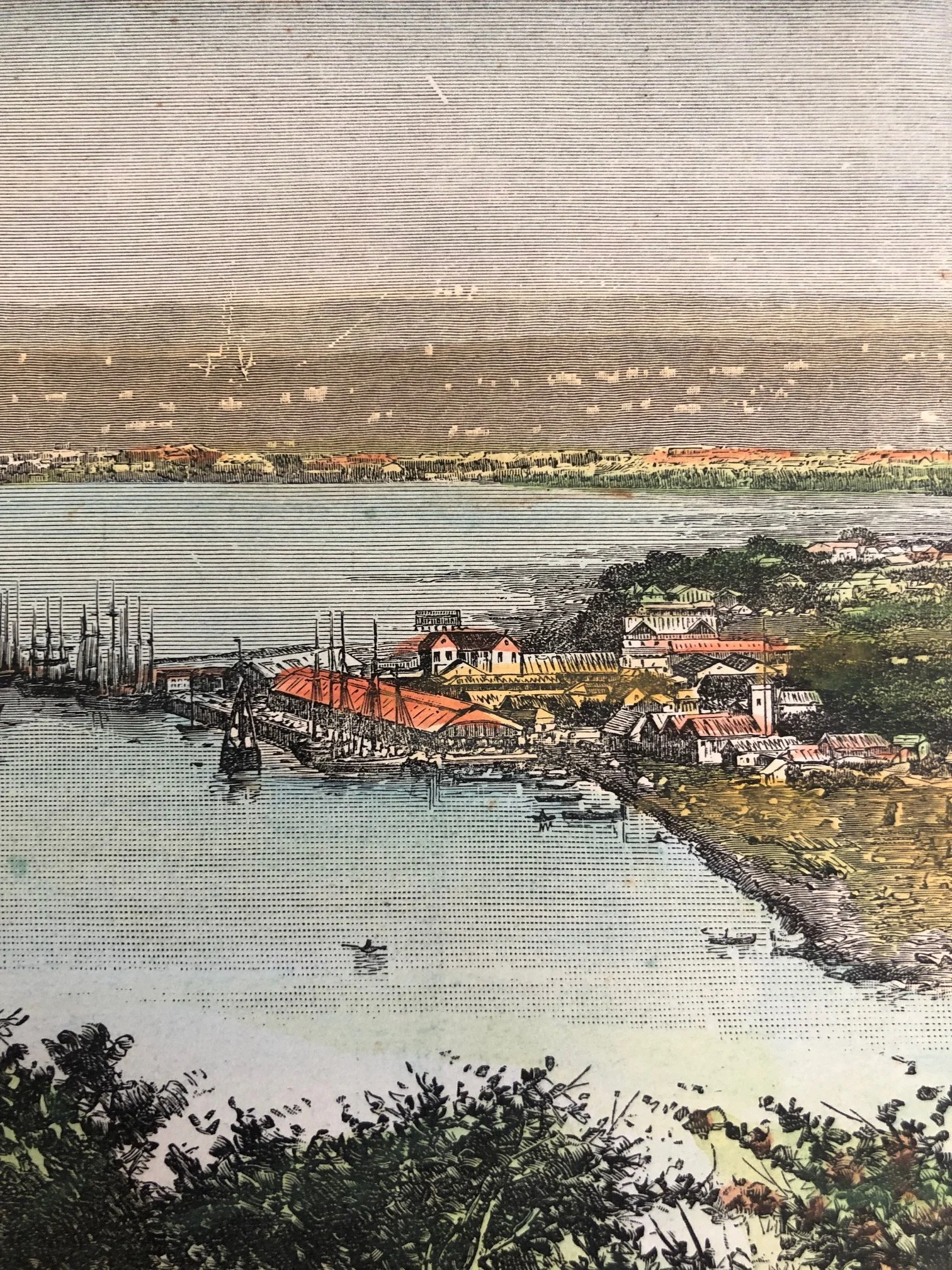
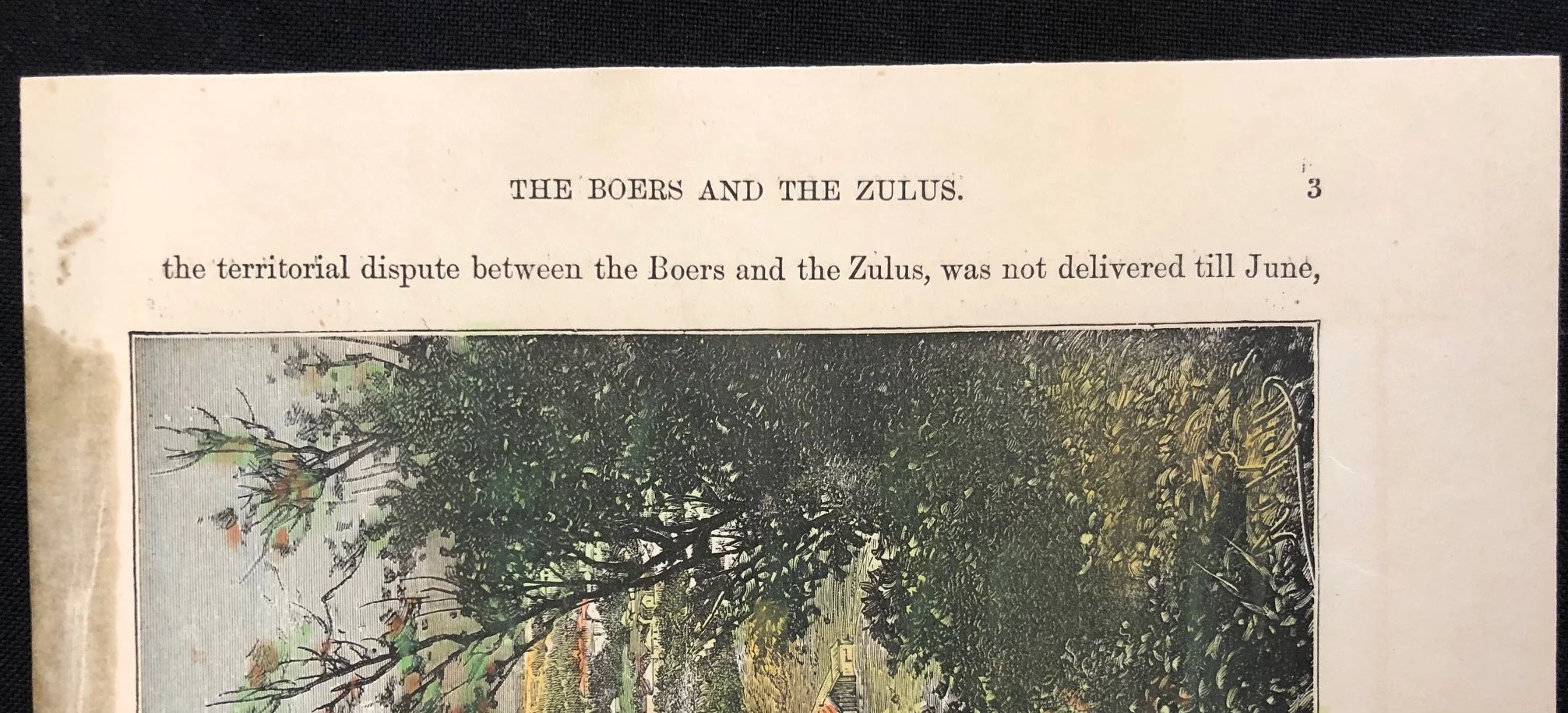
Woodcut of "PORT NATAL AND DURBAN. VIEW TAKEN FROM THE BLUFF." (c.1880)
This is a page excised from a late-Victorian history text, utilizing a repurposed engraving to illustrate the surrounding chapter.
The Engraving
The image is a wood engraving titled "PORT NATAL AND DURBAN. VIEW TAKEN FROM THE BLUFF."
Drawn by the artist T. Taylor (signature visible on the bottom left) and engraved by A. Kohl (signature visible on the bottom right).
This illustration was heavily circulated in the late 19th century and is most notably recognized for its inclusion in the English edition of Élisée Reclus' comprehensive work, The Universal Geography. Publishers of the era frequently reused high-quality printing plates like this one across various historical and geographical publications.
The Marginal Text and the Spark of War
What makes this specific clipping historically intriguing is the fragmented text running vertically along the margins:
"THE BOERS AND THE ZULUS."
"the territorial dispute between the Boers and the Zulus, was not delivered till June, 1878, and it had been arranged that the award should be made subject to the"
This text directly references the Blood River Territory Boundary Commission of 1878—the bureaucratic catalyst for the Anglo-Zulu War.
In early 1878, a commission was established to settle a bitter, long-standing border dispute between the Zulu Kingdom and the Transvaal Boers. The British High Commissioner, Sir Bartle Frere, who was actively seeking a pretext to invade Zululand to advance his plans for a federated South Africa, assumed the commission would rule against the Zulus.
To Frere's absolute dismay, the commissioners delivered their report in June 1878 (the date in the fragment's text), ruling almost entirely in favor of King Cetshwayo. Because a peaceful resolution ruined his imperial plans, Frere deliberately suppressed the commission's findings for months. When he finally delivered the boundary "award" to the Zulu delegates in December 1878, he maliciously attached an impossible ultimatum to it, demanding the total dismantling of the Zulu military system. When Cetshwayo inevitably failed to comply, British forces invaded in January 1879.
Page size: 240mm x 170mm
(Later) hand coloured woodcut. Sellotape residue.
R1,250