Pen-and-ink Caricature of Kaiser Wilhelm II by Denis Santry (1917)
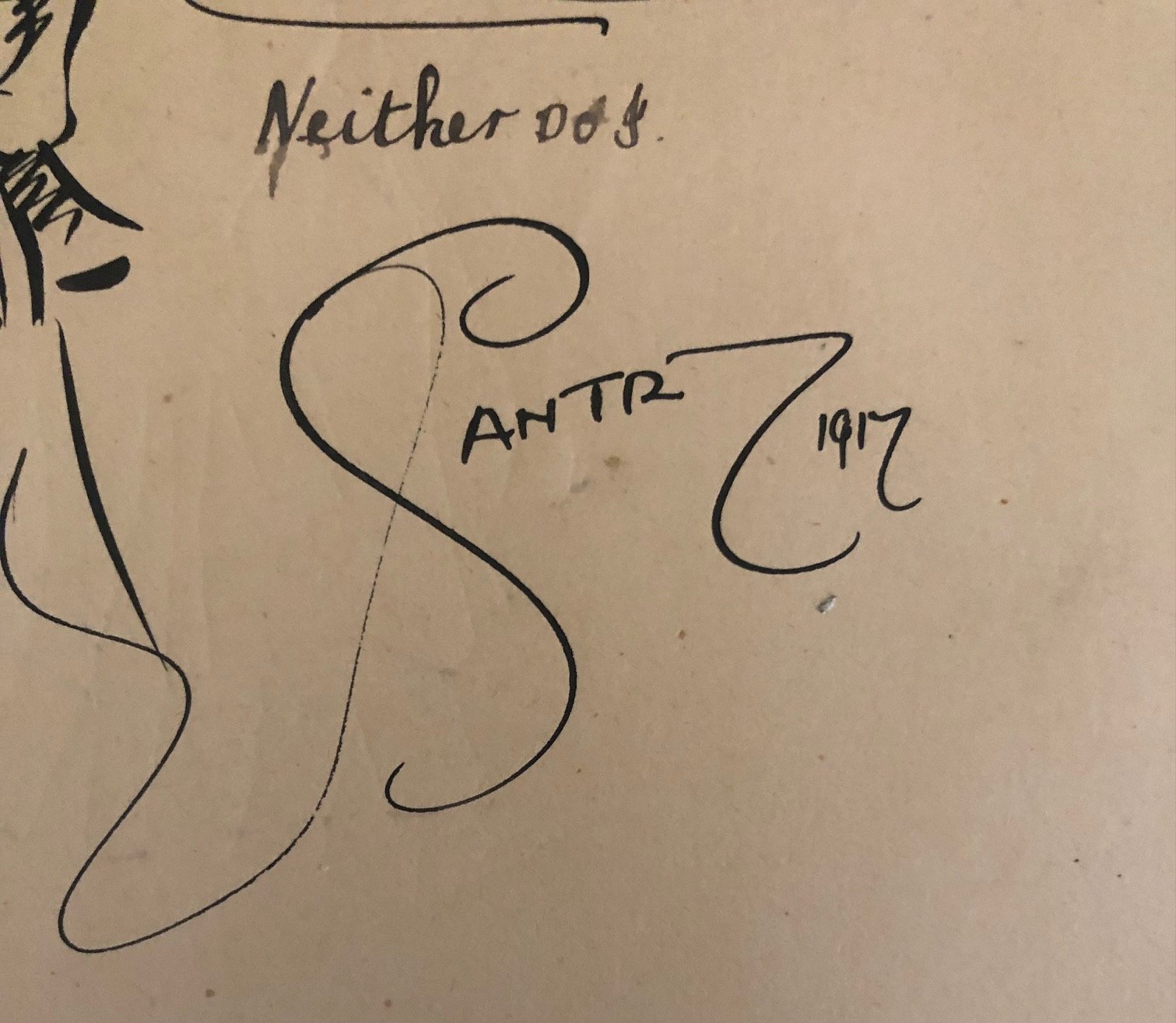
This pen-and-ink cartoon from an autograph book, is dated 1917. It offers a fascinating slice of World War I political propaganda from a South African perspective.
The Artist: Denis Santry
The artwork is signed "SANTRY 1917" by Denis Santry (1879–1960), an Irish-born architect and pioneer political cartoonist in South Africa.
During WWI, Santry was the chief political cartoonist for Johannesburg's Rand Daily Mail and Sunday Times.
Beyond print media, Santry was a pioneer of South African animated cinema, creating wartime animated propaganda shorts ("Topicalities") for African Film Productions around 1915–1917.
He later moved to Singapore in 1918, where he resumed architecture and designed iconic landmarks, including the Sultan Mosque and The Cenotaph war memorial.
The Context: "Springboks" on the Western Front
The speech bubble reads:
"We don't like SPRINGBOKS do we WILLIE?"
(with a penciled addition below: "Neither do I.")
The "Springboks": Long before the name became exclusively tied to South African rugby, "Springboks" was the moniker used for the South African Overseas Expeditionary Force serving in Europe and Africa during WWI.
Western Front Impact: By 1917, South African forces had earned international fame—and German dread—following their heroic, costly defense of Delville Wood during the Battle of the Somme in July 1916.
"Willie": This refers to either Kaiser Wilhelm II or his son, Crown Prince Wilhelm ("Little Willie"), who commanded the Imperial German 5th Army. In British and Commonwealth propaganda cartoons, "Willie" was the standard derogatory moniker for the Imperial German high command.
The Visual Satire
The central figure is depicted as a heavily caricatured Prussian officer wearing a Totenkopf (skull and crossbones) death's-head cap—associated with the elite Imperial German Hussar regiments and stormtrooper units.
The small creature perched atop his cap acts as a satirical sidekick prompting "Willie," highlighting the Allies' wartime narrative of German anxiety over Commonwealth troops.
The "Springbok" Connection: The joke in Denis Santry's cartoon relies on portraying the Emperor—the supreme commander of the German Armed Forces—as being personally rattled by the fighting reputation of the South African troops on the Western Front.
Dual Satire: Cartoonists of the period often played on the name double-entendre between Kaiser Wilhelm II ("Big Willie") and his eldest son, Crown Prince Wilhelm ("Little Willie"). Here, attributing the nervous speech bubble to the figure directly mocks Wilhelm II's leadership and his military's frustration with Commonwealth forces.
Page size: 225mm x 180mm
Minor stains, rubbing.
R1,000