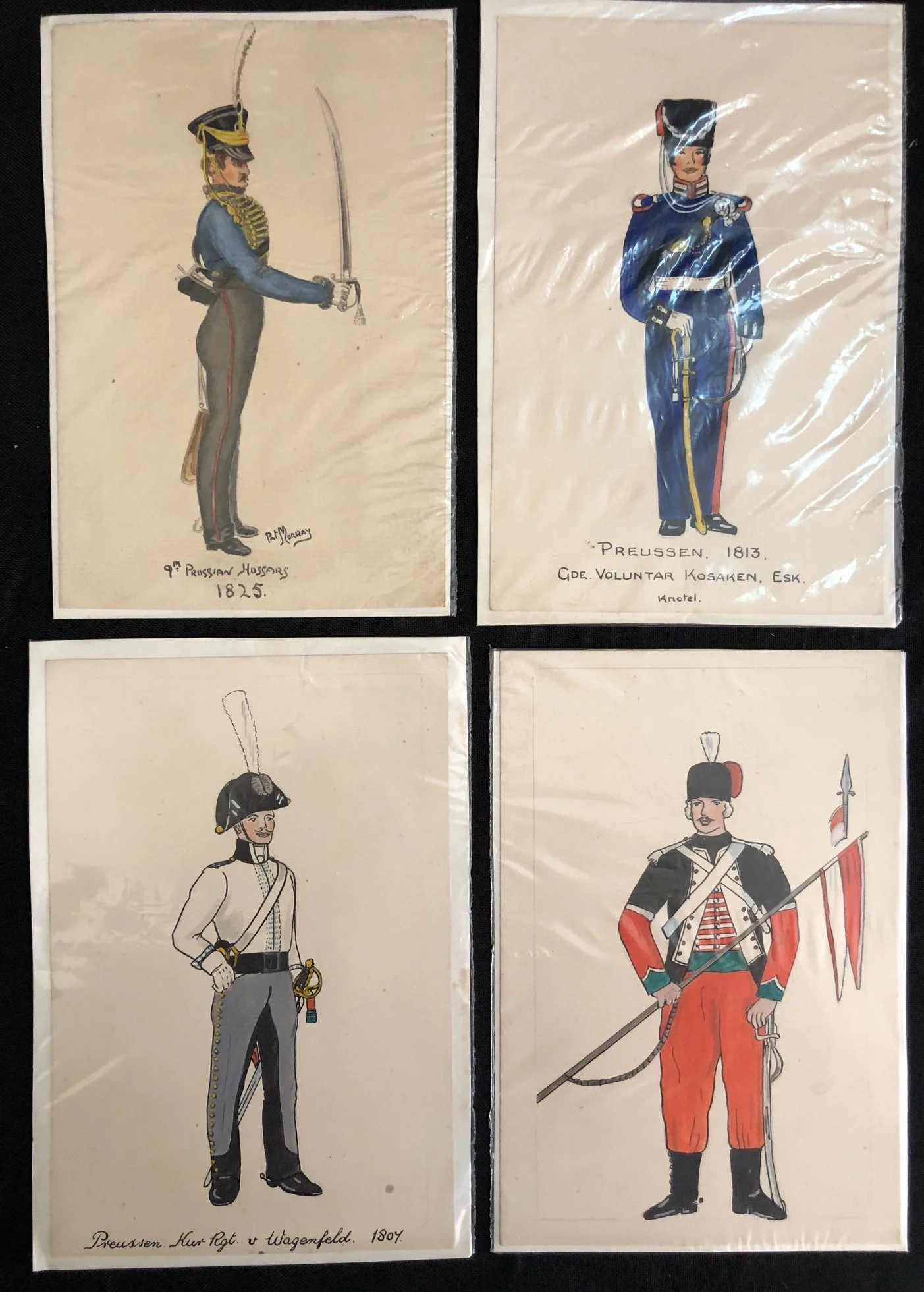
Four Paintings of Prussian Soldiers during the Napoleonic Wars.
This is a fascinating collection of hand-colored uniform plates, showcasing a highly turbulent and transformative era for the Prussian Army (Preußen) during and just after the Napoleonic Wars.
The plates themselves are a mix of historical reference styles. At least two are closely linked to Richard Knötel (1857–1914), the legendary German painter and art historian who essentially founded the scientific study of military uniforms (Uniformenkunde). His work remains the gold standard for historians and collectors because of its meticulous accuracy.
Top Left: "9th Prussian Hussars, 1825"
The Context: This plate captures the Prussian army during the peaceful, conservative Biedermeier period following the fall of Napoleon.
The Uniform: The figure wears a classic Hussar dolman (the tightly fitted, heavily braided jacket) in light blue, paired with grey overalls reinforced with leather on the inner leg for riding.
Historical Significance: By 1825, Prussian Hussar regiments had been reorganized following the total collapse of the old army in 1806 and the subsequent Wars of Liberation. The 9th Hussars (originally formed during the 1813 mobilization) came to represent the elite, dashing light cavalry of the post-Napoleonic peace, maintaining the intricate, Hungarian-inspired braiding that defined the Hussar mystique across Europe.
Top Right: "Preussen. 1813. Gde. Voluntar Kosaken. Esk." (Garde-Volontär-Kosaken-Eskadron)
The Context: 1813 was the pivotal year of the Befreiungskriege (Wars of Liberation), when Prussia rose up against Napoleon's occupation. Lacking resources, the Prussian state relied heavily on volunteers (Freiwillige Jäger and volunteer squadrons).
The Uniform: This shows a member of the Volunteer Cossack Squadron of the Guard. He wears a distinctively dark blue uniform with a black fur shako (Kolpak).
Historical Significance: During the 1812 retreat from Moscow, Prussian soldiers witnessed the devastating effectiveness of Russian Cossack irregular light cavalry against the French. Inspired, Prussia raised its own "Volunteer Cossack" units in early 1813. This specific Guard unit was made up of wealthy volunteers who paid for their own horses and equipment to fight for the liberation of the German states. The explicit attribution to Knötel at the bottom marks this as a study from his famous reference works.
Bottom Left: "Preussen Kur. Rgt. v. Wagenfeld. 1806" (Kürassier-Regiment von Wagenfeld Nr. 4)
The Context: This represents the tragic "Old Prussian" army of Frederick the Great's legacy, just months before it was utterly shattered by Napoleon at the twin battles of Jena and Auerstedt in October 1806.
The Uniform: A heavy cavalry officer in a pristine white coat, grey breeches with ornate side-buttoning, a large bicorne hat, and carrying a heavy straight-bladed broadsword (Pallasch). He is noticeably not wearing the steel breastplate (cuirass)—during this specific pre-war period, Prussian cuirassiers ironically left their breastplates in storage or only wore them for specific parades.
Historical Significance: The regiment was commanded by Major General Ernst Philipp von Wagenfeld. In 1806, the unit marched against the French but was caught in the chaotic retreat following the disaster at Jena. The 3rd Squadron surrendered at Erfurt, while the remaining squadrons under General Blücher fought a desperate rearguard action before finally capitulating at Ratekau. The regiment ceased to exist after the Treaty of Tilsit, making this a depiction of a "ghost" regiment of the old regime.
Bottom Right: Freikorps / Landwehr Pike-Bearer (c. 1813–1815)
The Context: Though unlabeled, this plate vividly illustrates the desperate, improvised nature of the Prussian mobilization against Napoleon in 1813.
The Uniform/Weapons: The soldier is dressed in a non-standard, rustic uniform consisting of a black coat with red facings, bright red trousers, a simple soft cap, and—most importantly—he is armed with a pike rather than a musket.
Historical Significance: When King Friedrich Wilhelm III issued his famous address "An Mein Volk" (To My People) in 1813, thousands of men flooded into the newly formed Landwehr (militia). Prussia was economically devastated and lacked the industrial capacity to manufacture enough muskets for everyone. As a temporary measure, the rear ranks of many Landwehr battalions were literally armed with medieval-style pikes and lances until firearms could be captured from the French or imported from Britain. It is a striking visual reminder that the defeat of Napoleon was won not just by elite guards, but by heavily under-equipped civilian volunteers.
Collector's Note
The mix of English handwriting (like "9th Prussian Hussars 1825") alongside traditional German military abbreviations suggests these may have been compiled, annotated, or mounted by a 20th-century uniform collector or military historian for a specialized reference collection. The vibrant watercoloring indicates they were intended to serve as highly accurate visual templates for uniform researchers, military modelers, or costume designers.
110mm x 160mm each
Various artists
R1,600 for the set.