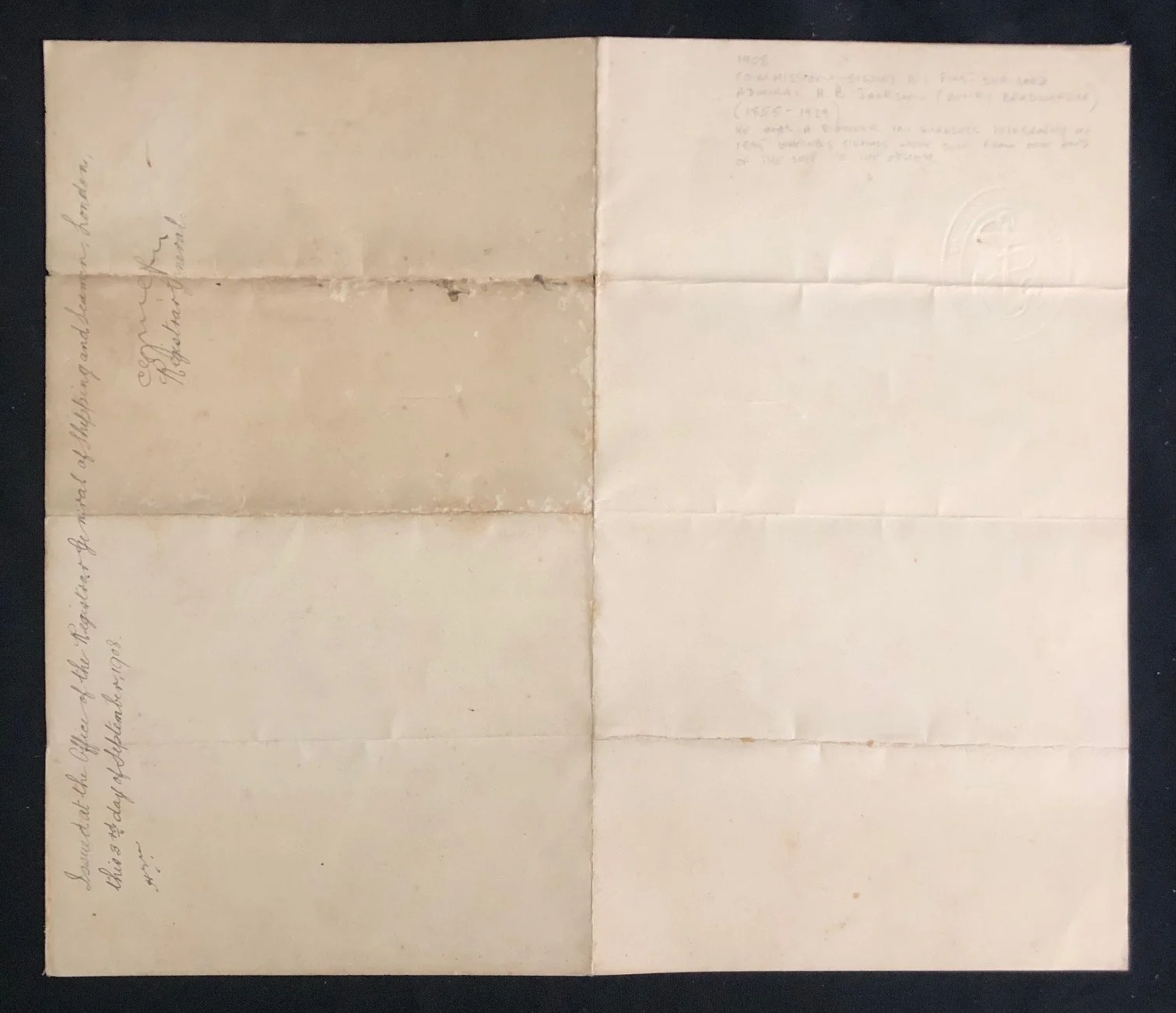
British Naval Commission Appointing Mr. Leoline Winton Theodore Lewis as a Sub-Lieutenant in the Royal Naval Reserve (1908)
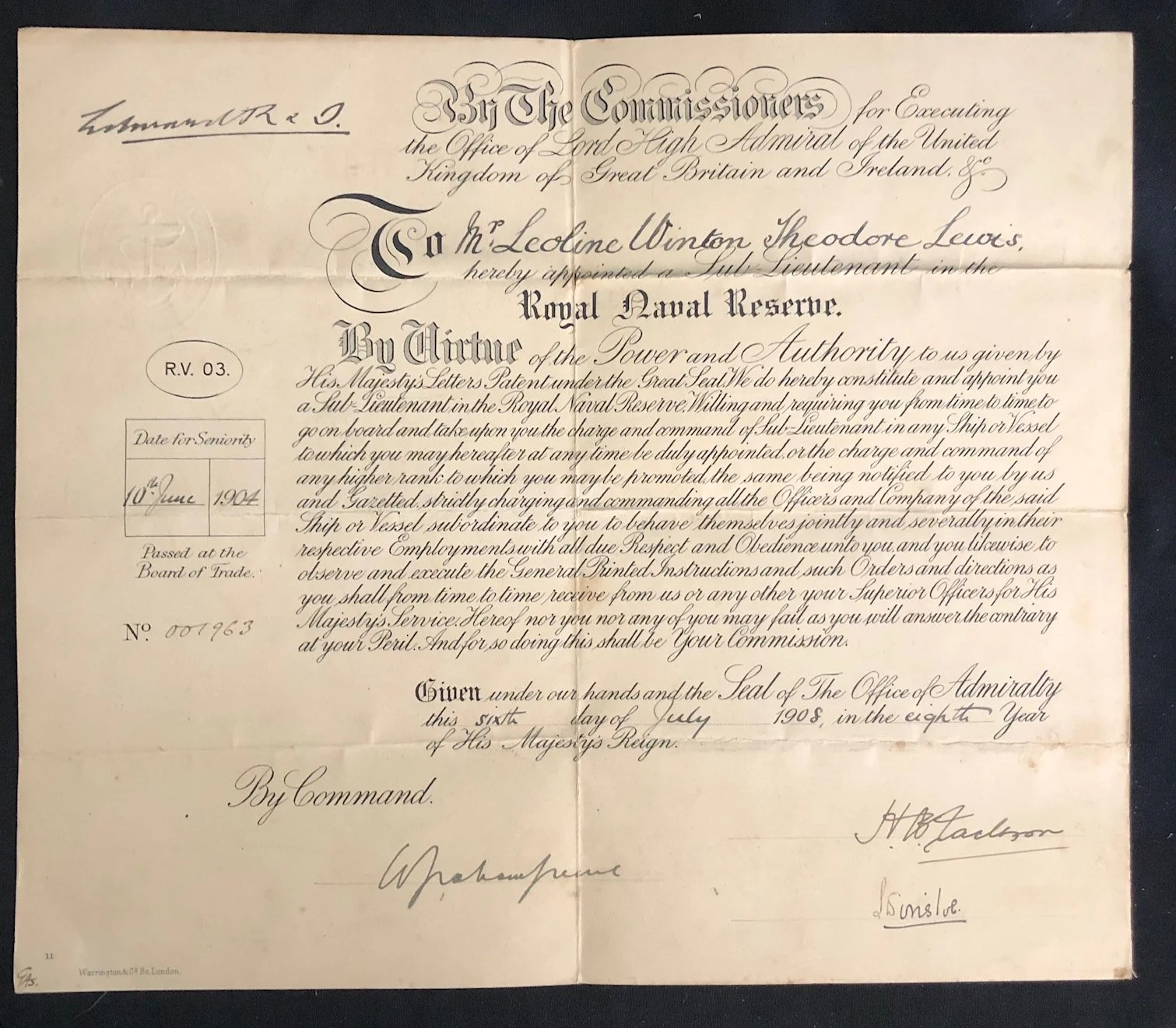
Original Edwardian-era British naval commission appointing Mr. Leoline Winton Theodore Lewis as a Sub-Lieutenant in the Royal Naval Reserve (RNR).
Beyond its beautiful calligraphic presentation, the document captures a precise moment of profound structural and technological transition within the British Empire's maritime forces, signed by men who would go on to command the global naval theatre of the First World War.
The Document Mechanics & Transcription
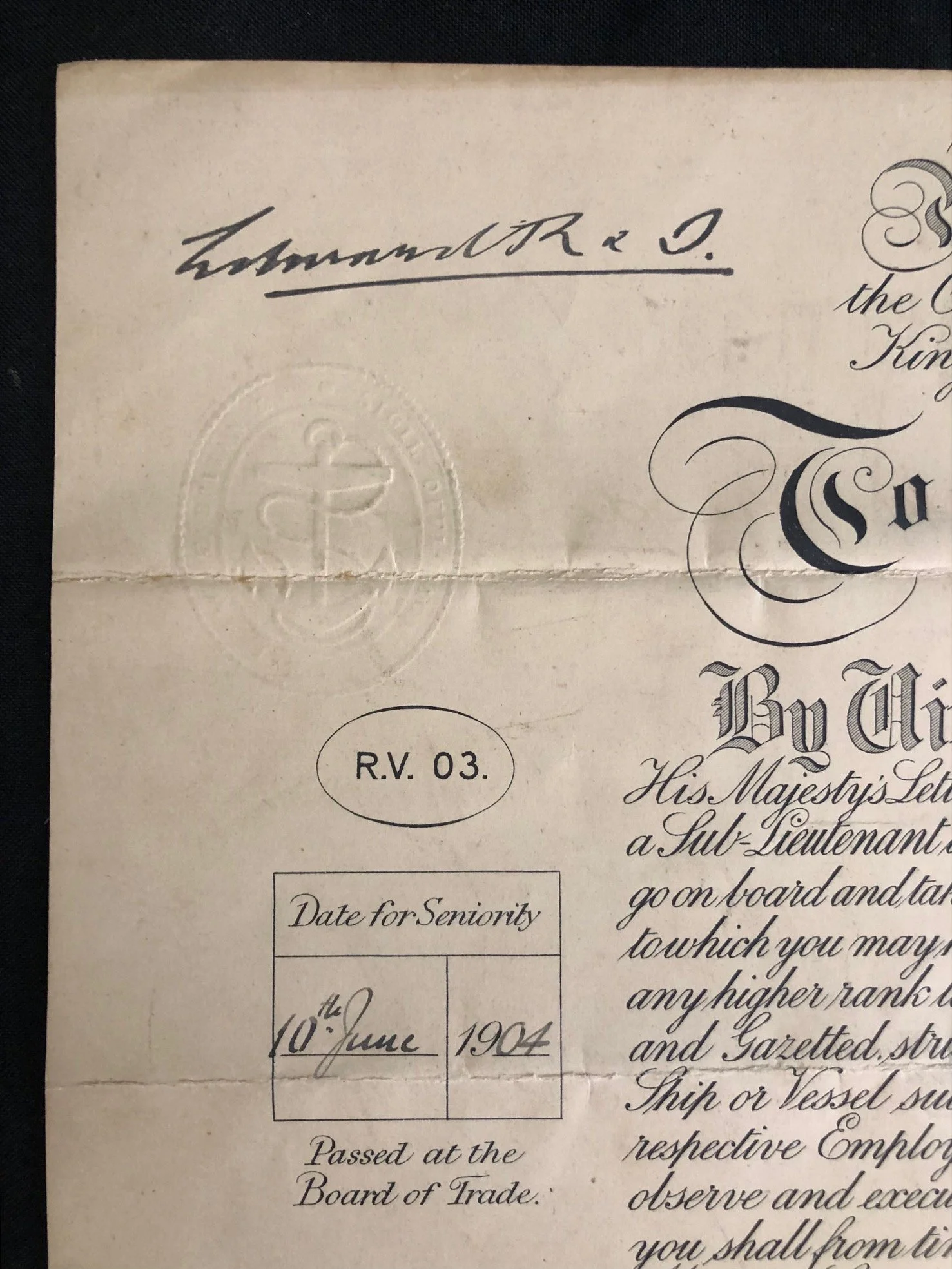
Issued under the authority of King Edward VII, whose royal cipher and signature stamp reads "Edward R & I" (Rex et Imperator).
"By the Commissioners for Executing the Office of Lord High Admiral of the United Kingdom of Great Britain and Ireland... To Mr. Leoline Winton Theodore Lewis, hereby appointed a Sub-Lieutenant in the Royal Naval Reserve. By Virtue of the Power and Authority to us given by His Majesty's Letters Patent under the Great Seal..."
Date for Seniority: 10th June 1904.
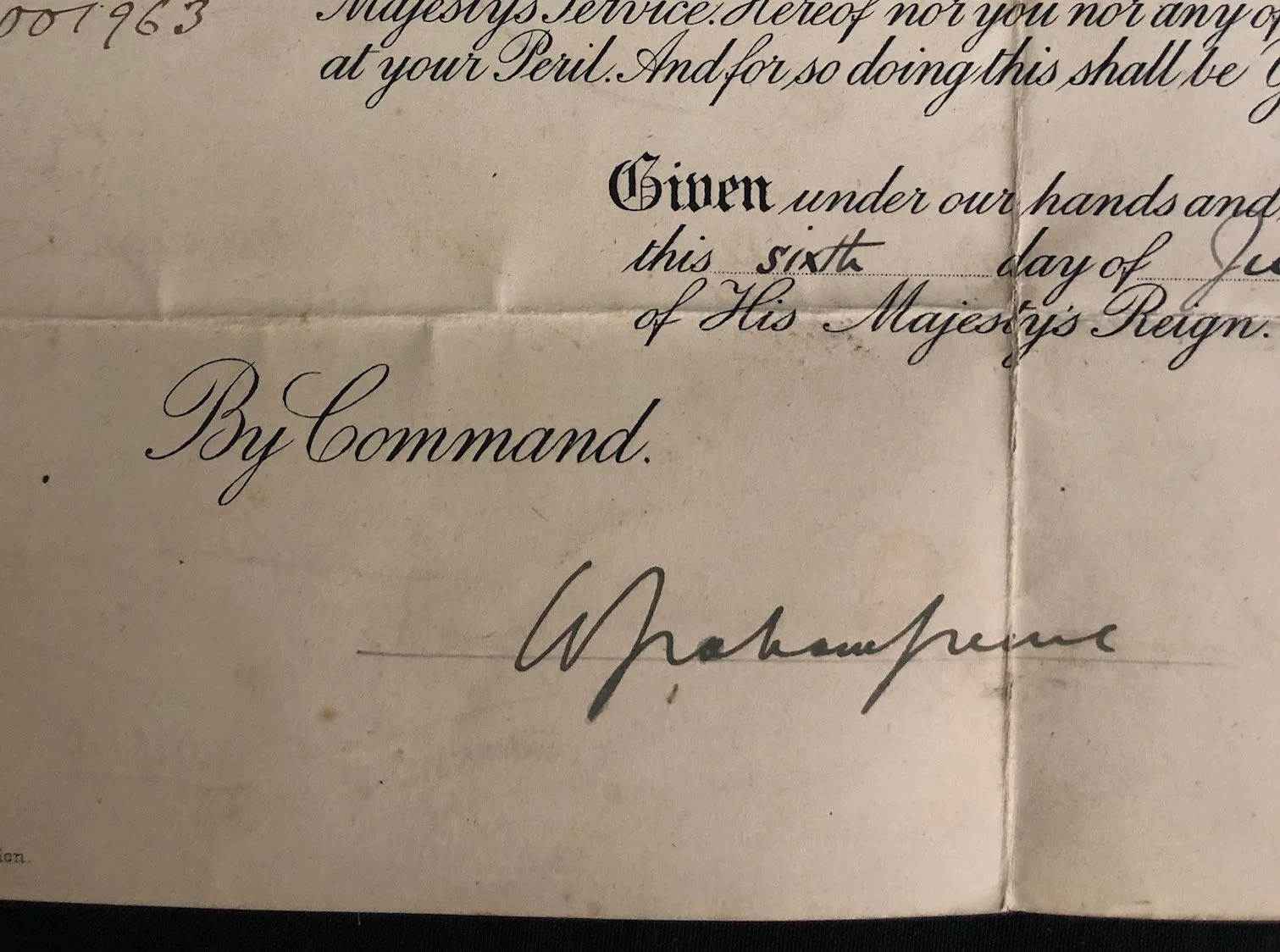
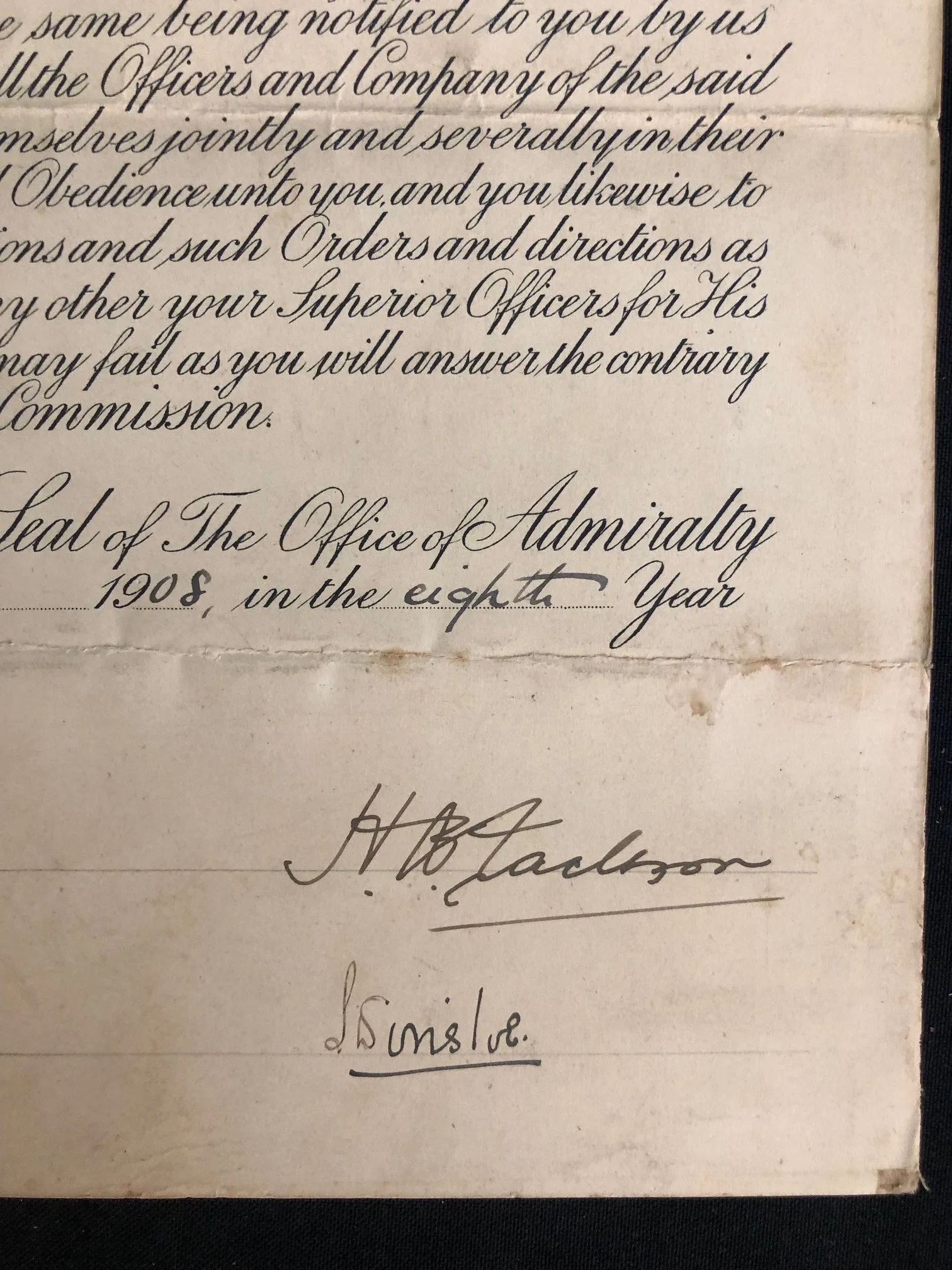
Given Under Our Hands: 6th July 1908 (in the eighth year of Edward VII's reign).
The Historical Significance
The Power of the "Board of Trade" Stamp
The commission explicitly notes: "Passed at the Board of Trade." This is the defining characteristic of the Royal Naval Reserve (RNR). Unlike the Royal Navy Volunteer Reserve (RNVR), who were civilian "weekend sailors," RNR officers were professional, highly qualified merchant navy captains, mates, and engineers.
To hold an RNR commission, a man like Leoline Winton Theodore Lewis first had to pass stringent professional seafaring examinations certified by the civilian Board of Trade. In times of peace, they operated the great commercial steamships, ocean liners, and trade vessels that fed the British Empire; in times of war, they were immediately called up as a ready-made officer corps to command auxiliary cruisers, minesweepers, and convoy escorts.
The Signature of a Wireless Pioneer: H.B. Jackson
Among the Lords Commissioners signing at the bottom right is "H. B. Jackson" (Sir Henry Bradwardine Jackson, 1855–1929). In July 1908, Jackson was serving as the Third Sea Lord and Controller of the Navy.
Jackson is one of the unsung tech giants of naval history. Working entirely independently of (and concurrently with) Guglielmo Marconi, Jackson was the first person in history to achieve successful ship-to-ship wireless radio communication. In the late 1890s, he successfully transmitted radio signals between naval vessels, fundamentally dragging command-and-control out of the era of flags and flashing lamps and into the modern age. He would eventually rise to become First Sea Lord in 1915 following the dramatic resignation of Admiral "Jacky" Fisher during the Gallipoli Campaign.
The 1904 vs. 1908 Lag: The "Fisher Revolution"
A curious archival detail is the gap between Lewis’s date of seniority (10 June 1904) and the actual issuance of the physical parchment (6 July 1908). This four-year delay is a direct symptom of the administrative upheaval gripping the Admiralty during those exact years.
In late 1904, Admiral John "Jacky" Fisher became First Sea Lord and launched a radical, frantic modernization program, scrapping hundreds of older warships ("too weak to fight and too slow to run"), introducing the revolutionary HMS Dreadnought (1906), and completely restructuring naval mobilization and reserve frameworks. This massive bureaucratic shake-up resulted in a notorious backlog of paperwork at Whitehall, meaning newly minted officers often waited years to receive their formal commission papers to sign.
An Edwardian Preservation
By the time the First World War broke out in 1914, the meticulous organization of these RNR officers proved to be a saving grace for Britain. Professional merchantmen like Sub-Lieutenant Lewis stepped directly onto the bridges of armed merchant cruisers and anti-submarine vessels, bearing the brunt of the gruelling war of attrition against German U-boats.
355mm x 310mm when open.
Folded, discoloured.
R2,000