Inspector of Mines, Brakpan District ref silicosis / miner’s phthisis (1930)
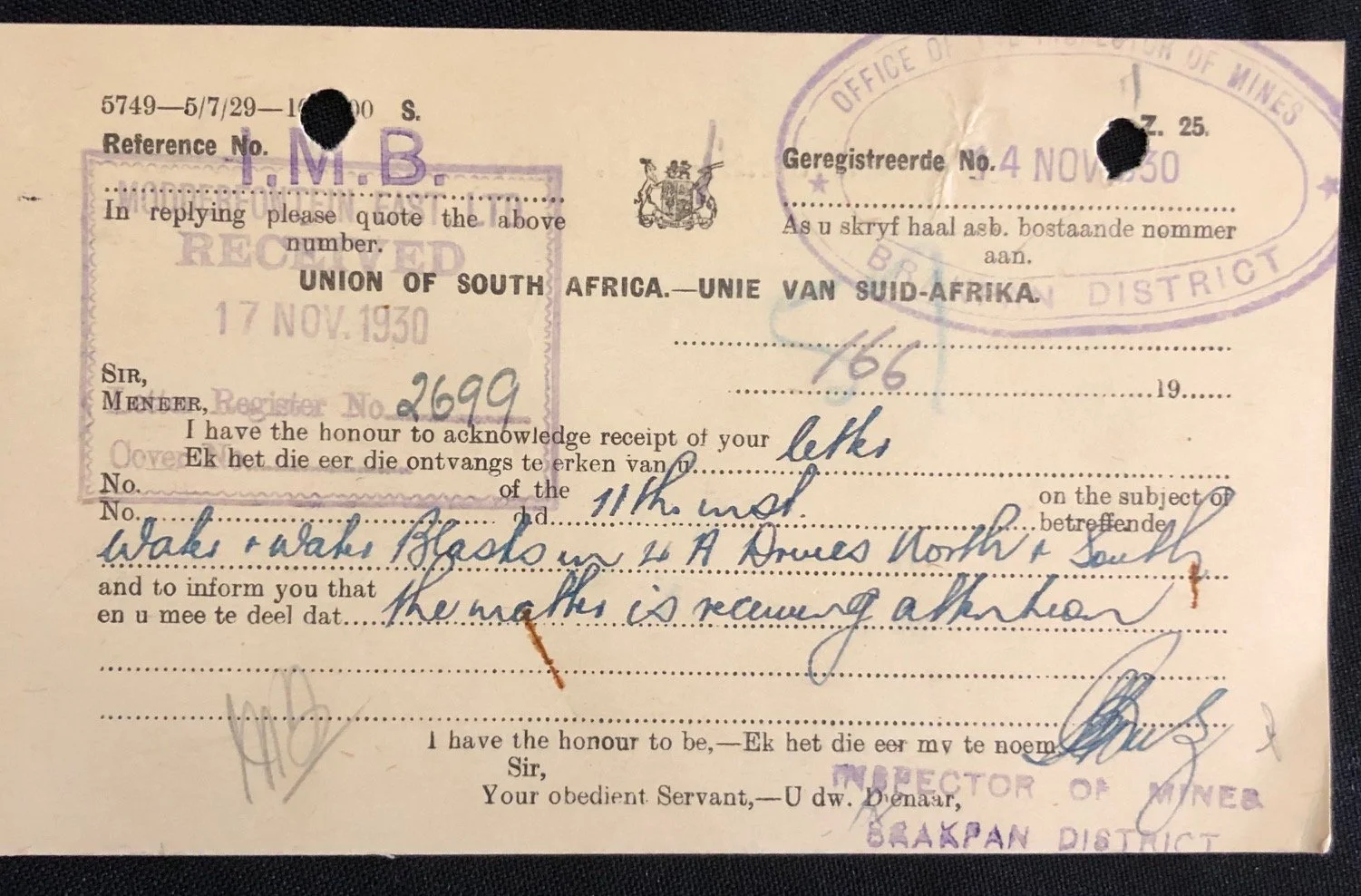
This is a fascinating piece of Witwatersrand mining postal history from the interwar period of the Union of South Africa. It consists of the front and back of an official, bilingual (English/Afrikaans) post-card sized acknowledgement form sent by a government mining official.
The Timeline and Postmarks
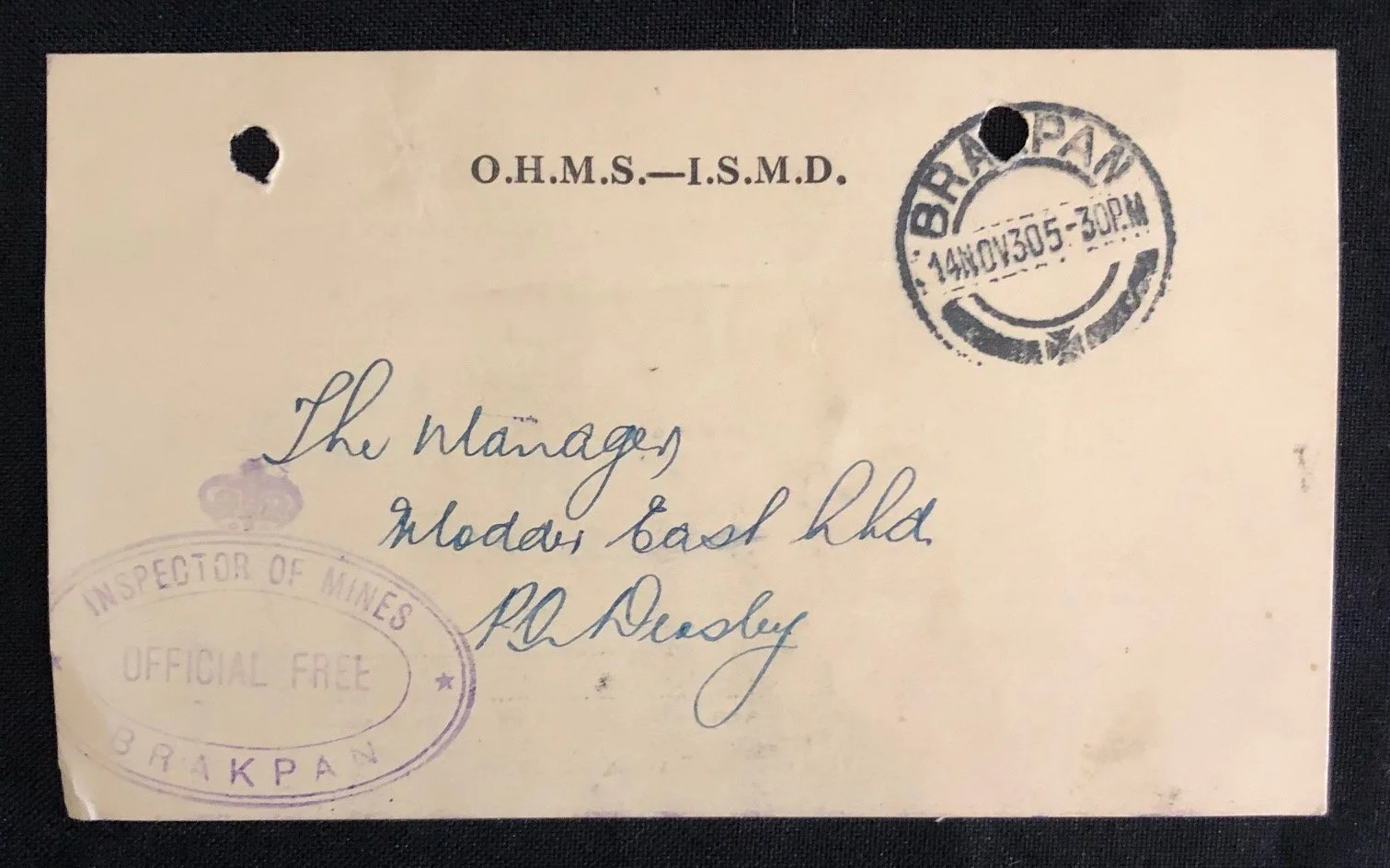
Though the Brakpan postmark on the front looks a bit ambiguous at a glance (14NOV305-30PM), looking at the official stamps on the reverse gives us the precise timeline:
Sent/Postmarked: 14 November 1930 from Brakpan.
Received: 17 November 1930 at the Modder East mine office (noted by the purple rectangular MODDERFONTEIN EAST LTD. RECEIVED stamp).
The Sender: Inspector of Mines, Brakpan District
The card is printed with O.H.M.S.—I.S.M.D. (On His Majesty's Service — Inspector of South African Mines Department or similar branch abbreviation).
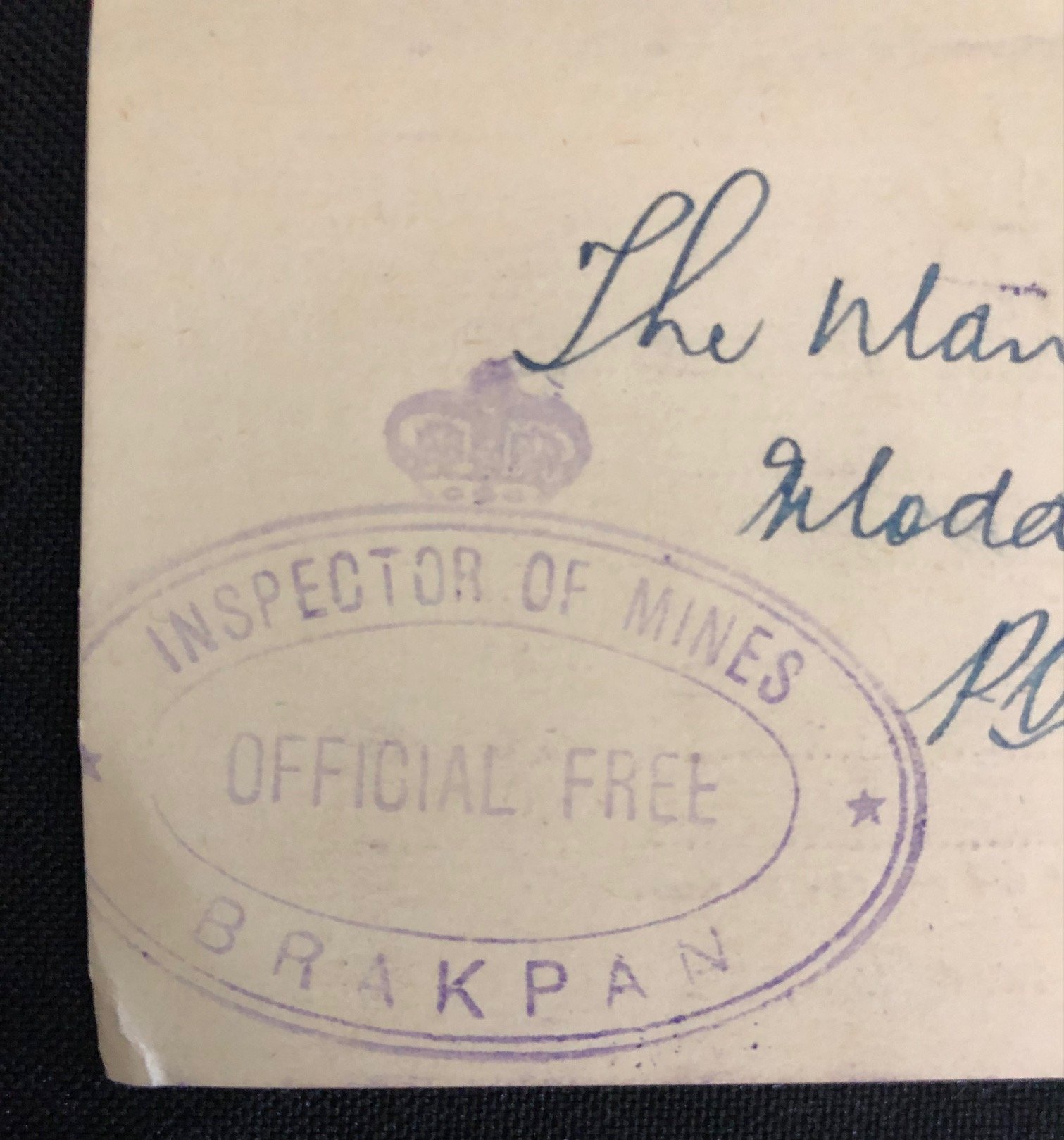
In 1930, South Africa was a self-governing Dominion within the British Empire under King George V. Because it was official government business, it bears an oval "INSPECTOR OF MINES / OFFICIAL FREE / BRAKPAN" stamp, meaning it required no postage stamps.
The Inspector of Mines was a powerful regulatory figure responsible for enforcing the Mines and Works Act, monitoring safety, investigating accidents, and managing community or operational complaints on the East Rand—one of the richest gold-mining sectors in the world.
The Recipient: Modder East Ltd.
The card is addressed to:
The Manager,
Modder East Ltd.
P.O. Dersley
Modderfontein East (Modder East) was an important gold mine on the far East Rand, officially incorporated in 1917 and commencing production shortly after. Dersley was the specific railway siding and postal hamlet established right next to the mine to service its workers and operations.
The Message: A Mining Safety/Operations Issue
The handwritten text on the reverse is an official acknowledgement of a specific operational issue at the mine. It reads:
"Sir, I have the honour to acknowledge receipt of your letter of the 11th inst. [instant, meaning current month] on the subject of Water + water Blasts in 26 A Drives North + South and to inform you that the matter is receiving attention."
Historical Context of "Water Blasts"
In 1930s South African gold mining, a water blast was a crucial piece of safety equipment, but also a frequent source of regulatory scrutiny.
The Purpose: When miners blasted rock face with explosives, it created a lethal amount of fine silica dust. Inhaling this caused silicosis (miner’s phthisis), a devastating lung disease that ravaged the Witwatersrand workforce.
The Regulation: By law, mines had to install "water blasts"—devices that discharged a continuous spray of water and compressed air into the development drives (like 26 A Drives North & South) immediately after a dynamite blast to lay the dust and dissolve toxic nitrous gases.
The Context of the Card: The fact that the Mine Manager wrote to the Inspector regarding water blasts in specific drives suggests either a technical dispute over regulations, a reported failure of the system, or an application to alter blasting times. The Inspector's formal reply—ending in the classic imperial bureaucratic sign-off, "I have the honour to be, Sir, Your obedient Servant"—shows the tight oversight the state maintained over the East Rand gold mines during this era.
140mm x 900mm
Minor wear, punch holes.
R1,000