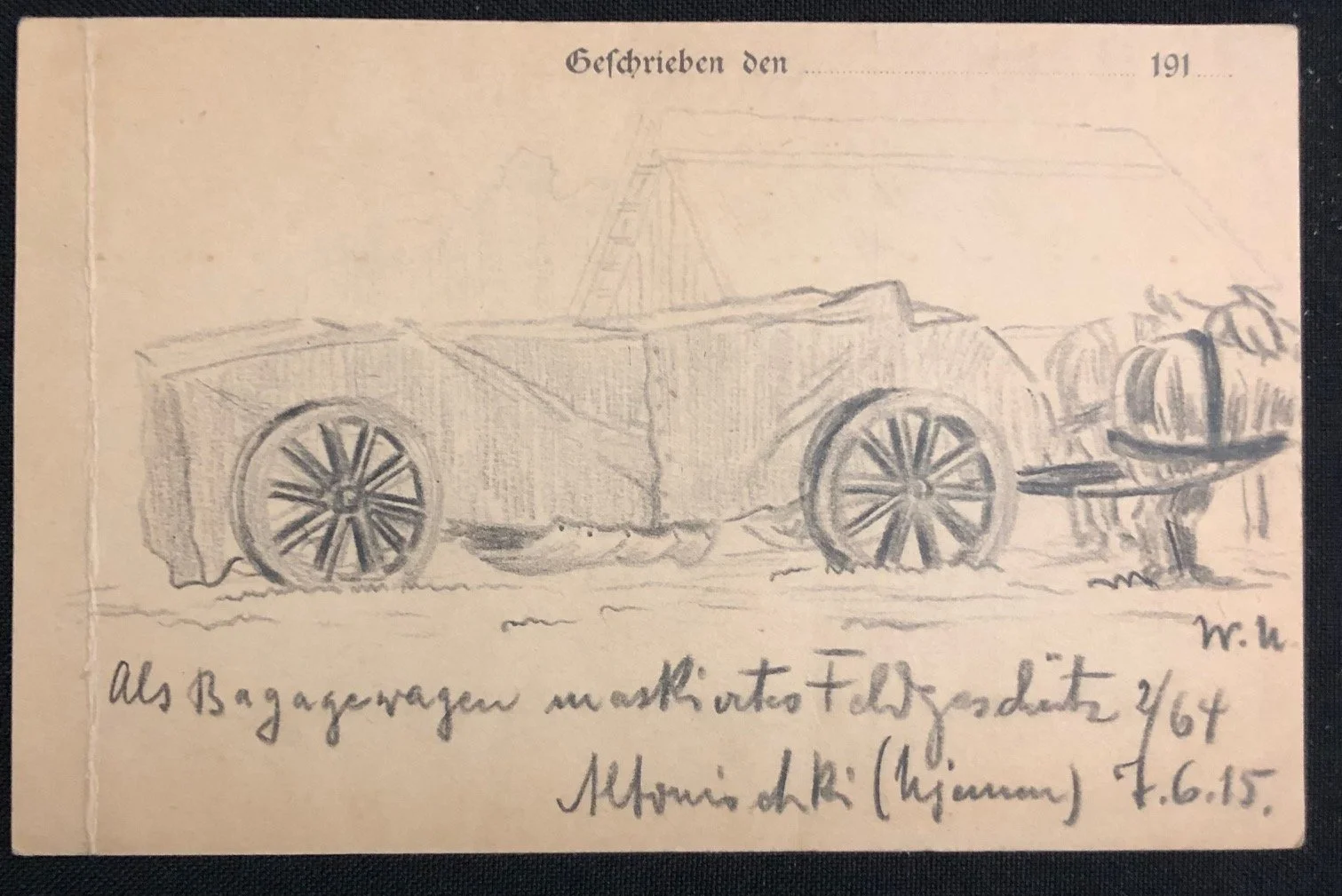
"Field Gun Camouflaged as a Baggage Wagon”. Otavifontein (Njansa), 7 June 1915. First World War: the South West Africa Campaign (1914–1915).
This unused Feldpostkarte (German Military Field Postcard) contains a fascinating, hand-drawn pencil sketch depicting an extraordinary, deceptive tactic from a frequently overlooked theatre of the First World War: the South West Africa Campaign (1914–1915).
The German inscription, date, and location on the front reveal a story of military desperation, camouflage, and the final days of Imperial Germany's presence in Southern Africa.
Translating the Inscription: Operational Deception
The handwritten German text at the bottom reads: "Als Bagagewagen maskiertes Feldgeschütz 2/64, Otavifontein (Njansa) 7.6.15. Monogram: "W.U.
Translation: "Field gun 2/64 masked/camouflaged as a baggage wagon. Otavifontein (Njansa), 7 June 1915."
Underneath a crude, improvised canvas or wooden framework designed to look like an ordinary horse-drawn supply cart hides a deadly German field artillery piece. By June 1915, the Schutztruppe (German colonial forces) were heavily outnumbered by the invading Union of South Africa forces led by Generals Louis Botha and Jan Smuts. Lacking ammunition, reinforcements, and air superiority, the Germans resorted to asymmetrical deception to move their remaining artillery pieces without attracting the attention of South African scouts or reconnaissance aircraft.
The Location: The Twilight of German South West Africa
The location written on the card—Otavifontein—is the smoking gun for its exact historical context.
By June 1915, the South African forces had captured Windhoek and pushed the remaining German troops into the far north of the territory. The German commander, Victor Franke, established his final defensive line in the fertile, water-rich valley around Otavi and Otavifontein.
The date on the sketch—7 June 1915—places this drawing three weeks before the final Battle of Otavi (30 June 1915) and one month before the entire German force unconditionally surrendered at nearby Khorab on 9 July 1915. The sketch captures the tense, final weeks of preparation before the German colony collapsed entirely.
The Unused Feldpostkarte: A Captured or Abandoned Souvenir?
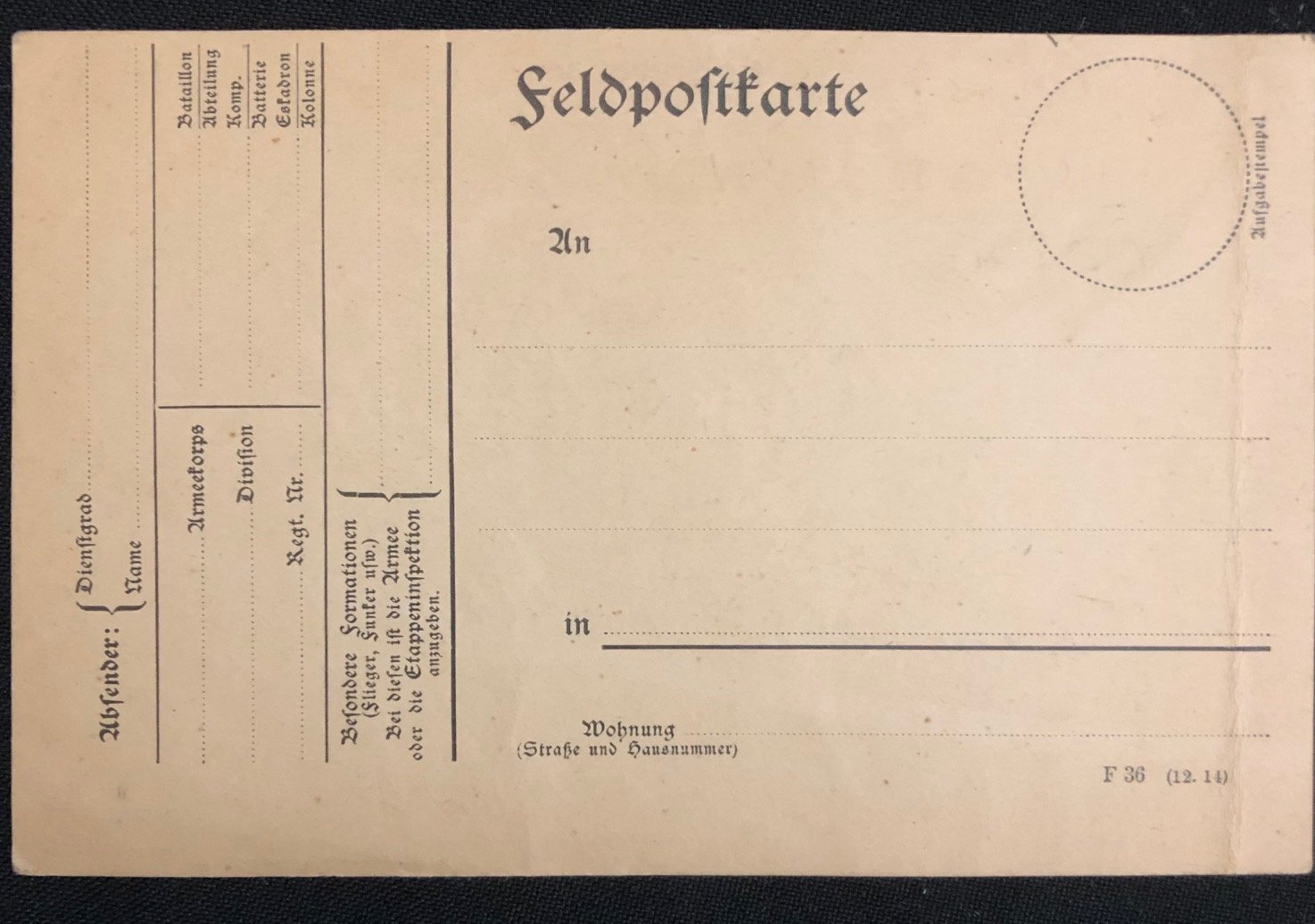
The back of the card is a standard, un-mailed Imperial German military postcard format (Feldpostkarte), printed around December 1914 (as indicated by the tiny printer's code "12.14" in the bottom right corner).
Because the card was sketched on June 7th, but never filled out with an address, stamped, or processed through the military postal system, it tells its own story of the chaotic retreat. German soldiers in the north were entirely cut off from Germany; there were no ships or mail runs leaving the territory. This card was likely drawn by a soldier or officer (initials W.U.) as a personal visual diary of the clever tricks they were using in the field. When the surrender occurred a month later, many of these personal effects were either kept as souvenirs by the prisoners of war or acquired by South African soldiers.
A Record of the "Artillery Duels"
Despite being heavily outnumbered, the German Schutztruppe had highly trained artillery units that managed to stall the South African advance at several points using precise fire. The reference to "2/64" likely refers to a specific battery or gun designation within their makeshift defensive structure. Disguising a field gun as a baggage wagon allowed the Germans to position artillery pieces forward along roads or farm tracks, ready to spring an ambush on advancing South African mounted brigades who would mistake the weapon for a retreating supply convoy.
Postcard: 140mm x 92mm
R2,000