A Collection of Angolan First Day Covers (1975-6)
The collection of First Day Covers (FDCs) represents a highly specific and turbulent window in southern African history: the immediate aftermath of Angolan independence.
These envelopes capture the exact moment a newly formed socialist state began asserting its identity through state media and postal infrastructure, right as it plunged into a decades-long civil war. Here are the historically significant details embedded in these covers:
The Birth of the People's Republic
Angola officially gained independence from Portugal on November 11, 1975, following a brutal anti-colonial war. The dates on these FDCs range from December 31, 1975, to June 1976. These are some of the very first philatelic outputs of the newly declared República Popular de Angola (People's Republic of Angola), governed by the Marxist-Leninist MPLA.
Militant and Marxist Iconography
Overnight, Angolan postage transitioned from honoring Portuguese kings and colonial explorers to featuring stark, revolutionary socialist realism.
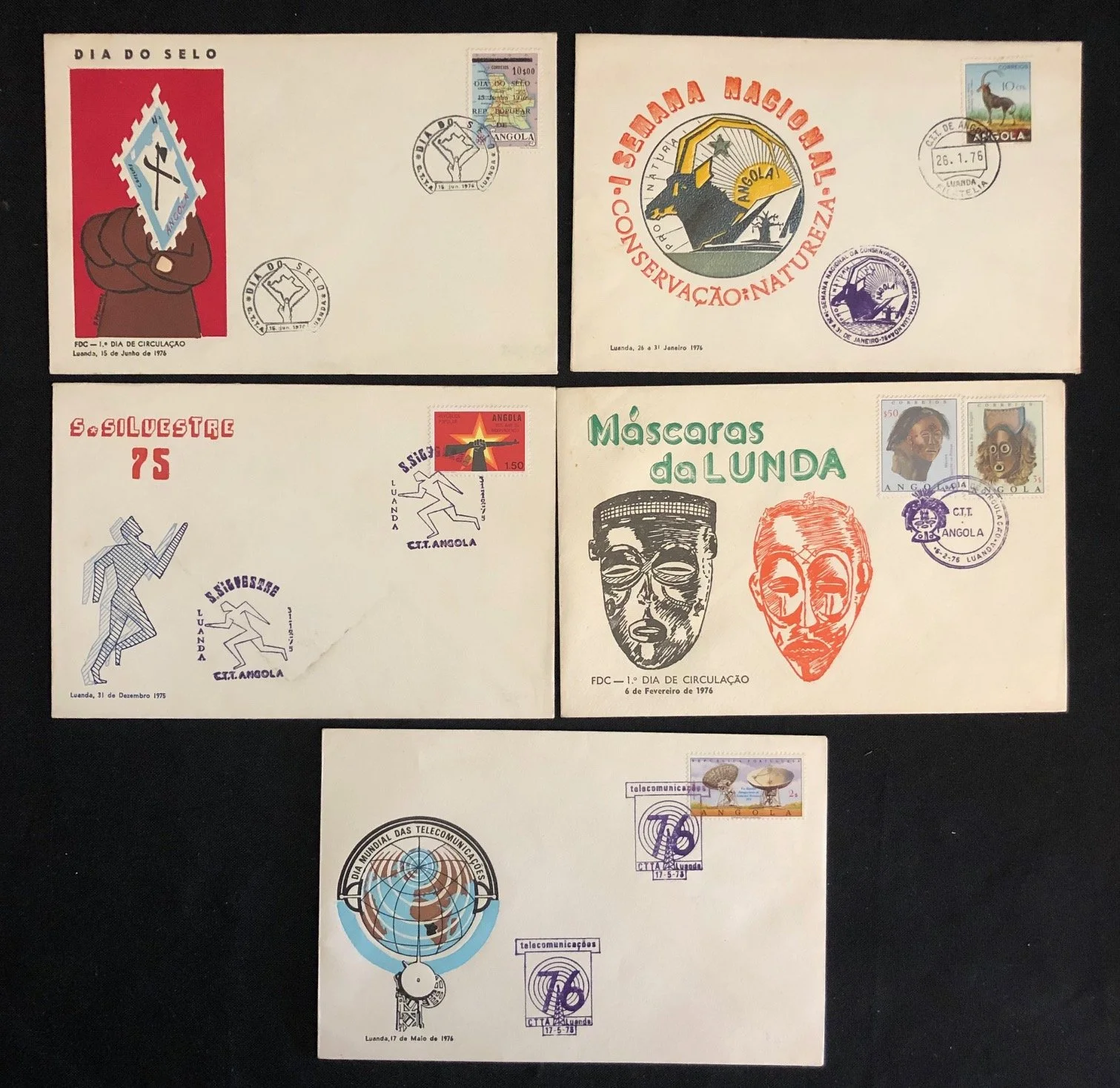
The S. Silvestre Cover (December 31, 1975): Issued just six weeks after independence, the stamp on this cover features a bright red star and a black silhouette of a raised arm clutching an assault rifle. It is a striking juxtaposition: celebrating the traditional Saint Silvester road race (a New Year's Eve athletic tradition) using overt militant propaganda.
The Dia do Selo Cover (June 15, 1976): The art depicts a massive, stylized clenched fist. The stamp being held features a crossed machete and half-gear—the official emblem of the ruling MPLA party, symbolizing agricultural and industrial workers.
Reclaiming African Heritage
Alongside the political propaganda, the new government used these early stamps to decolonize its cultural representation and highlight indigenous Angolan heritage.
Máscaras da Lunda (February 6, 1976): This issue proudly features traditional masks from the Lunda (or Chokwe) people of northeastern Angola, centering indigenous art rather than European colonial history.
Conservação da Natureza (January 1976): This cover highlights the Palanca Negra Gigante (the Giant Sable Antelope). Endemic only to a small region of Angola, this animal became a powerful symbol of national pride and survival for the newly independent nation.
The Currency Transition Lag
The denominations on the stamps themselves (such as "10$00" on the top two covers and "1.50" on the S. Silvestre cover), are still priced in the colonial Angolan Escudo. Despite casting off Portuguese rule in late 1975, the new government did not have the immediate economic infrastructure to mint its own money. They continued using the colonial currency until the Angolan Kwanza was finally introduced in 1977, making these covers a snapshot of a country caught precisely between two eras.
170mm x 113mm
All have minor wear.
R1,250