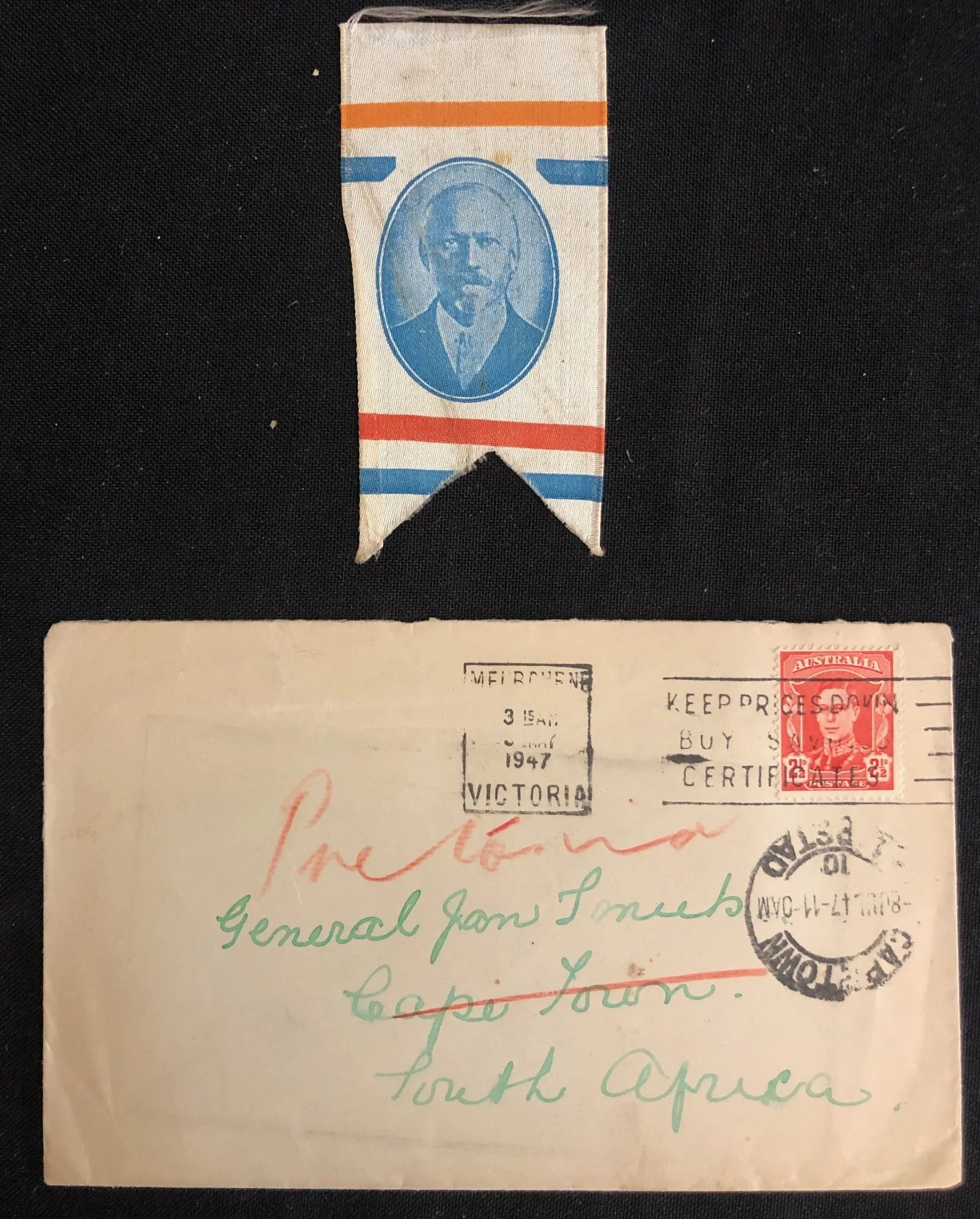
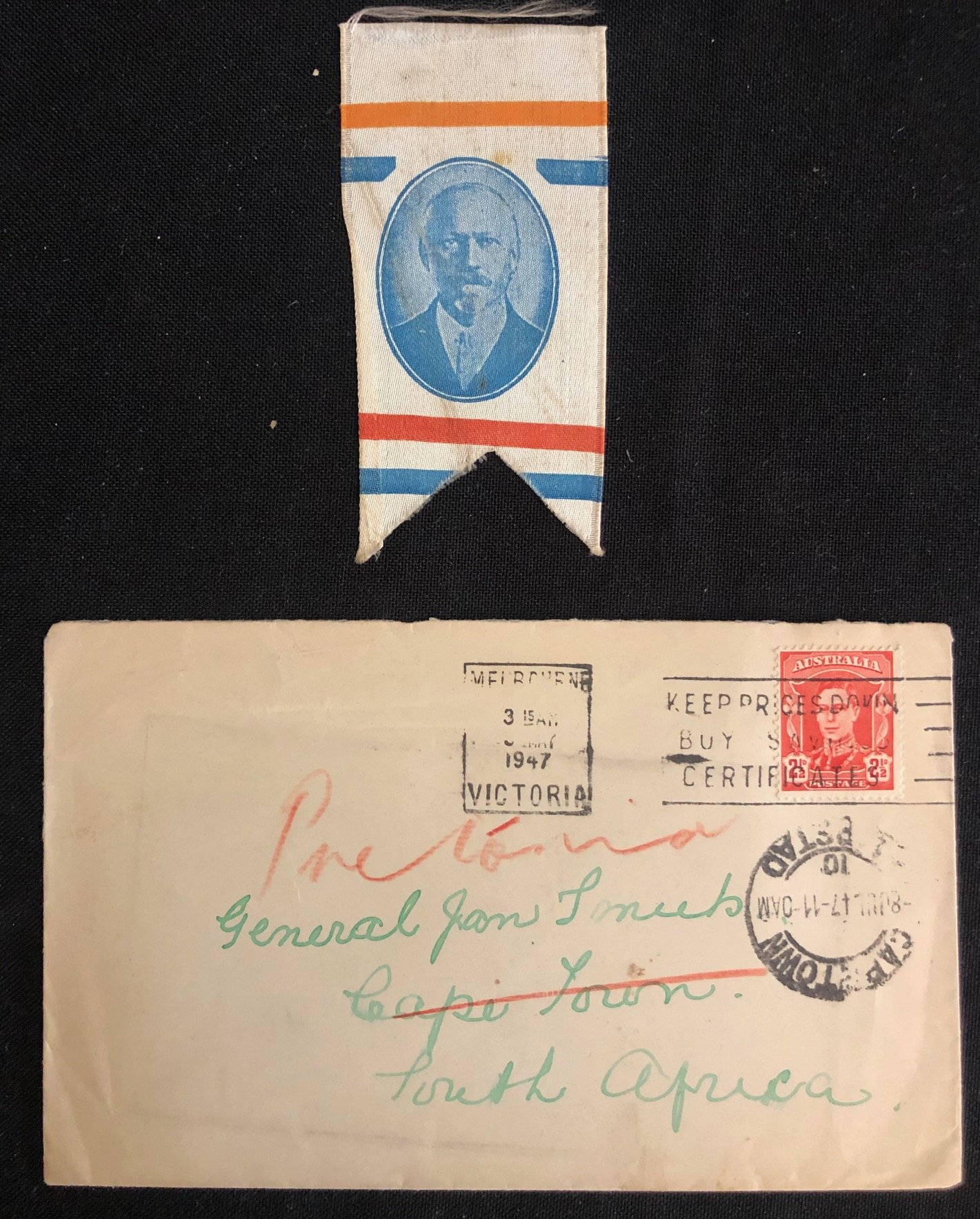
Envelope from Australia addressed to "General Jan Smuts, South Africa." Together with an election ribbon (2) 1947
This collection of 2 items of mid-20th-century postal history and political ephemera connects Australia and South Africa at a pivotal geopolitical moment.
The Global Stature of Jan Smuts
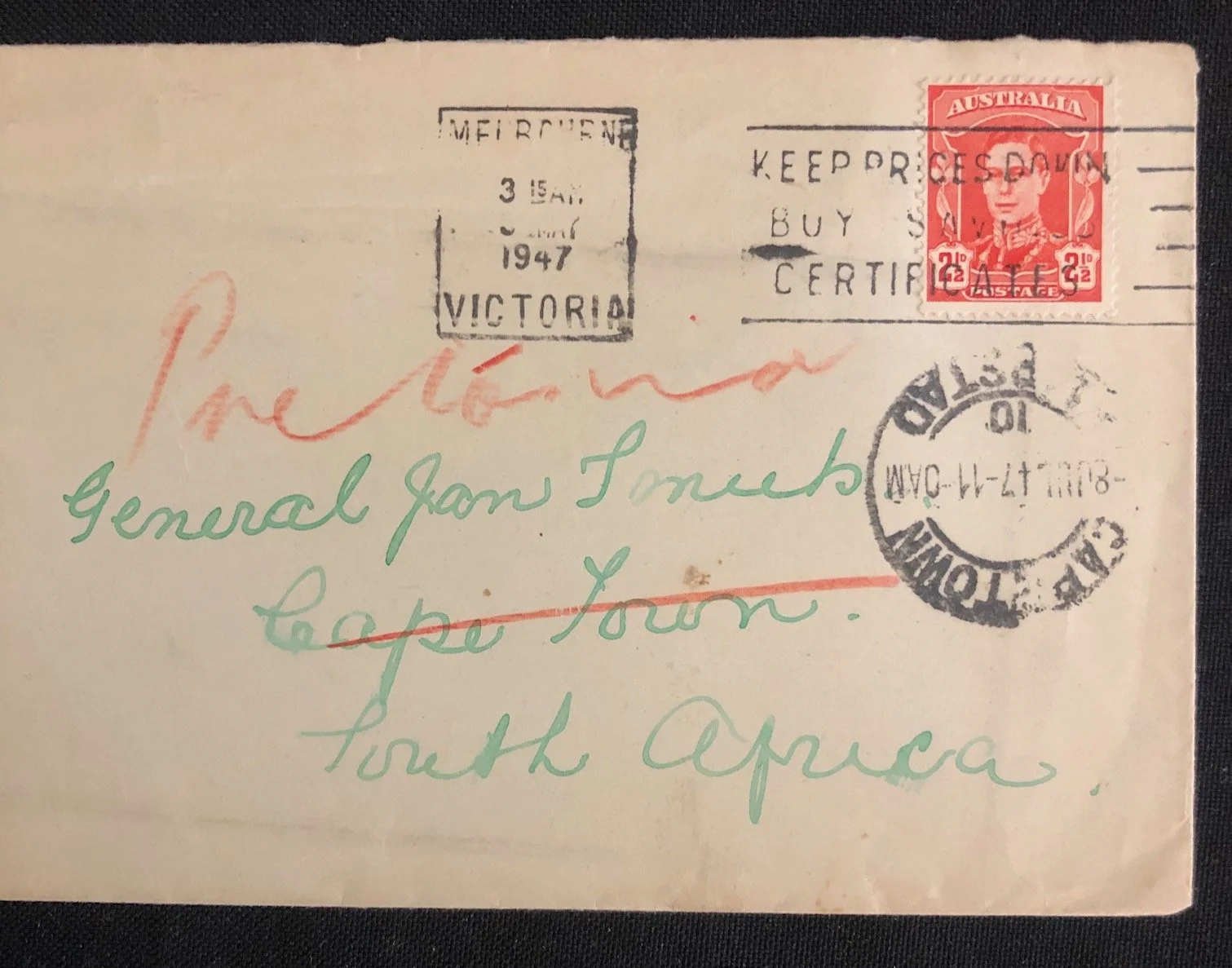
The envelope is addressed simply to "General Jan Smuts, South Africa." The fact that an international letter could be posted from Melbourne, Australia, with such a minimal address speaks volumes about Smuts' immense global prominence at the time. By 1947, Field Marshal Jan Smuts was not just the Prime Minister of South Africa; he was an internationally revered Commonwealth statesman, a military leader from both World Wars, and a key architect of both the League of Nations and the United Nations.
The Twilight of an Era (July 1947)
The postmarks tell an exact historical story:
Departure: It was canceled in Melbourne on 3 July 1947.
Arrival & Redirection: It hit Cape Town on 8 July 1947, where "Cape Town" was struck through and "Pretoria" was written in orange pencil.
This redirection reflects the dual-capital system of South Africa. Because the letter arrived in July—well after the parliamentary session in Cape Town had concluded for the winter—the postal services knew to route the Prime Minister's mail to the administrative capital, Pretoria (or his nearby farm, Doornkloof).
More importantly, this letter catches Smuts at the absolute twilight of his power. Less than a year later, in May 1948, Smuts’ United Party would suffer a shocking defeat to the National Party, fundamentally shifting South African history toward the formal implementation of Apartheid and leading to his retirement from frontline politics.
The Commemorative Ribbon
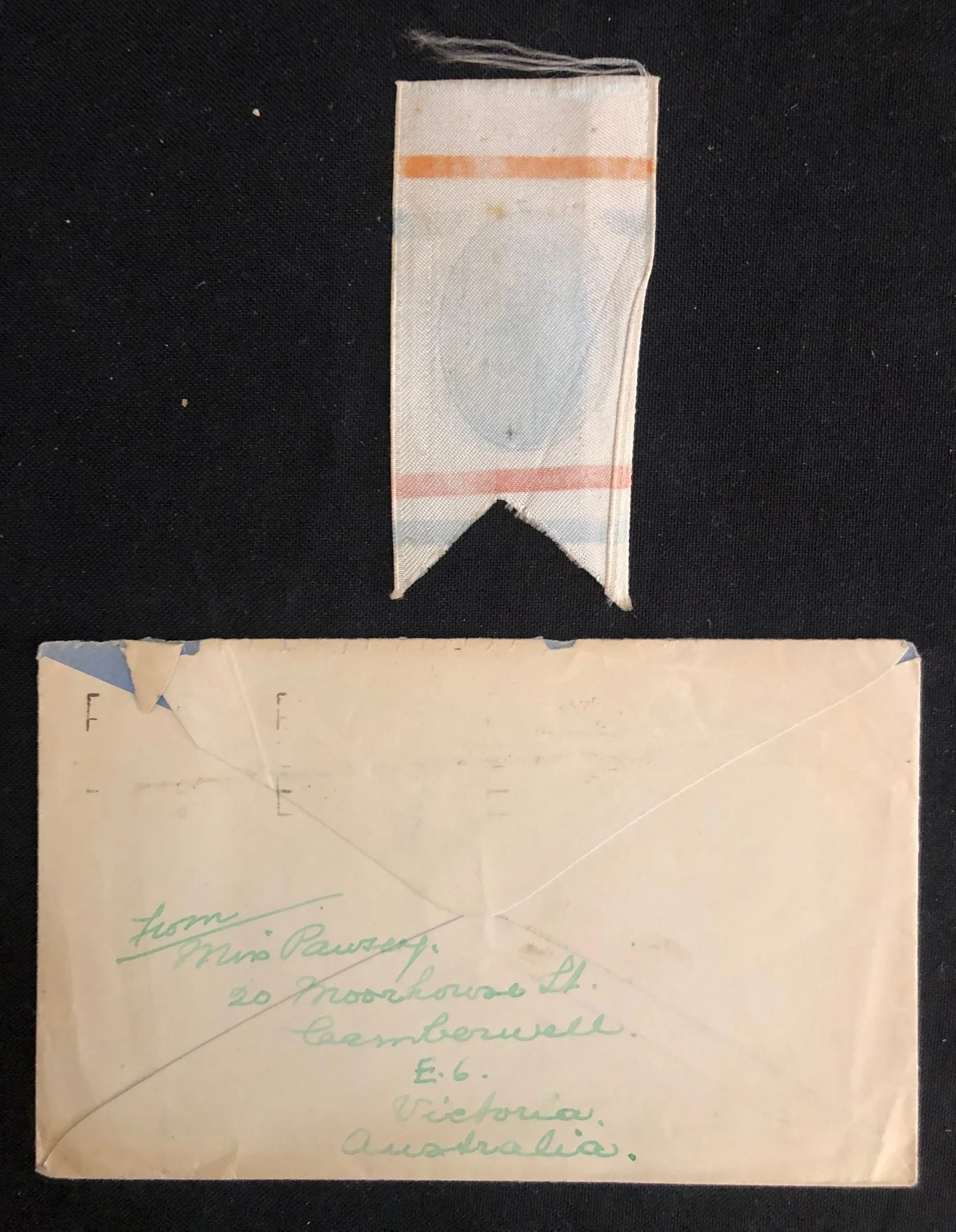
The silk ribbon featured in both images is a classic piece of political memorabilia. It shows a portrait of Smuts framed by the horizontal bands of the Prinzenvlag (orange, white, and blue), which served as the basis for the South African flag from 1928 to 1994. These ribbons were frequently produced for patriotic rallies, wartime fundraising (such as the "Smuts Birthday Fund" during WWII), or by ardent Commonwealth admirers—like Mrs. Pawsey of Victoria who viewed Smuts as a hero of the British Empire.
Letter: 145mm x 90mm
R1,000