Post Office Savings Book - “Native” Bernard Mokabe - member of the Native Military Corps (NMC) 1946
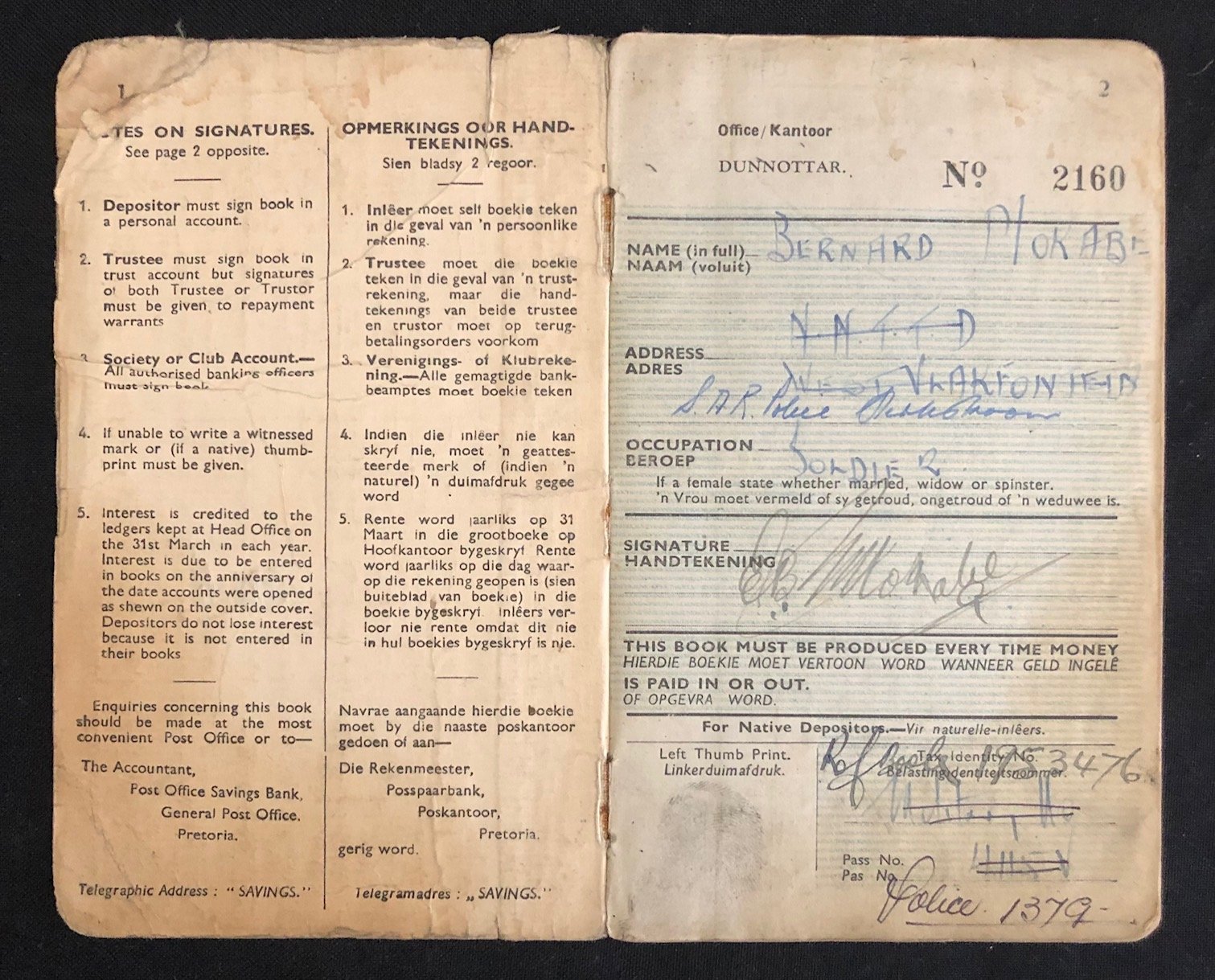
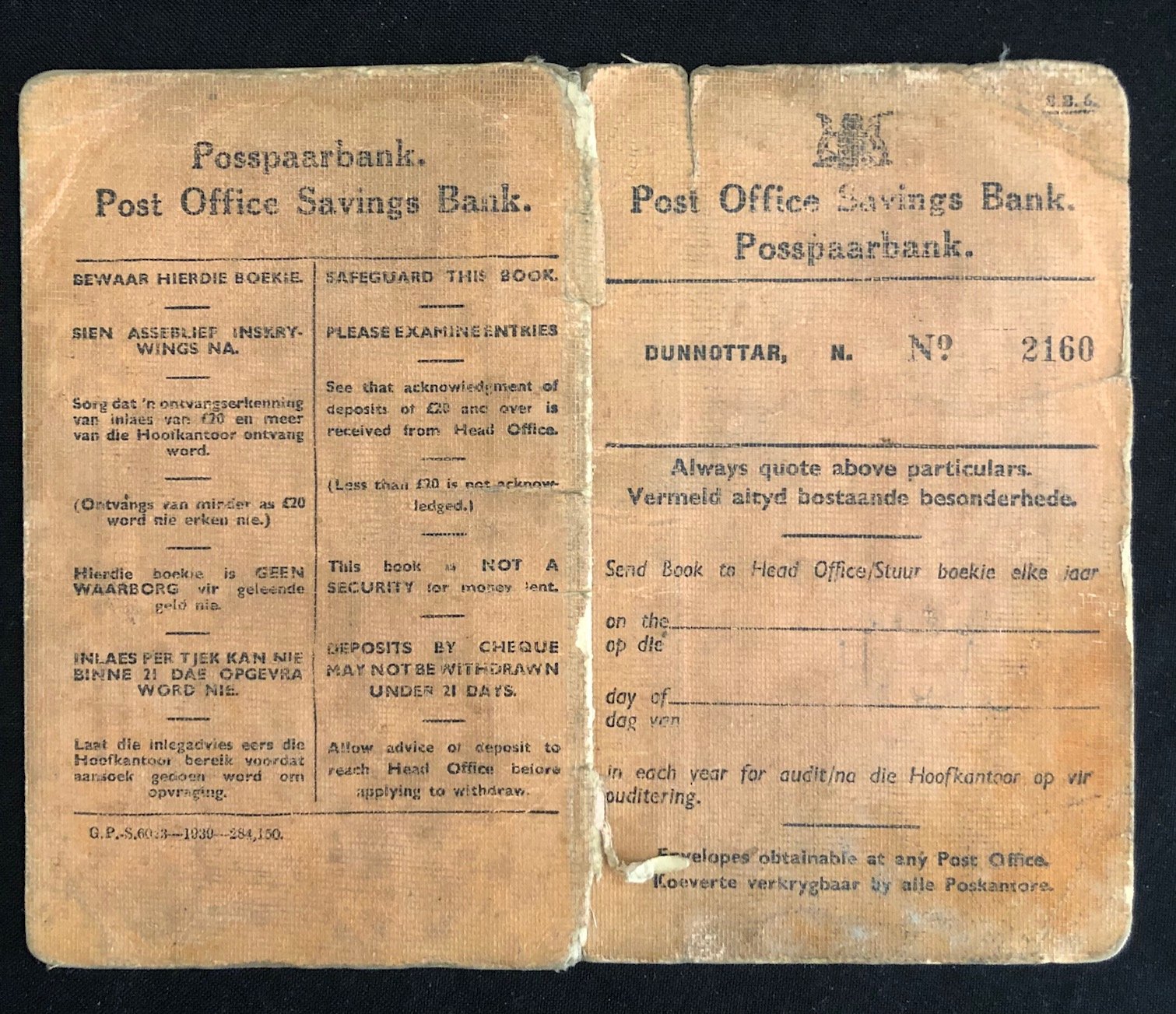
This is a pre-apartheid artefact of mid-20th-century South African social and military history. This is a Union of South Africa Post Office Savings Bank book belonging to a man named Bernard Mokabe, dating from the World War II era and its immediate aftermath (1944–1946).
Several intersecting historical details make this item particularly compelling:
The Native Military Corps (NMC) Connection
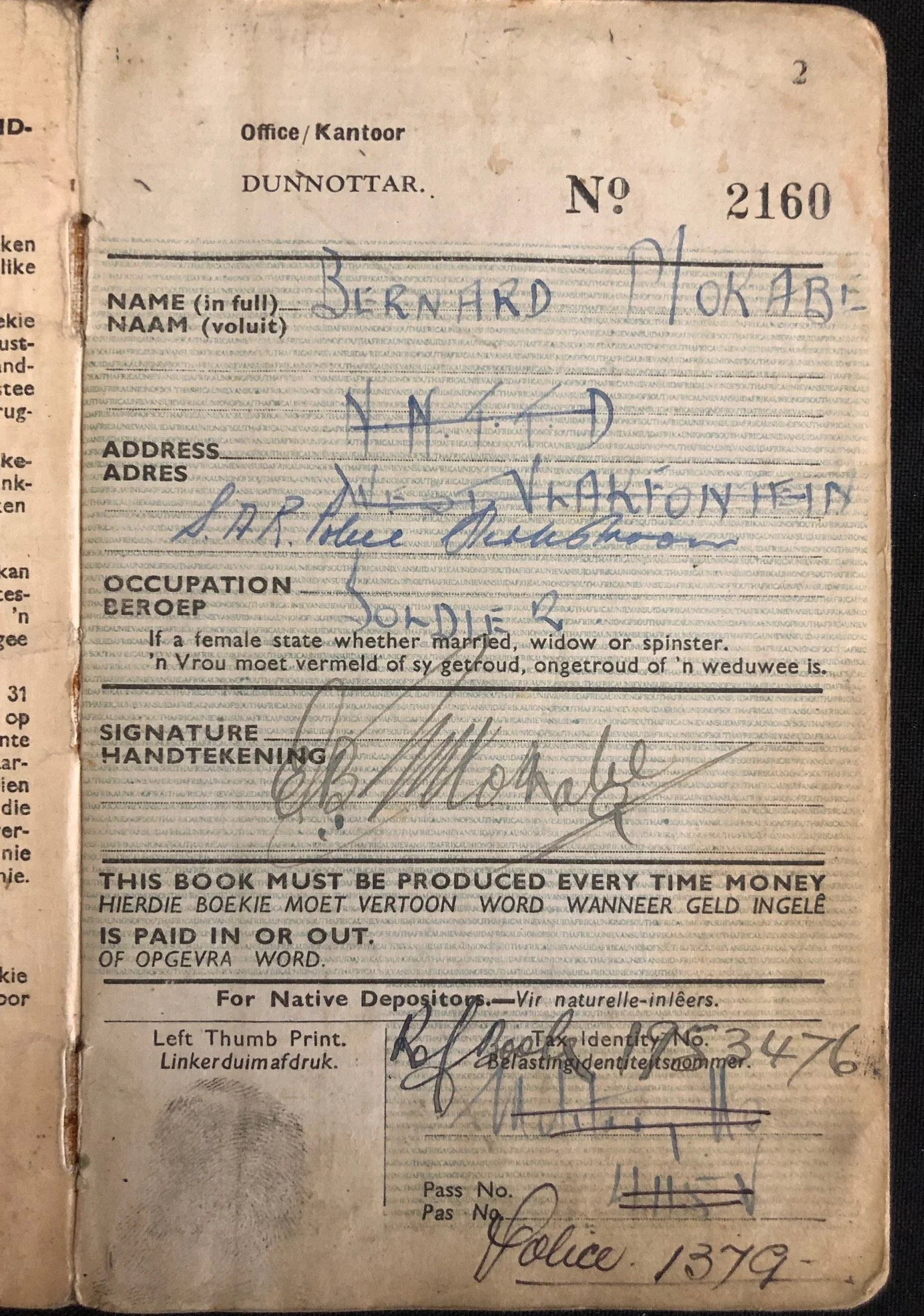
Bernard Mokabe’s occupation is clearly listed as "SOLDIER". Given the date of the first stamps—June 1944 —Mokabe would have been a member of the Native Military Corps (NMC).
During World War II, the South African Union Defence Forces recruited over 75,000 Black South Africans into the NMC. Crucially, due to the racial politics of the Smuts government, Black soldiers were legally barred from carrying firearms and were instead officially used as non-combatant guards, drivers, stretcher-bearers, and logistics personnel—though many routinely found themselves in combat situations in North Africa and Italy.
The Location: Dunnottar and Vlakfontein
The savings book was issued at Dunnottar. Dunnottar, located on the East Rand (Gauteng), was a major military hub during WWII. It was the site of a key South African Air Force training base (No. 4 Air School under the Joint Air Training Scheme) and served as a major stationing and transit point for troops.
The address listed is "Vlakfontein," a sprawling historic township area on the East Rand (near modern-day KwaThema/Springs) that supplied labour to the nearby gold mines and military infrastructure.
Bureaucratic Control and the "Native Depositor" Section
The document vividly illustrates the institutional segregation of the era, just a few years before the formal implementation of Apartheid in 1948.
On page 2 there is a specific, explicitly labeled section: "For Native Depositors.—Vir naturelle-inlêers."
Under this section, Mokabe was required to provide a Left Thumb Print and a Tax Identity Number / Pass No.
This cross-referencing of a simple savings bank book with the hated "Pass" system or tax identity documents shows how financial tracking was intertwined with the state's movement-control apparatus for Black citizens.
Post-War Dispersal: From Dunnottar to South West Africa
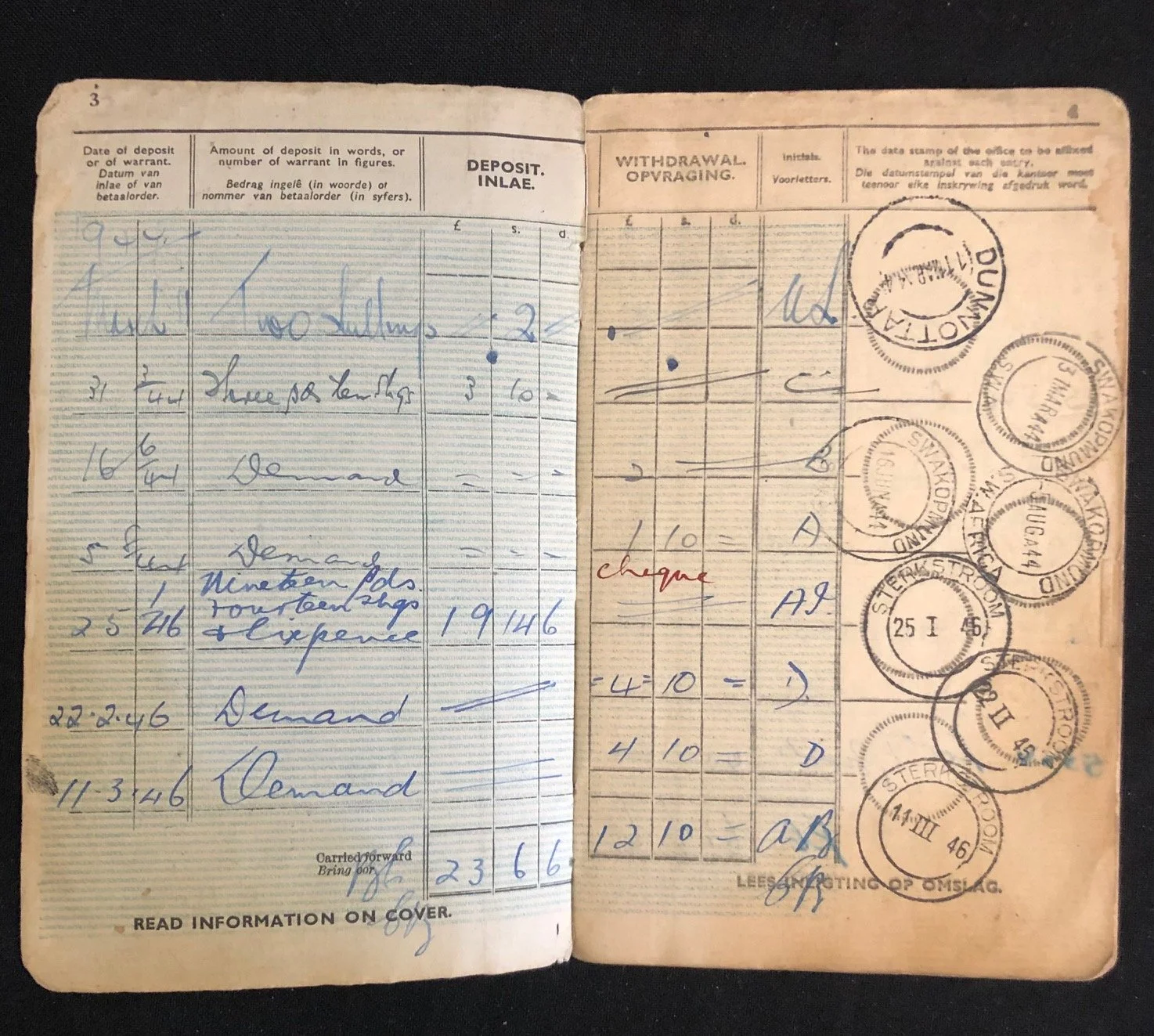
If you trace the postal stamps on page 4, you can map out Mokabe's movements at the end of the war:
June 1944 – August 1944: The book is stamped in Dunnottar and Swakopmund (located in South West Africa, now Namibia). South West Africa was administered by South Africa as a League of Nations mandate at the time, and South African forces were heavily stationed there.
January 1946 – March 1946: The stamps shift to Sterkstroom, a small town in the Eastern Cape. This likely marks his return home or a post-war deployment following the general demobilization of the Native Military Corps in late 1945.
The "S.A.R. Police" Clue
In the address field, there is an intriguing, slightly later handwritten addition: "S.A.R. Police Dunnottar" and a note at the bottom right reading "Police 1379".
This suggests that either during or immediately after his military service, Mokabe was attached to the South African Railways & Harbours (S.A.R.) Police unit based at Dunnottar. The S.A.R. Police was a distinct, highly militarized police force tasked with securing the vital rail infrastructure, harbors, and military supply lines of the Union.
100mm x 160mm (closed book).
Worn; well used.
R1,000