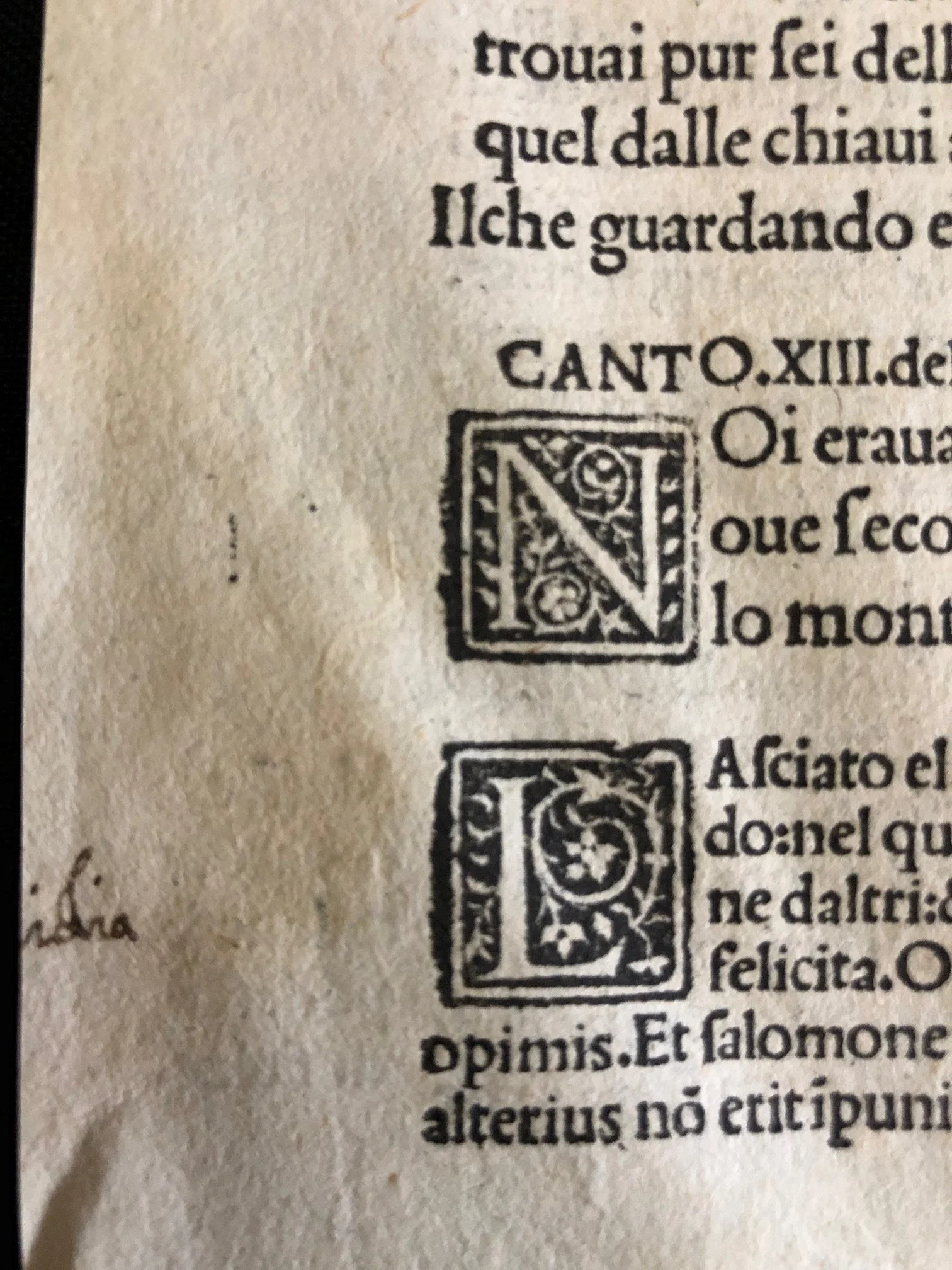
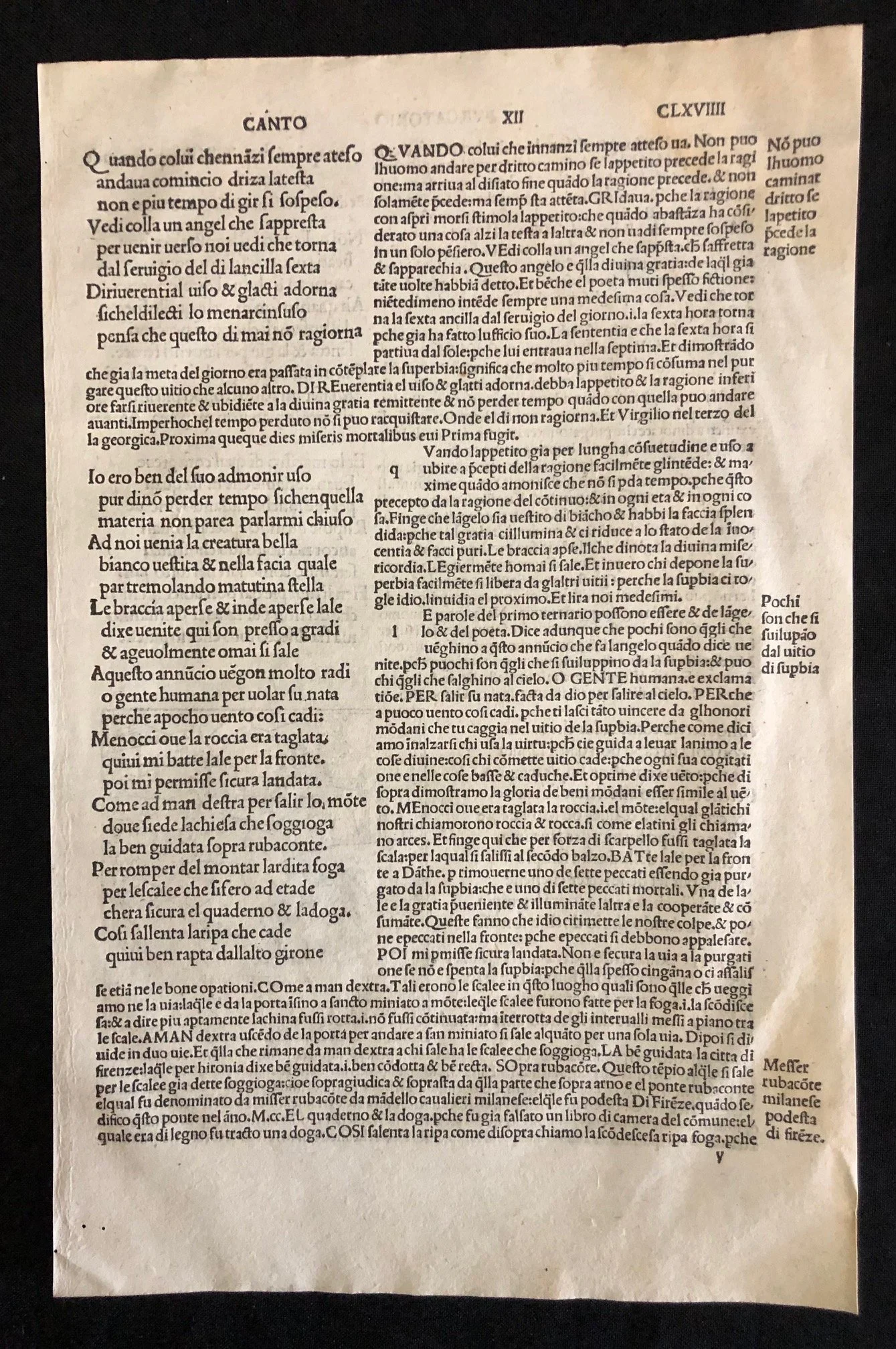
A Page from Dante Alighieri’s Divina Commedia (Divine Comedy). Incunabula, c.1491
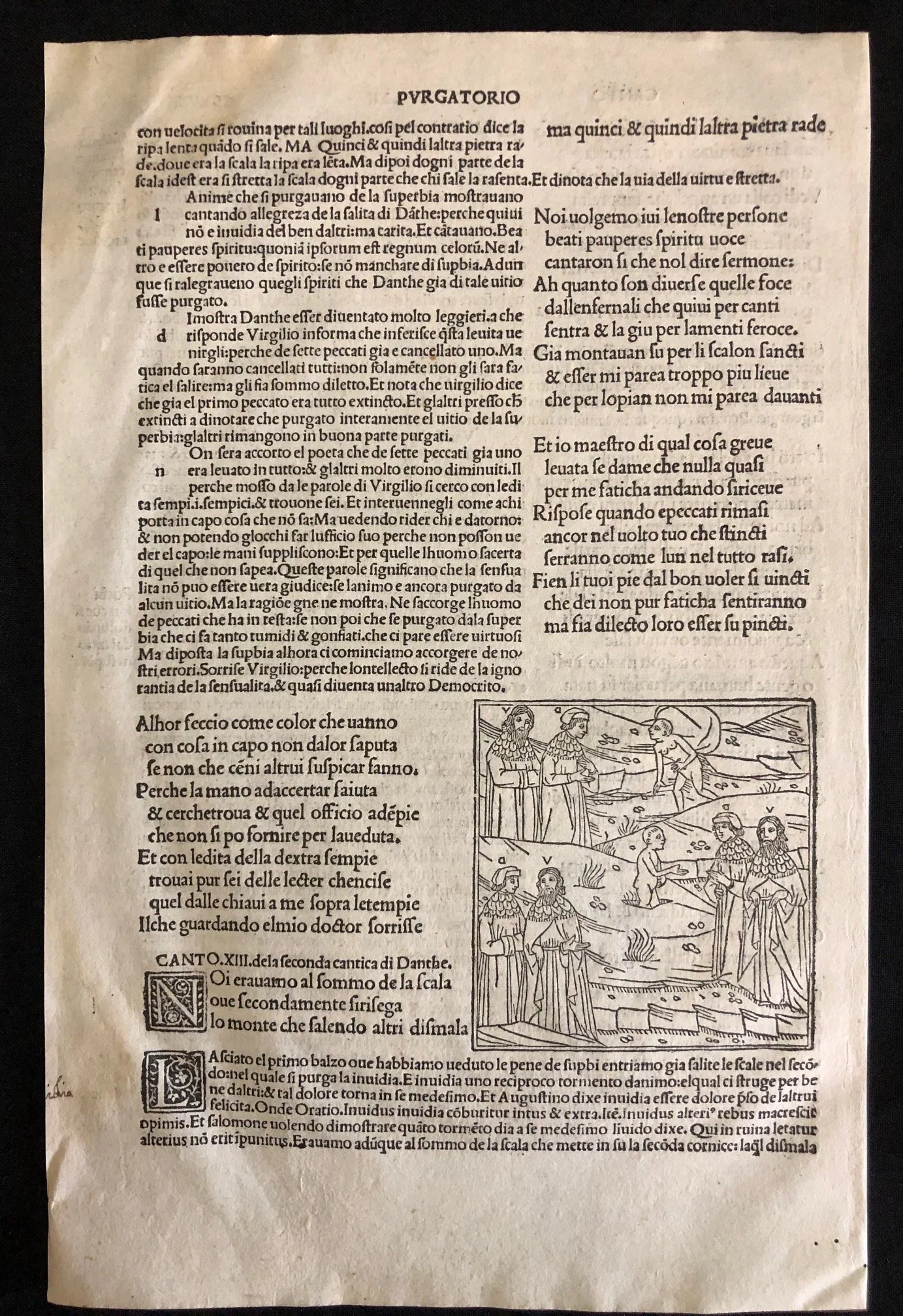
This is a single leaf from a late 15th-century or early 16th-century illustrated edition of Dante Alighieri’s Divina Commedia (Divine Comedy). Printed on both sides of the page.
Capturing the transition between Canto XII and Canto XIII of Purgatorio, where Dante and Virgil move from the First Terrace (the Proud) to the Second Terrace (the Envious).
Beyond the literary genius of Dante, several overlapping historical, typographic, and artistic details make this specific leaf fascinating:
The Dynamic Layout: Commentary "Swallowing" the Text
Notice how Dante’s actual poetic verses are printed in a larger, bolder typeface, while a denser, smaller text wraps completely around them.
In the early decades of printing (the incunabula era up to the early 1500s), printers adopted the layout of medieval manuscripts. Important classical or religious texts were rarely printed alone; they were surrounded by heavy scholarly commentary.
The commentary surrounding the text is almost certainly that of Cristoforo Landino, a massive figure of the Italian Renaissance. His Comento sopra la Comedia (first published in Florence in 1481) became the definitive Renaissance way to read Dante. The layout physically shows how Renaissance humanist scholarship literally framed the way readers consumed medieval vernacular poetry.
The Famous 1491 Venetian Tradition
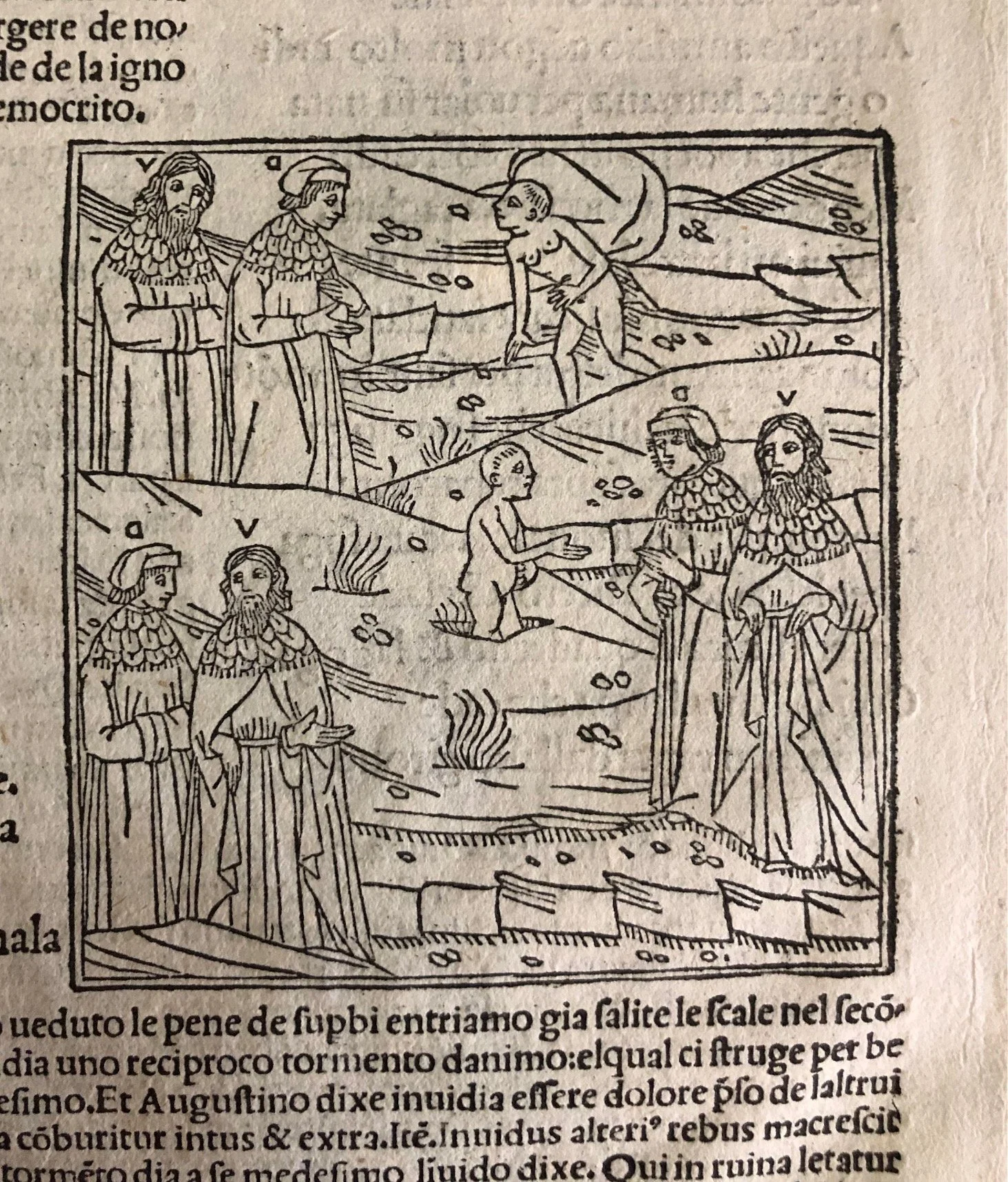
The charming woodcut illustration on the first page is a hallmark of early Renaissance book illustration, specifically tracing back to Venice in the 1491 editions (printed by either Bernardino Benali/Matteo Capcasa or Petrus de Plasiis).
Early woodcuts don't just show a single snapshot; they show a continuous narrative within one frame. If you look closely at the woodcut, you can see Dante and Virgil appearing multiple times in the same scene—first standing at the bottom discussing the path, and then appearing higher up the mountain as they progress.
On the first page, Dante is talking to an angel who brushes his forehead. In the narrative of Purgatorio, an angel carves seven "P"s (for Peccatum, sin) on Dante's forehead. At the exit of each terrace, an angel wipes one away. The text explicitly mentions Dante feeling lighter because one of the heavy sins has just been erased.
Catchwords and Gothic-Roman Hybridity
There are a couple of small production details that tell a story about the craftsmanship of the printer:
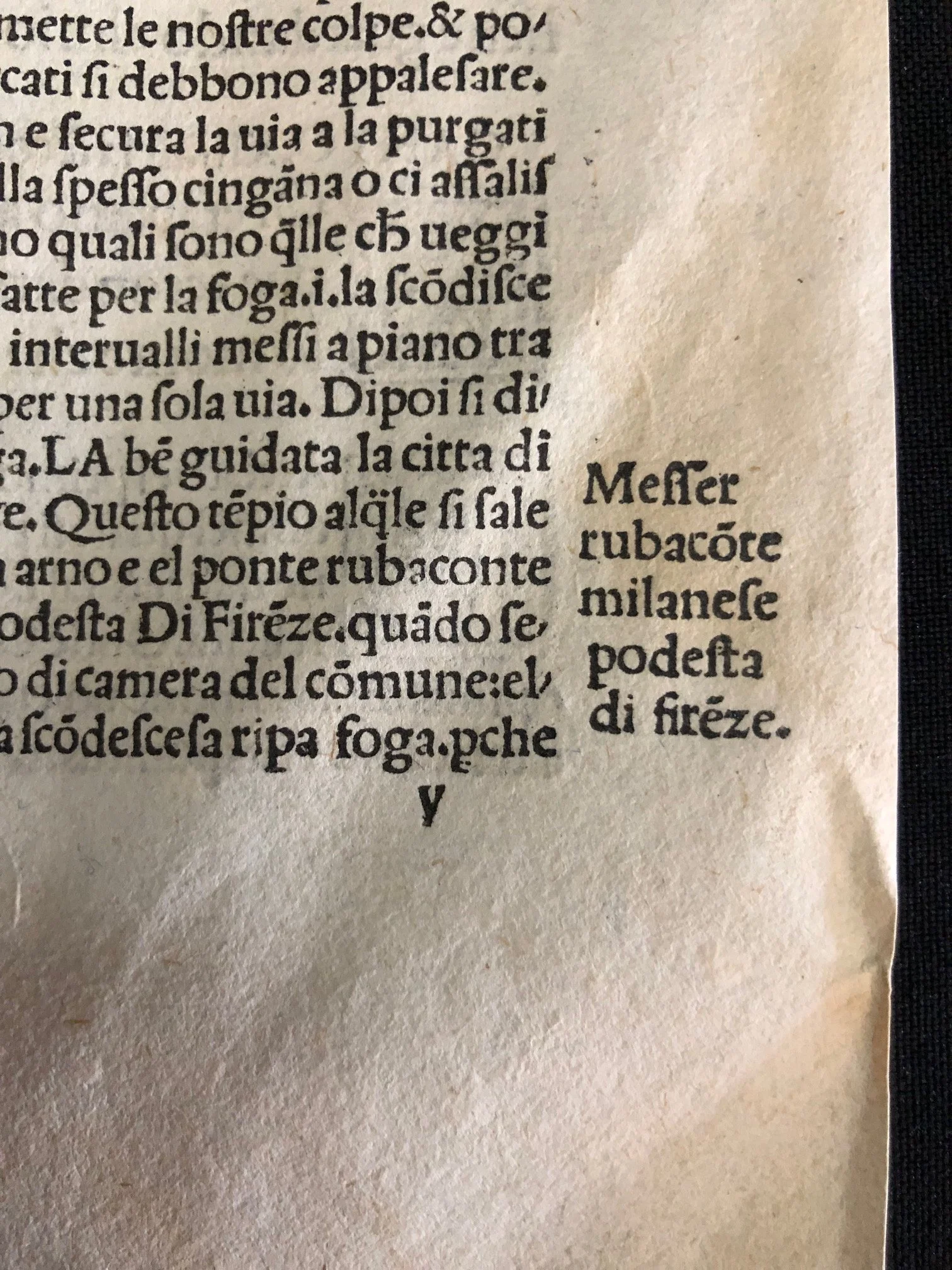
The "Signature" Letter: At the very bottom right of the second page, you can see a solitary lowercase "y". This is a signature mark used by the bookbinders to ensure the large printed sheets were folded and bound in the correct chronological order.
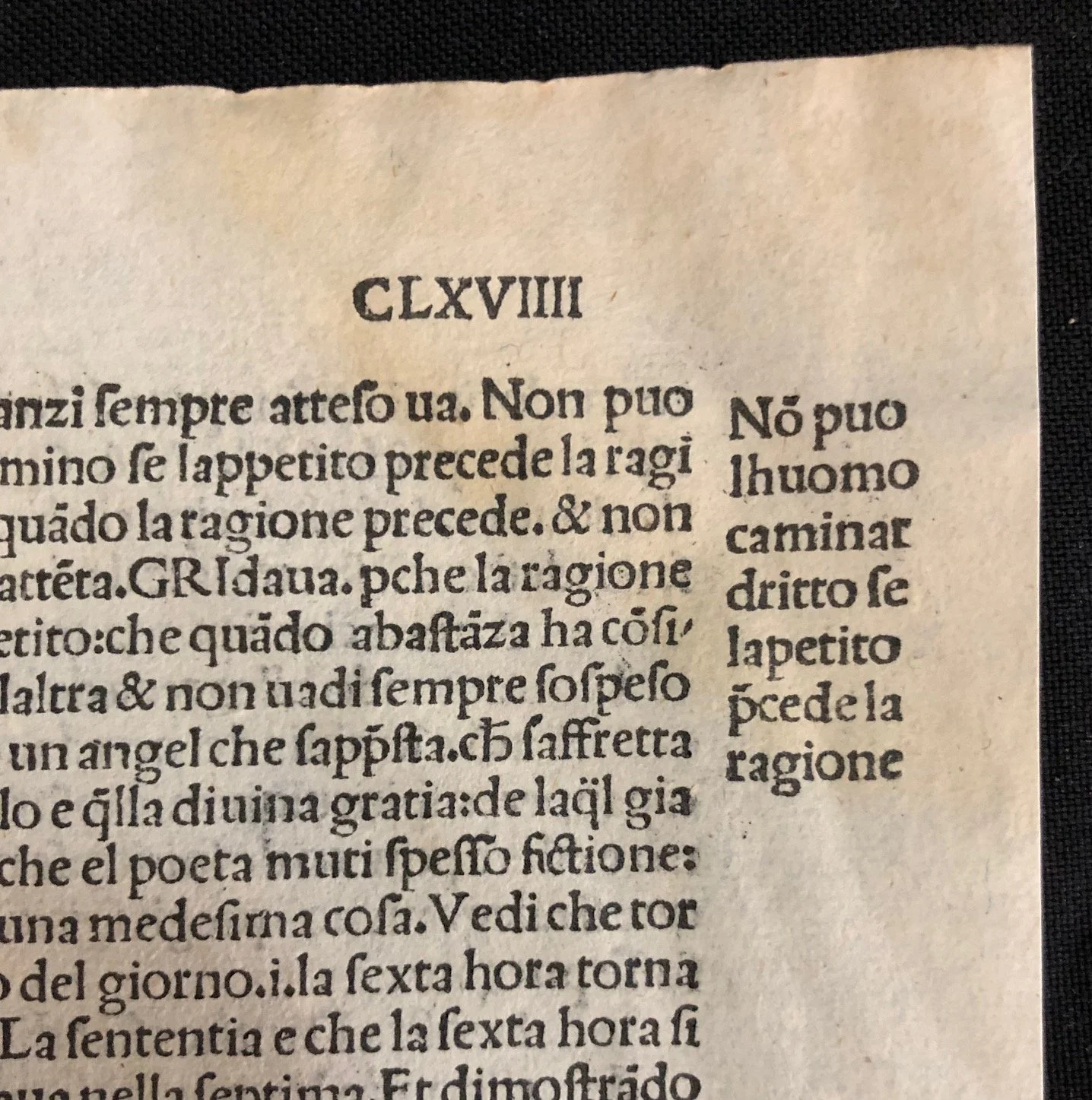
Marginal Summaries: The tiny blocks of text in the outer margins (e.g., "No puo lhuomo caminar dritto se lapetito pcede la ragione" — "Man cannot walk straight if appetite precedes reason") functioned as quick-reference summaries for readers before the invention of modern indices.
The Linguistic Transition
The text is printed in a wonderful Renaissance snapshot of the Italian language. It features typical early printing abbreviations (like using a tilde over a vowel, such as cōtītua, to replace an "m" or "n" to save horizontal space and keep the margins perfectly justified). It also mixes Latinate spellings (like using "ct" in delecto or fructo) with the evolving Tuscan vernacular that Dante himself championed.
It is a beautiful survival of the era when the printing press was actively transforming Dante from a regional Italian poet into a monumental, mass-produced classic of Western civilization.
Some yellowish stains on the corners; creasing
200mm x 300mm
R7,500