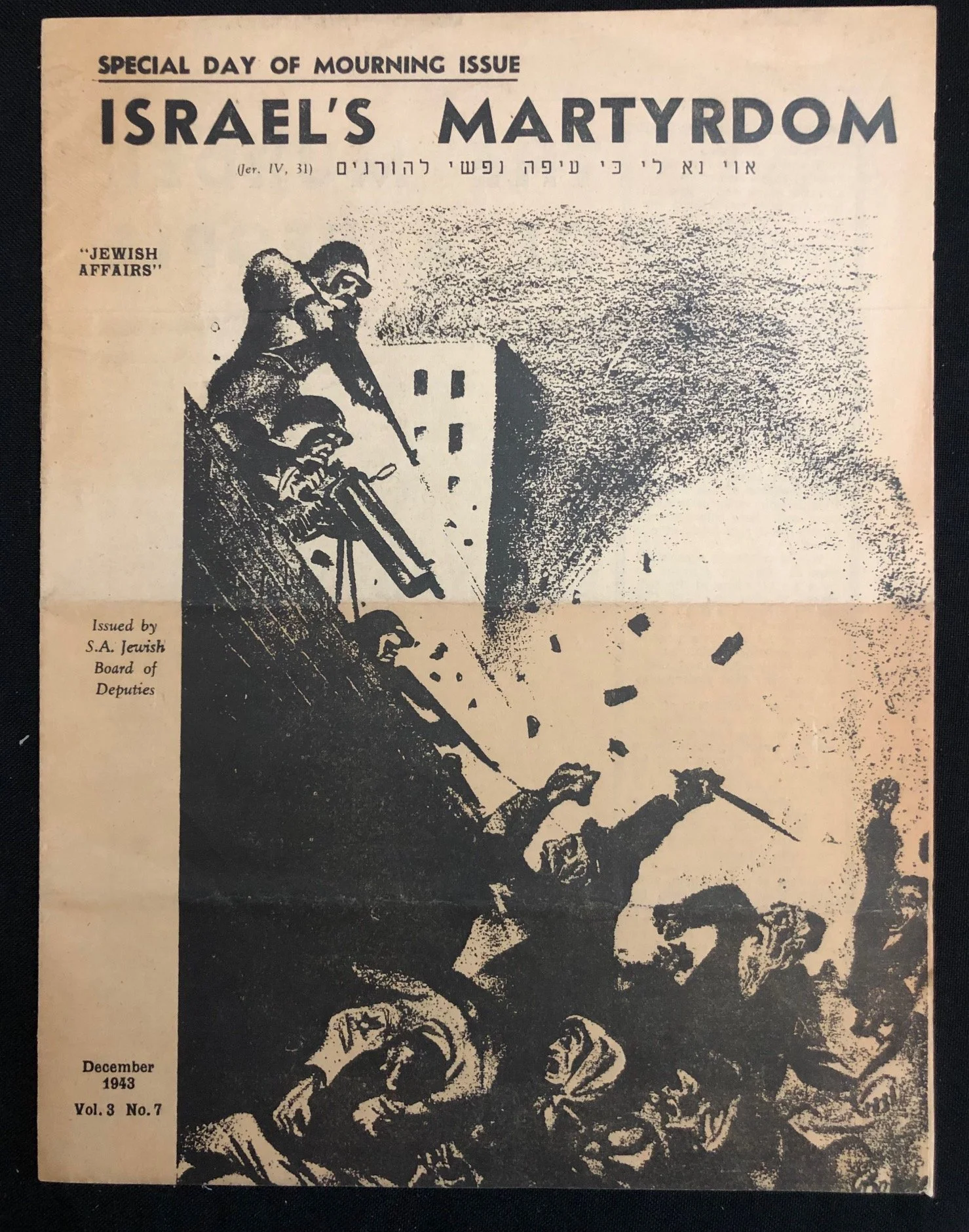
December 1943 issue of Jewish Affairs "Israel's Martyrdom," - Holocaust. Published in Johannesburg.
This December 1943 issue of Jewish Affairs, titled "Israel's Martyrdom," is a profound and harrowing piece of history. Published in Johannesburg by the South African Jewish Board of Deputies. This booklet serves as a stark artifact of how the global diaspora was reacting to the Holocaust in real-time while World War II was still raging.
The Real-Time Transmission of Holocaust Information
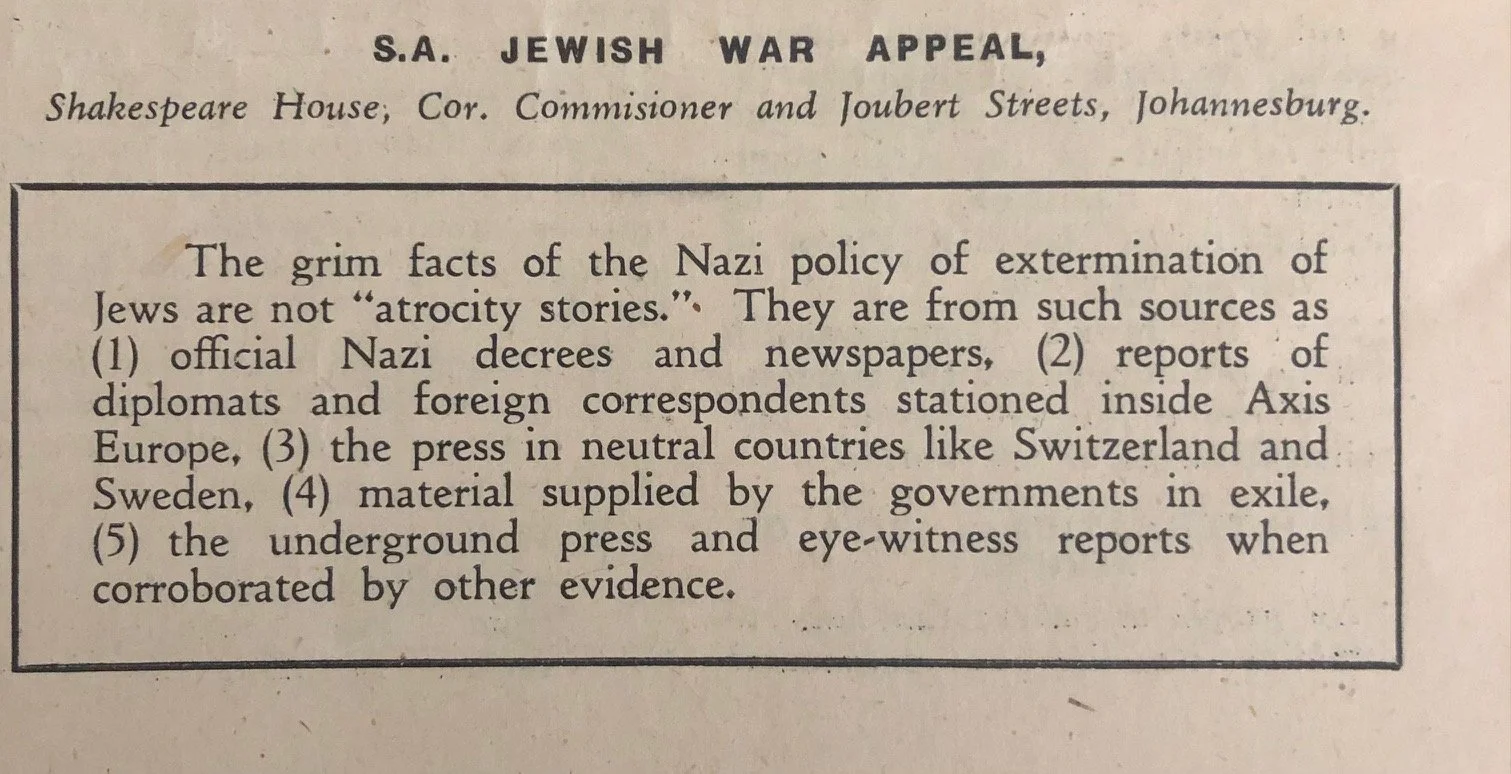
What is particularly striking to historians is its publication date: December 1943. There is a common misconception that the full extent of Nazi Germany's "Final Solution" only became known to the world when the concentration camps were liberated in 1945.
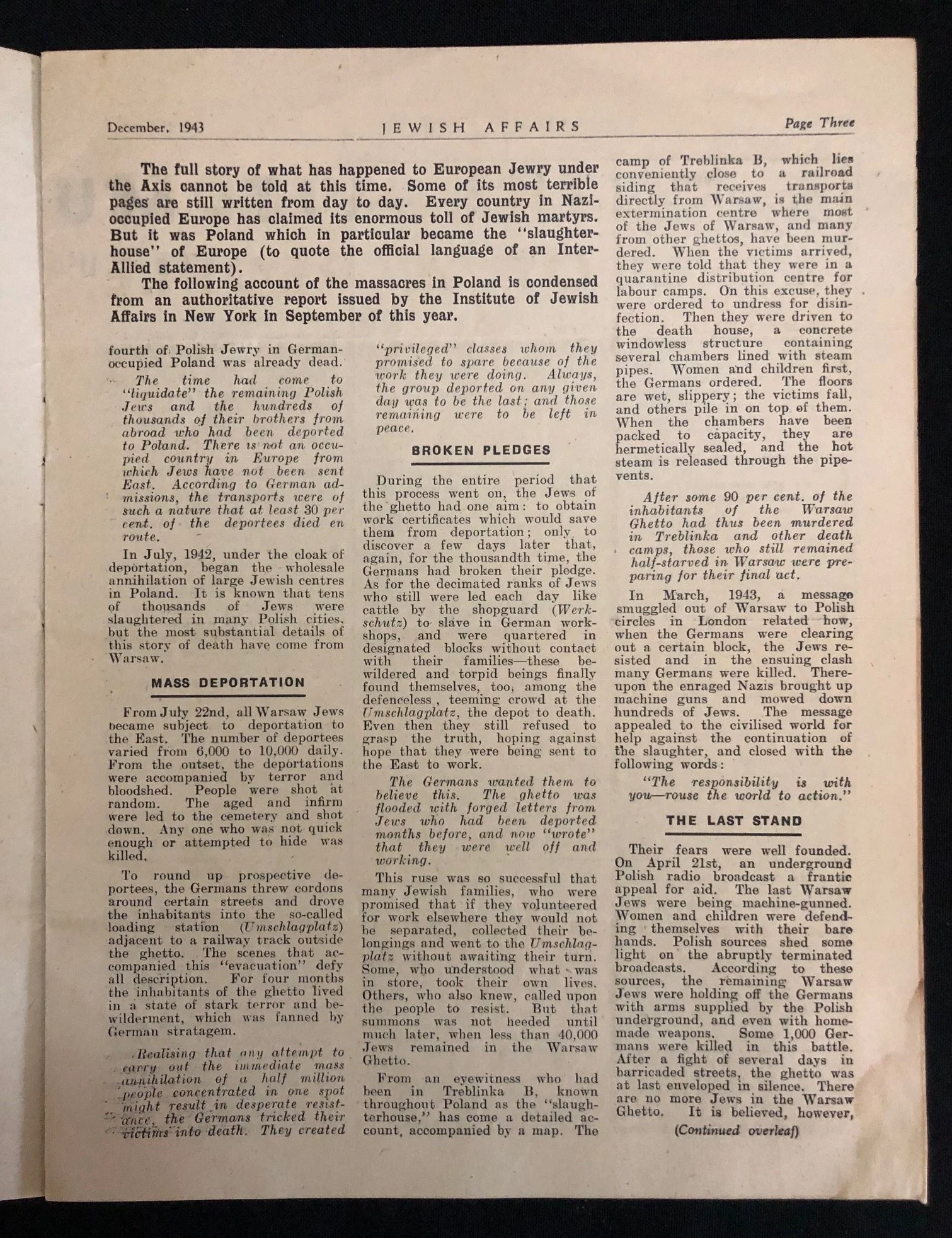
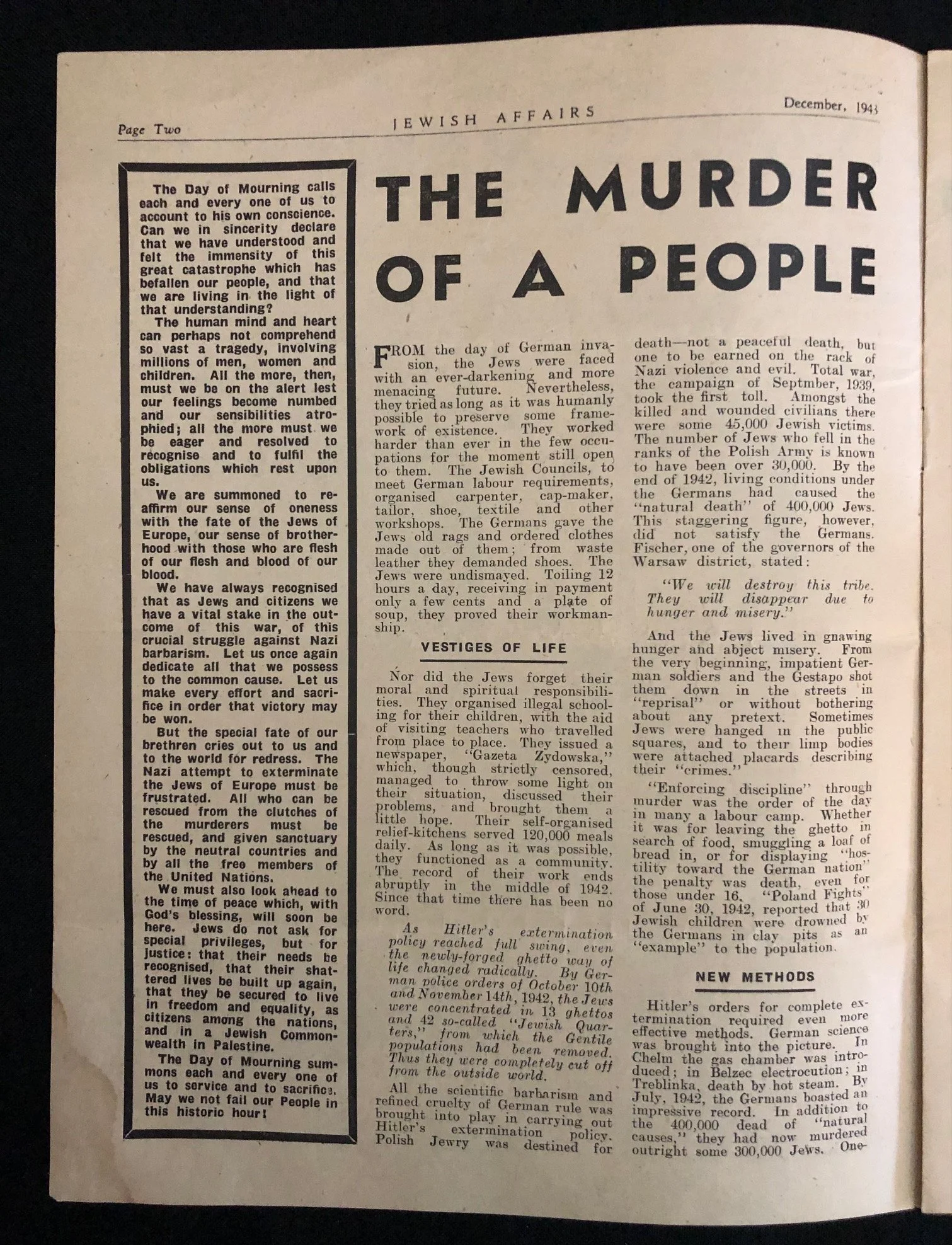
This document proves otherwise. Under the section "New Methods," the text explicitly details Hitler’s orders for "complete extermination" and mentions specific camps:
It notes that in Chelm (Chelmno), the gas chamber was introduced.
It references Belzec and Treblinka.
While some of the early wartime rumours regarding the exact mechanisms of mass murder were slightly inaccurate (such as the mention of "electrocution" or "hot steam" before the precise mechanics of carbon monoxide and Zyklon B gas chambers were fully verified globally), the core, horrific truth of systematic industrial slaughter was explicitly known, documented, and published in South Africa by late 1943.
The Powerful Cover Imagery
The cover artwork is highly symbolic. It depicts Nazi soldiers utilizing heavy weaponry from fortified positions against desperate, resisting civilians. Given the December 1943 date, this is almost certainly an immediate reaction to the Warsaw Ghetto Uprising, which occurred earlier that year between April and May 1943. The imagery honours those who fought back with meagre weapons against an industrialized military force, framing their struggle not just as slaughter, but as active "martyrdom" and resistance.
A Bilingual Diaspora in Mourning
The contrast highlights the linguistic and cultural landscape of the South African Jewish community at the time.
Text written in English to communicate with the broader South African public and the English-integrated younger generation.
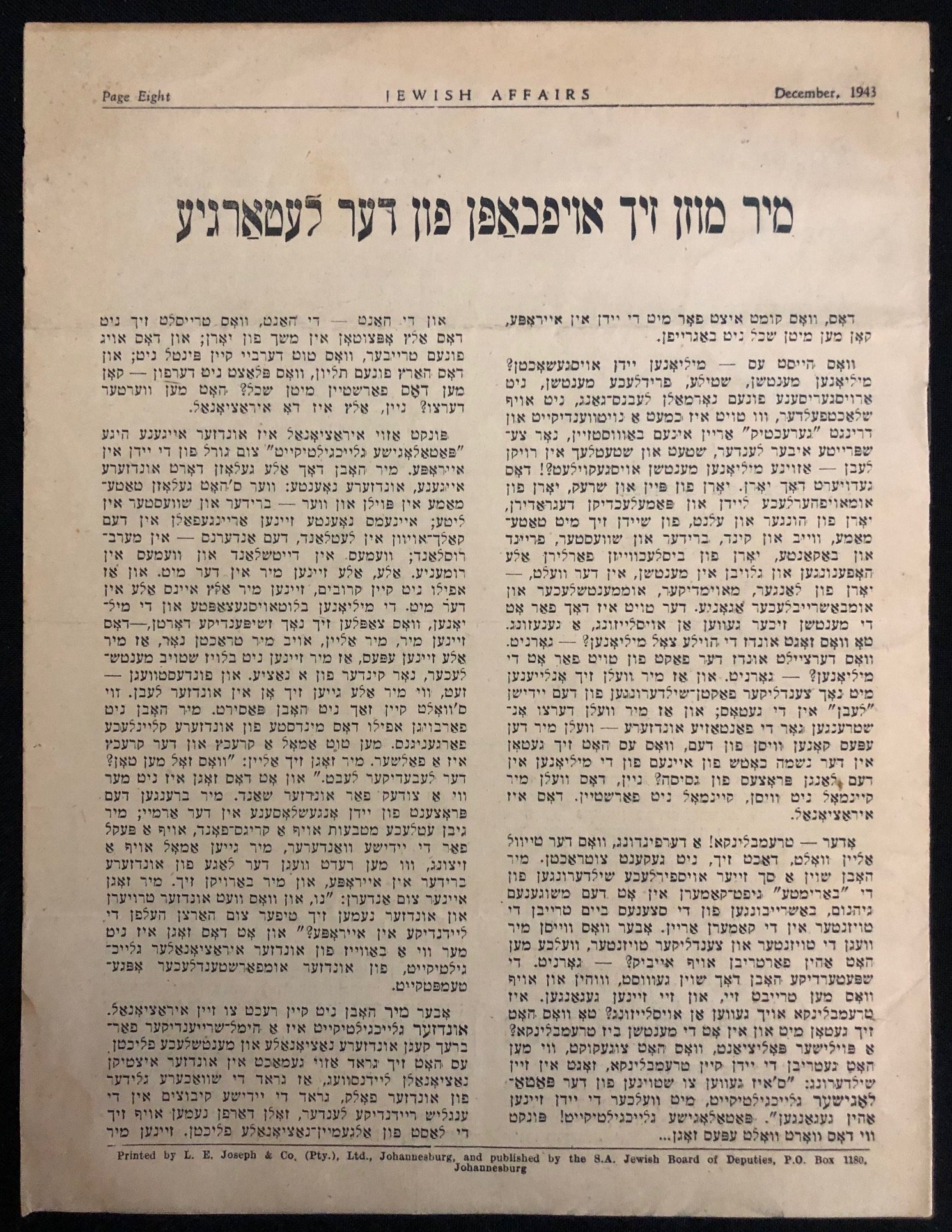
Text featuring a powerful editorial written entirely in Yiddish, titled “Mir Muzen Zich Aufveken Fun Der Letargie” ("We Must Awaken From Our Lethargy").
Yiddish was the mother tongue of the thousands of Eastern European Jewish immigrants (primarily from Lithuania) who had fled to South Africa in the late 19th and early 20th centuries. Printing this call to action in Yiddish was an intimate, direct appeal to a community whose immediate families, hometowns, and cultural roots in Europe were actively being erased.
190mm x 250mm
Stained bottom right; general wear.
R800