Eastern Cape frontier reports - Missionary, Van der Kemp c.1806
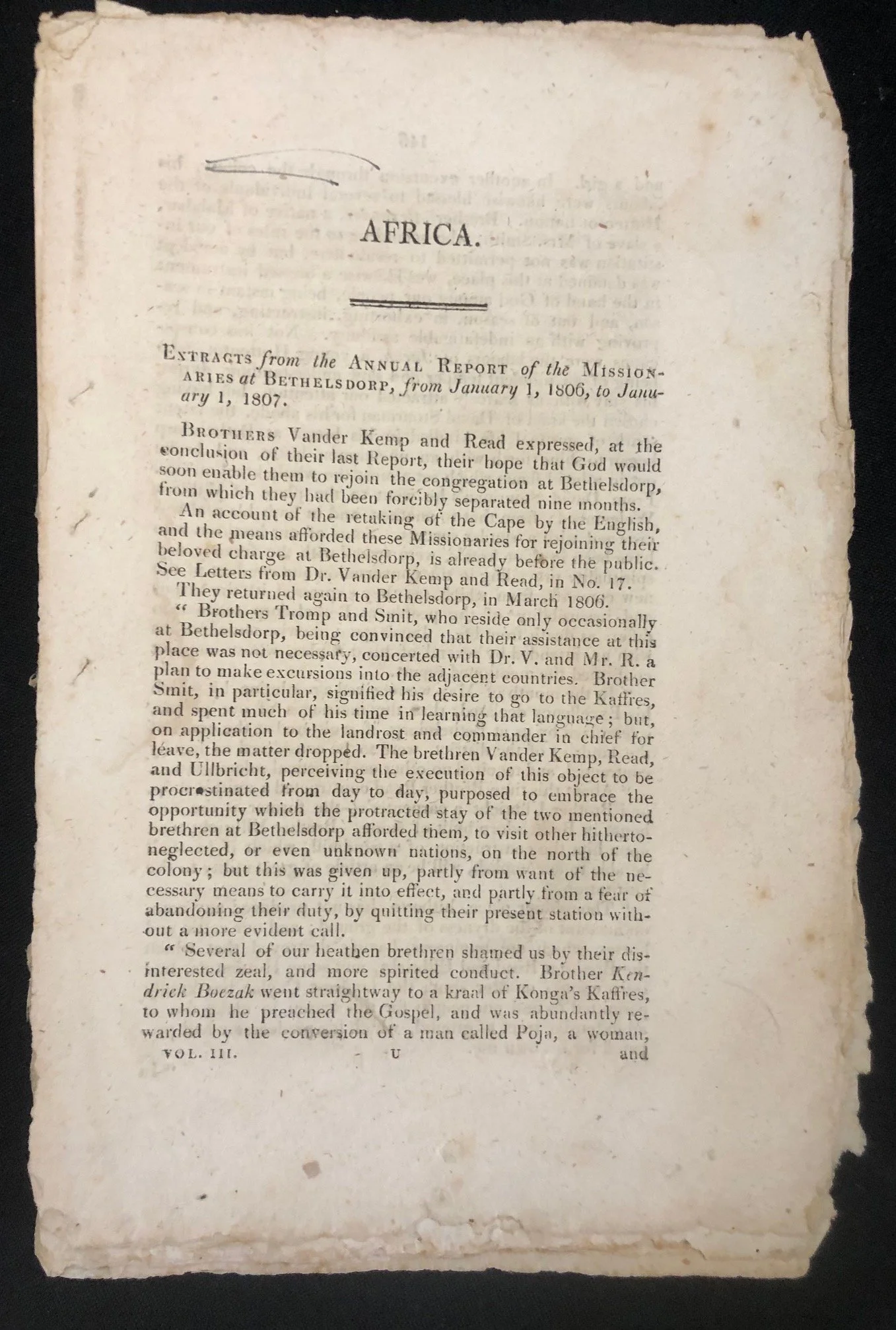
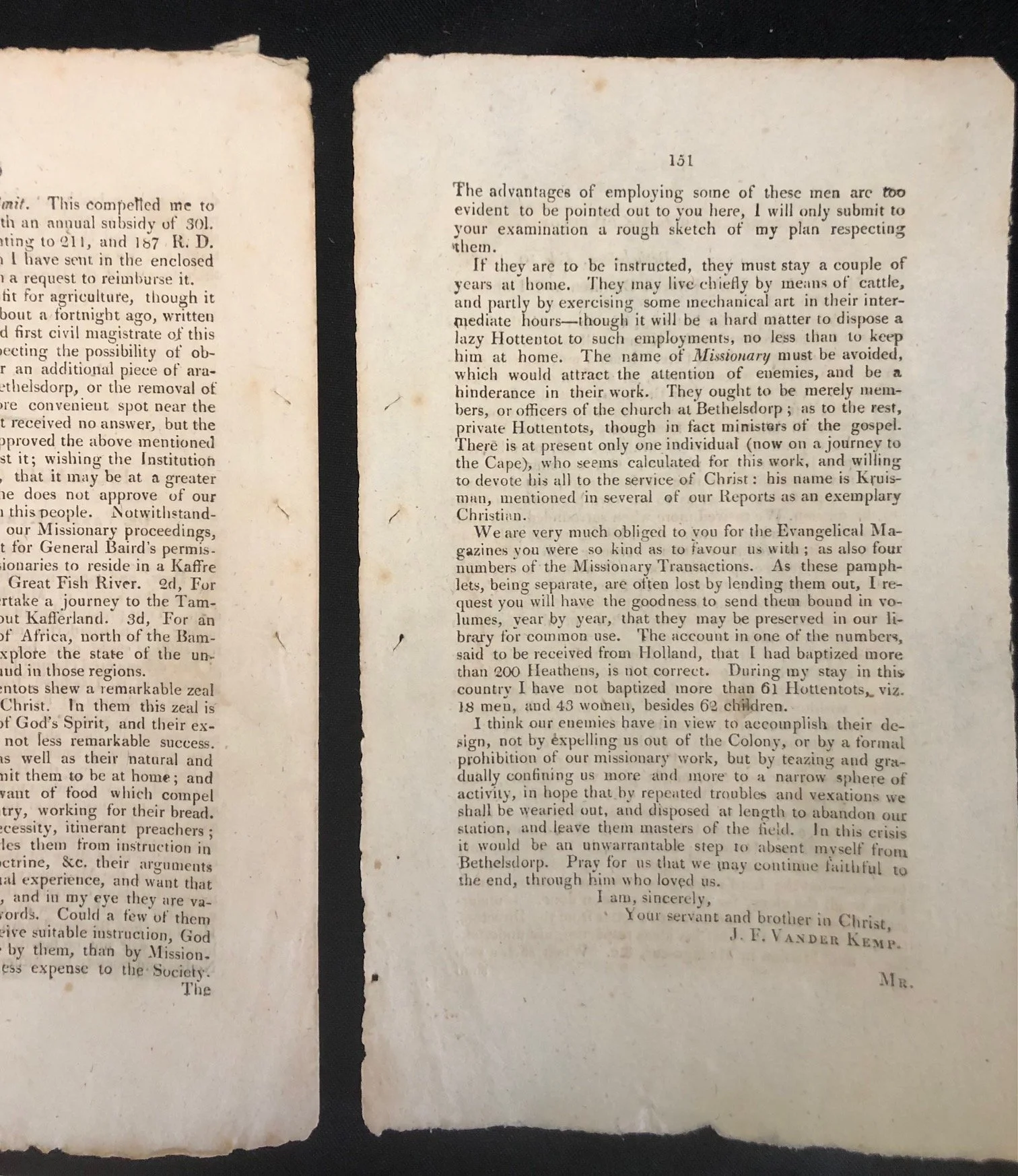
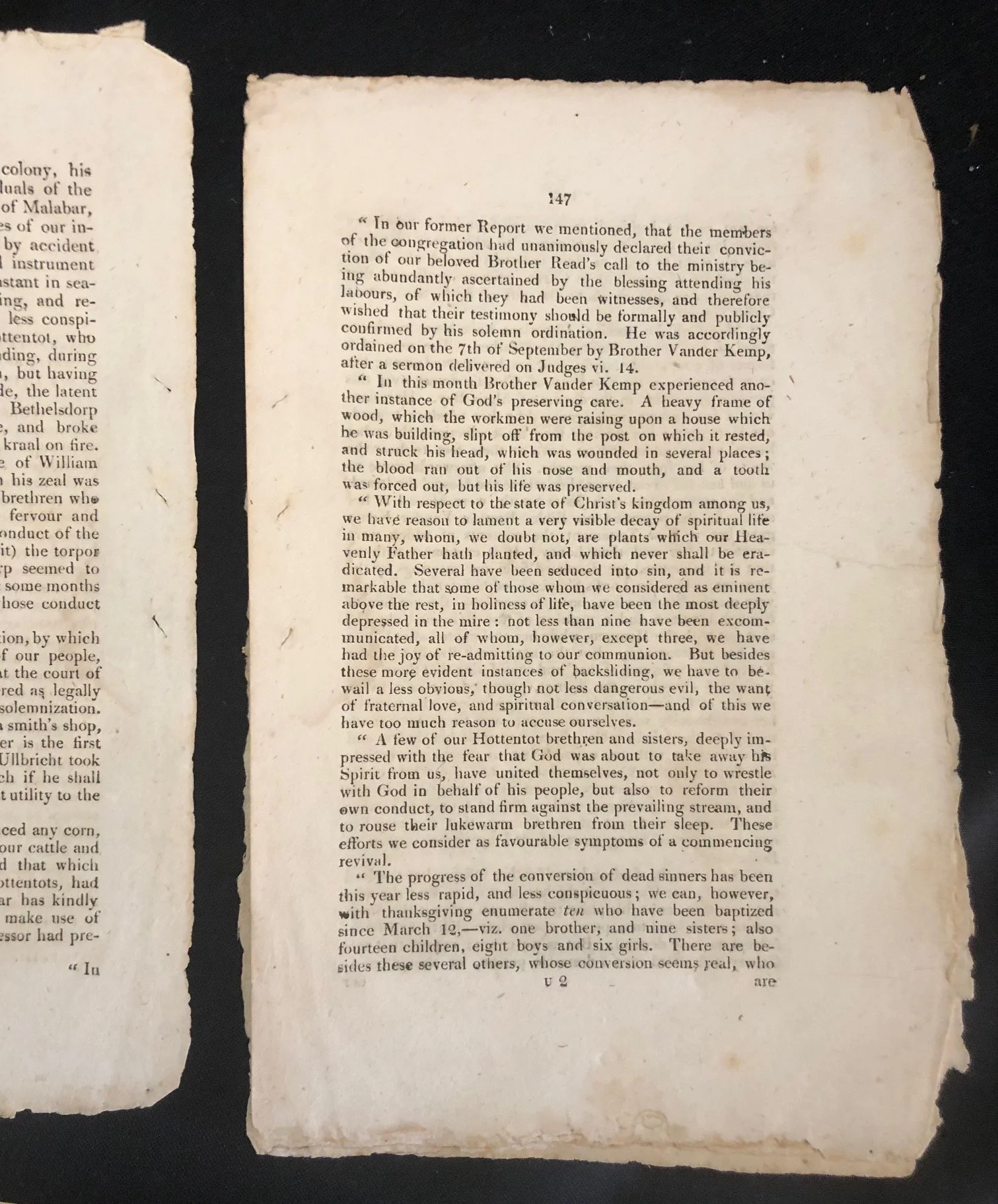
8 pages. (The van der Kemp extracts complete). This is specifically pages 145 to 152.
These leaves from Volume III of the Transactions of the Missionary Society were printed in London by the firm of Bye and Law.
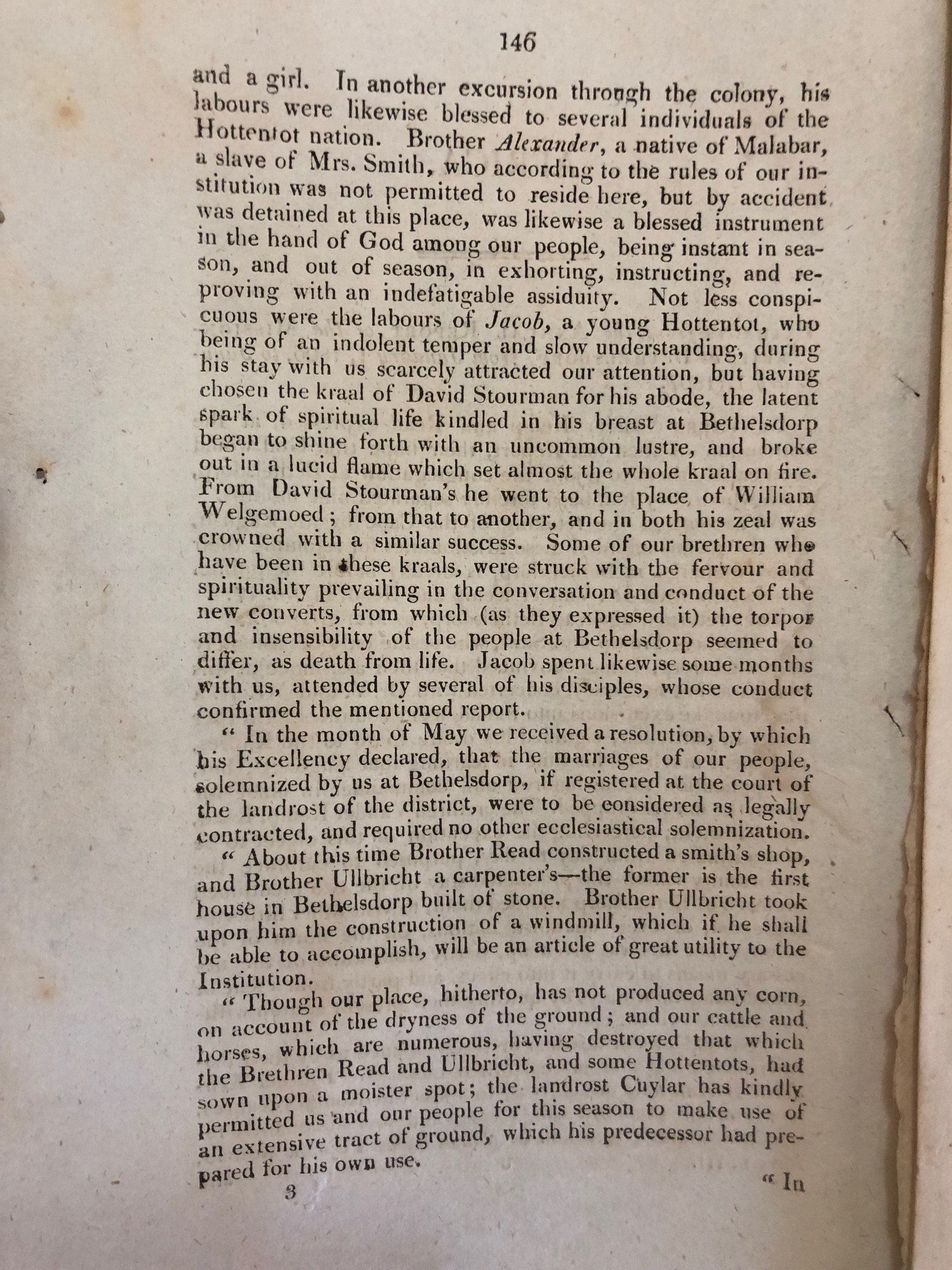
This was a massive deal for early Cape society. Van der Kemp was a radical egalitarian who believed in total racial equality. To the horror of the white colonial establishment, he refused to adopt European dress or standards, lived in a simple reed hut, and in 1806, married a young, freed slave girl from Madagascar, Sara Janse. His colleague, James Read, similarly married a local Khoikhoi woman, Elizabeth Valentyn. By securing legal recognition for marriages performed at the mission outside the state church, they were establishing a refuge where indigenous and mixed-race unions held legal and spiritual legitimacy—a direct challenge to the racial hierarchy of the frontier.
The "Lazy Hottentot" Myth vs. Economic Frontier Realities
On page 151, Van der Kemp explicitly addresses a common colonial trope of the era, writing about how to dispose of a "lazy Hottentot to such employments..." Local white farmers frequently complained that missions like Bethelsdorp robbed them of cheap labor by giving the Khoikhoi (referred to historically in the text as "Hottentots") a place to live without working for colonists. However, pages 146 and 147 reveal a bustling, self-sustaining industrial community despite incredibly harsh environmental conditions ("the dryness of the ground").
They note that Brother Read constructed a smith’s shop.
Brother Ullbricht built a carpenter’s house out of stone and was attempting to build a windmill.
They were actively negotiating with the local landdrost (magistrate), Cuyler, for more arable land.
Cultural Resiliency: David Stourman’s Kraal
On page 146, the report mentions a young convert named Jacob who chose "the kraal of David Stourman for his abode." David Stuurman is a legendary figure in South African history. He was a chief of the Khoikhoi who fiercely resisted colonial encroachment during the Third Frontier War. Stuurman’s kraal near the Gamtoos River was a sanctuary for displaced indigenous people and escaped slaves. The fact that the Bethelsdorp missionaries were interacting with Stuurman's kraal shows how deeply embedded the mission was with the political and resistance networks of the Eastern Cape frontier—a relationship that kept the local authorities in a constant state of anxiety.
A Fragment of the Transactions of the London Missionary Society
Bibliographically, these leaves (numbered 145 to 151, featuring the distinct "U" and "U 2" signatures at the bottom of the pages for the binder) come from the Transactions of the London Missionary Society (likely Volume III, as indicated on page 145). These annual compendiums were sent back to England to satisfy wealthy evangelical donors. Because these reports were printed in small batches and often broken up or bound into composite volumes, surviving contemporary printings of these specific early Eastern Cape frontier reports are exceptionally scarce and highly valued by historians of southern Africa.
These leaves from Volume III of the Transactions of the Missionary Society were printed in London by the firm of Bye and Law.
The Printers: Bye and Law
Located at St. John’s Square, Clerkenwell, Deodatus Bye and Henry Law were highly prominent printers of religious, institutional, and classical texts during the late 18th and early 19th centuries. They were the official printers for the Society for Promoting Christian Knowledge (SPCK) and handled the extensive, multi-volume print runs for the London Missionary Society (LMS).
Publication Details
Publisher: The volumes were officially published and sold "by Order of the Directors of the Missionary Society, for the benefit of the Institution." * Distribution: They were distributed primarily through the evangelical booksellers Williams and Smith (Stationers' Court, Ludgate Street, London).
Because these annual Transactions were compiled from letters and journals trickling in from volatile global frontiers, they were often issued first in separate, episodic pamphlets (as explicitly mentioned on page 151: "as these pamphlets, being separate, are often lost by lending them out..."). Once a full volume's worth of material was gathered, they were printed collectively by Bye and Law as a complete volume for library preservation.
Each page: 140mm x 222mm
R2,000