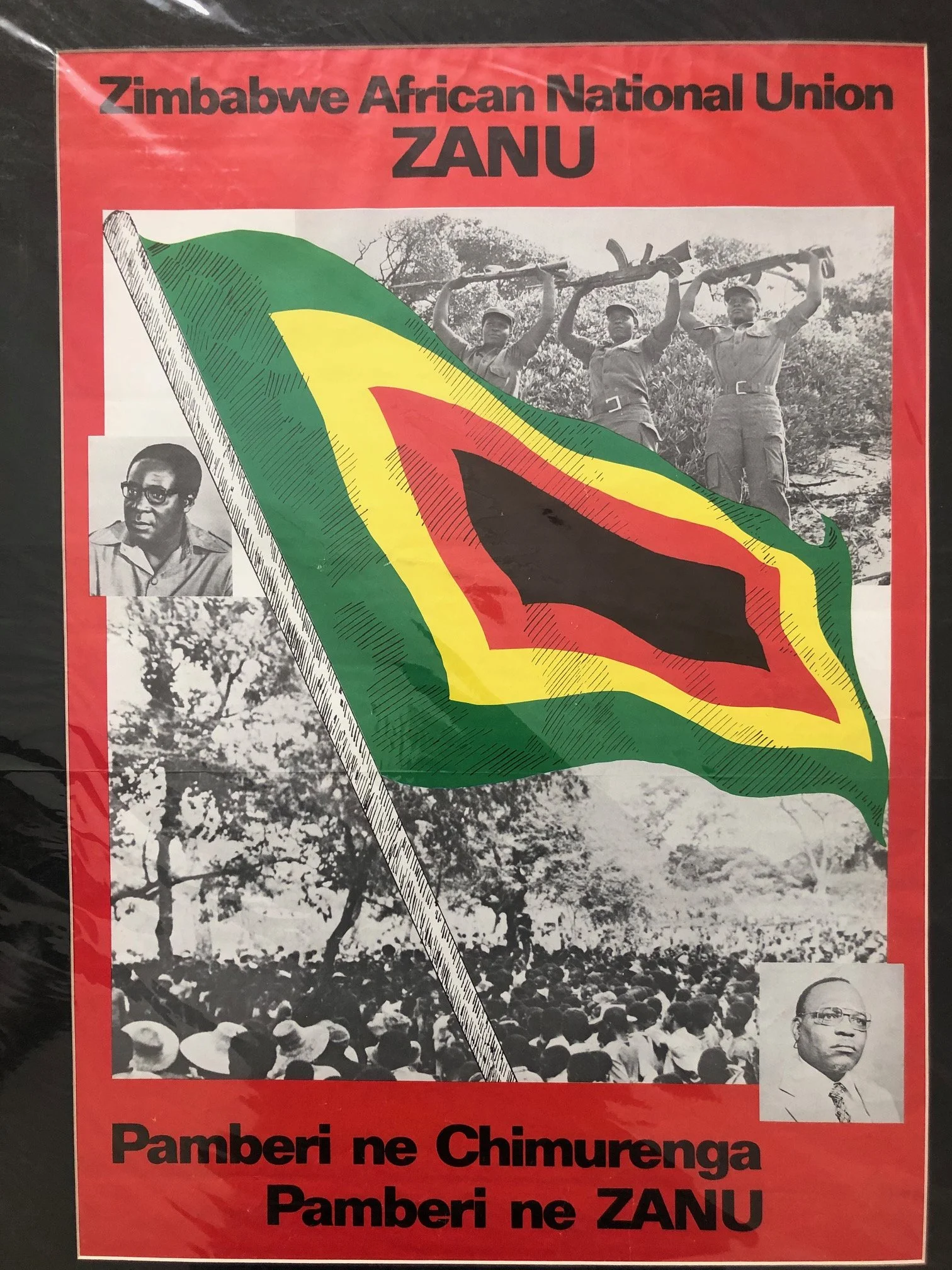
Poster: Forward with the Revolutionary Struggle. Forward with ZANU (printed before the elections. c.1979)
"Pamberi ne Chimurenga" (Forward with the Revolutionary Struggle)
"Pamberi ne ZANU" (Forward with ZANU)
Liberation poster dating from the late 1970s, a pivotal period near the climax of the Zimbabwean Liberation War (the Rhodesian Bush War). It serves as a fascinating historical window into the propaganda, visual culture, and internal dynamics of the liberation movement just before the birth of Zimbabwe in 1980.
The Dynamic Dual Leadership: Mugabe and Sithole
The visual composition of the poster captures a highly specific and volatile political transition within ZANU.
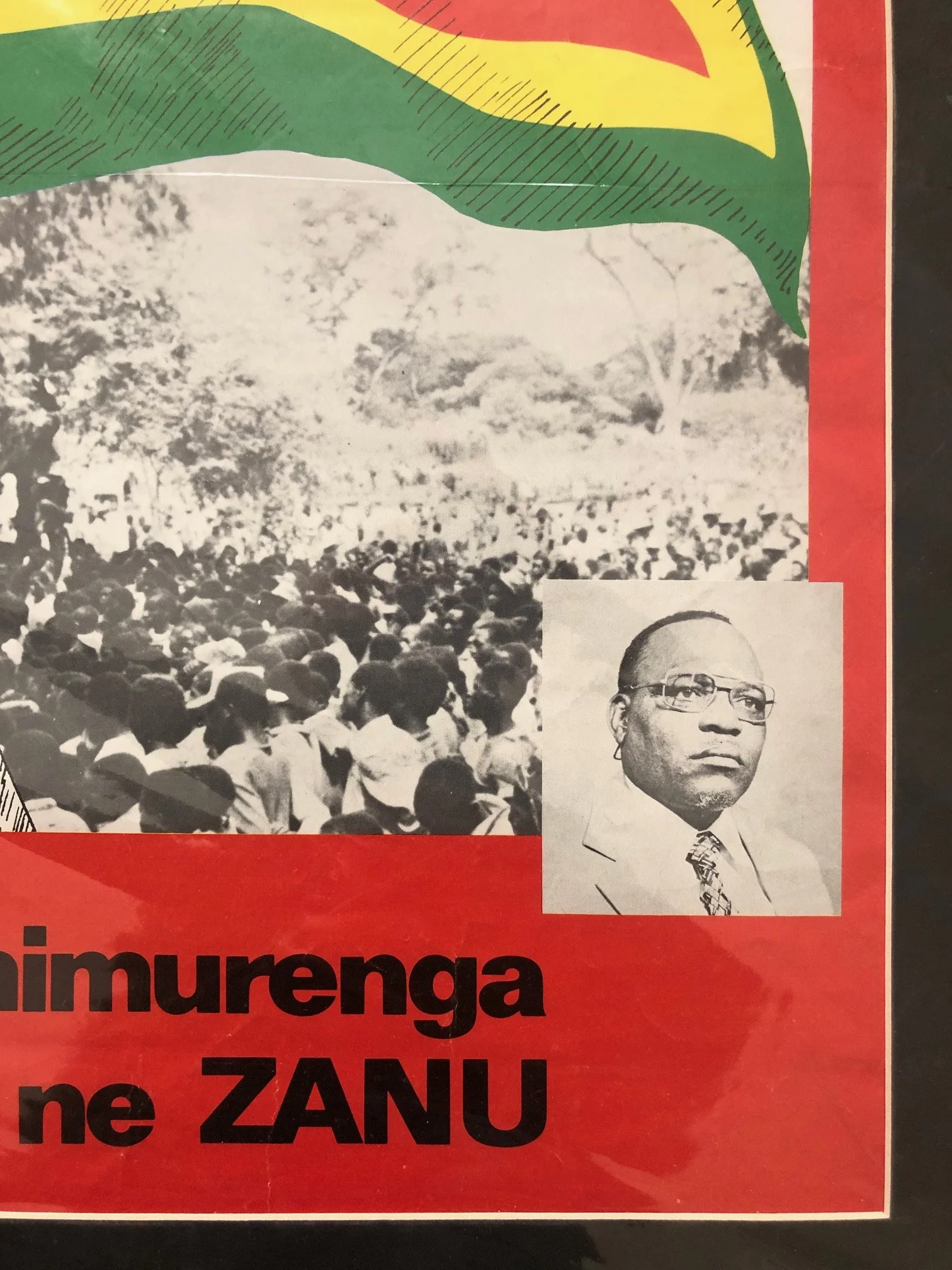
The Bottom-Right Portrait: This features Ndabaningi Sithole, the founding president of ZANU when it split from Joshua Nkomo’s ZAPU in 1963.
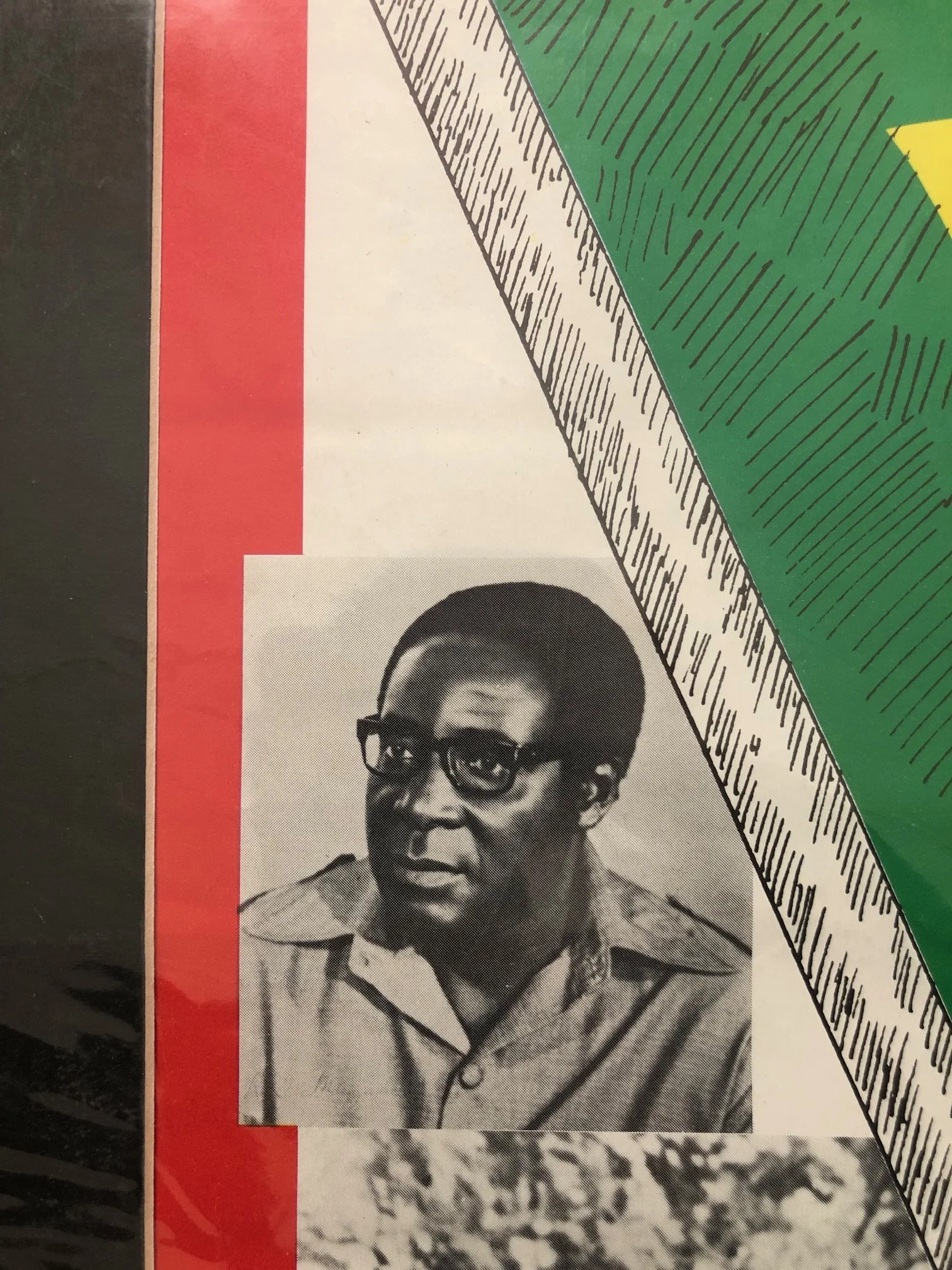
The Left Portrait: This features a younger Robert Mugabe, who served as the party’s secretary-general.
The Historical Friction: By the late 1970s, when this poster was likely printed, a massive internal shift had occurred. Following the assassination of Herbert Chitepo in 1975 and the 1976 Mgagao Declaration by frontline guerrillas, Mugabe effectively usurped Sithole as the militant leader of ZANU’s military wing (ZANLA) operating out of Mozambique. Sithole went on to lead a more moderate internal faction (ZANU-Sithole). Posters that feature both men side-by-side are rare transitional artifacts, often printed internationally by solidarity networks or during brief moments of attempted political alignment before Mugabe completely consolidated power for the 1980 independence elections.
The Slogan: Chimurenga and the Call to Arms
At the bottom of the poster, the Shona slogans read: "Pamberi ne Chimurenga" (Forward with the Revolutionary Struggle) "Pamberi ne ZANU" (Forward with ZANU)
The word Chimurenga is deeply heavy with historical resonance. It refers to a war of liberation or revolutionary struggle.
The First Chimurenga (1896–1897) was the historic uprising led by spiritual ancestors like Mbuya Nehanda against the British South Africa Company's colonial encroachment.
By naming the 1960s–1970s bush war the Second Chimurenga, ZANU was deliberately legitimized not as a modern political anomaly, but as the direct spiritual and physical continuation of a century-old struggle for ancestral land.
Visual Representation of Women Guerrillas
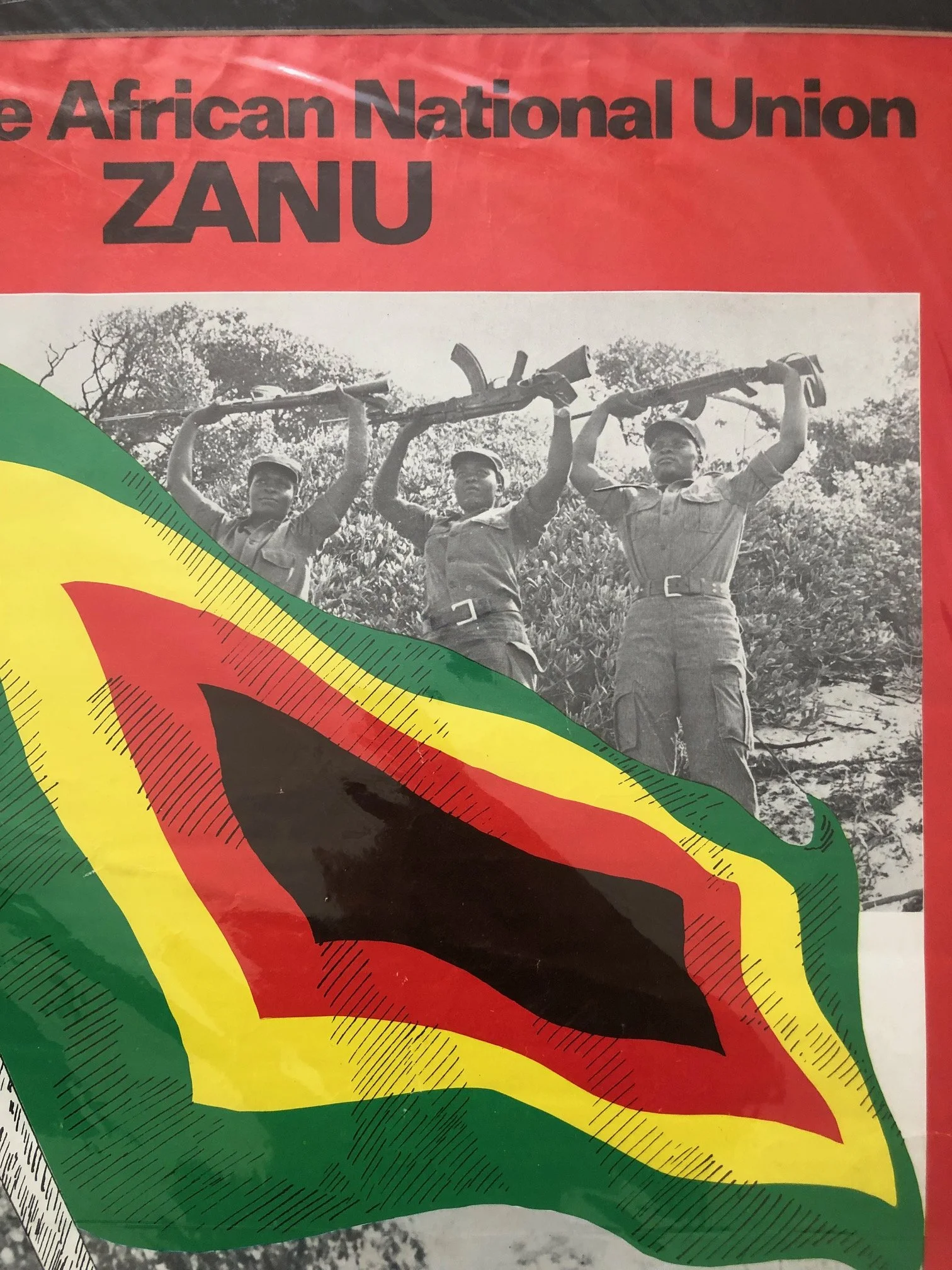
At the top right of the central image, three cadres are shown holding AK-47 assault rifles above their heads. Notably, these figures appear to be women combatants.
Unlike many traditional armies of the era, ZANLA (ZANU's armed wing) heavily publicized the involvement of women in the frontline struggle through the Female Detachment formed in 1974.
Images of women in uniform carrying arms were highly effective propaganda tools, utilized both domestically to mobilize rural populations and internationally to signal a modern, progressive, and egalitarian Marxist-Leninist liberation movement to state sponsors in China and the Eastern Bloc.
The Evolutionary Flag
The flag depicted featuring green, yellow, and red concentric rectangles around a black central core—was the official party flag of ZANU. This design provided the direct structural DNA for the current national flag of Zimbabwe. When independence was achieved in 1980, the party flag’s colour scheme was retained, with the addition of the white triangle on the hoist, the red Marxist star, and the soapstone Zimbabwe Bird, forever fusing the identity of the ruling party with the identity of the new nation-state.
Minor edge wear.
425mm x 605mm
R2,500