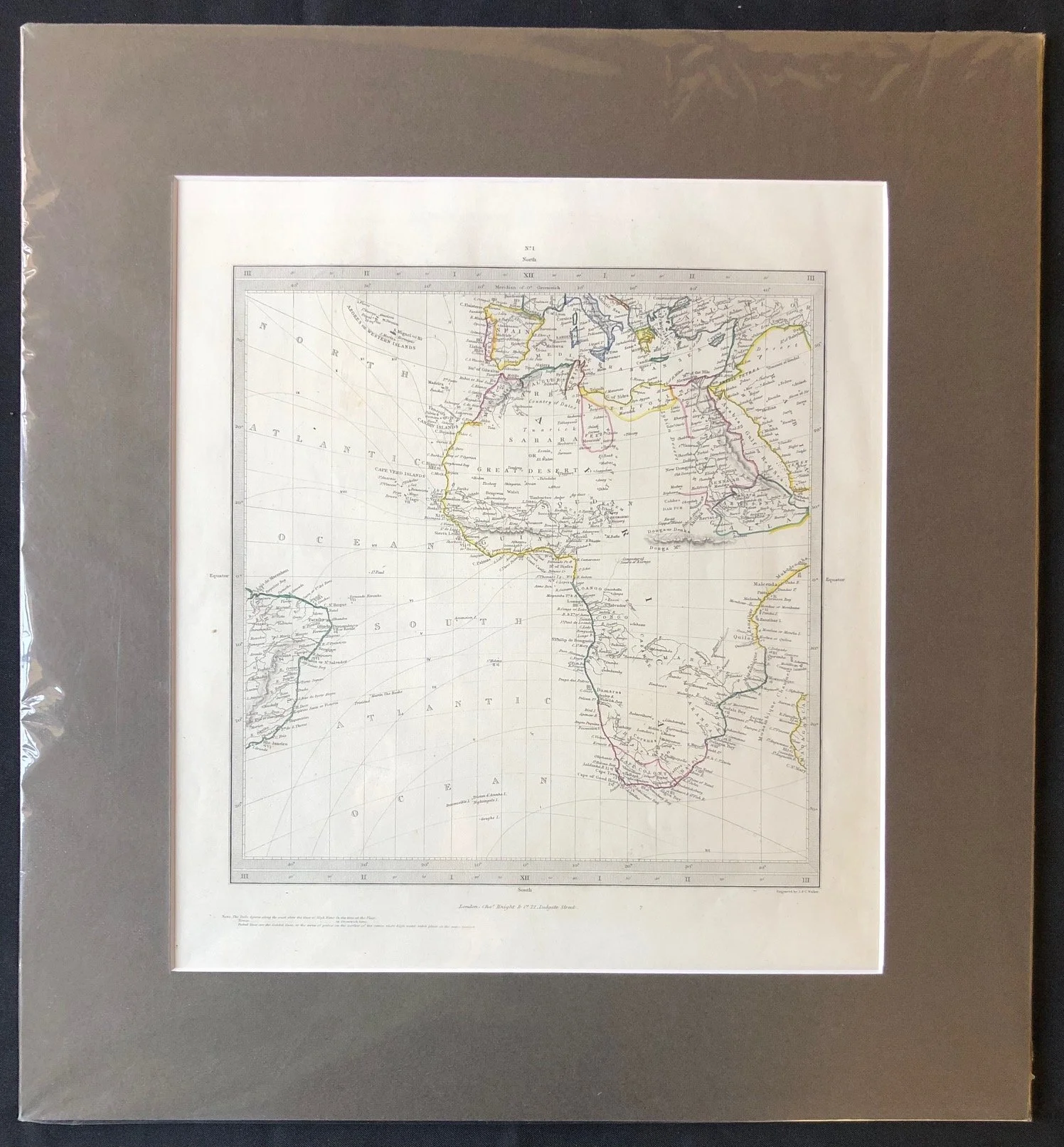
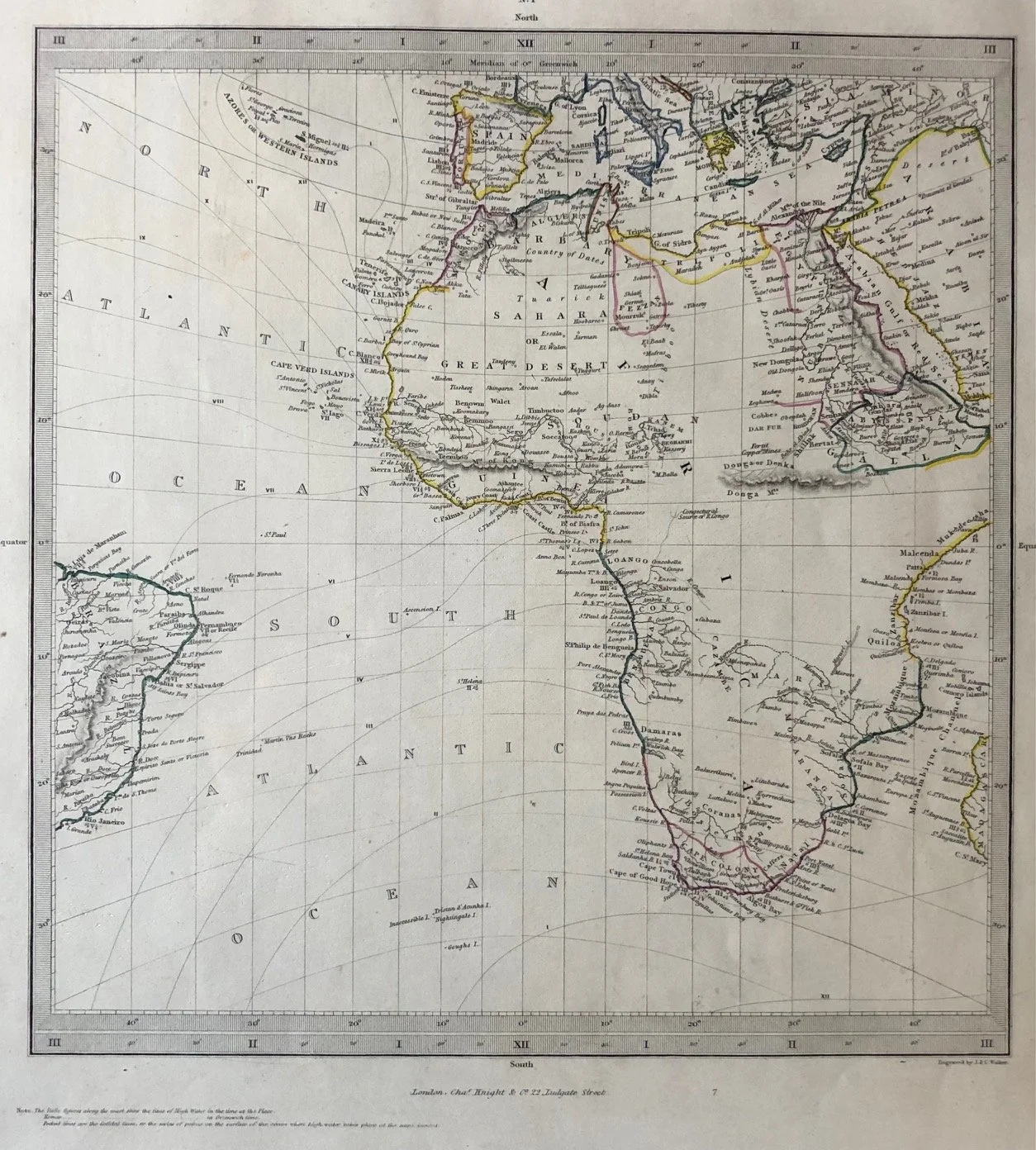
Africa, and featuring the eastern protrusion of South America, published by the SDUK (c.1831)
Hand coloured engraving.
This map is an intriguing 19th-century engraving titled "Africa" (and featuring the eastern protrusion of South America), published in London by Charles Knight & Co. for the Society for the Diffusion of Useful Knowledge (SDUK). Engraved by J. & C. Walker, this particular sheet captures a fascinating intersection of mathematical cartography, phantom geography, and colonial geopolitics.
The Unusual Gnomonic Projection
Unlike standard Mercator or stereographic maps of Africa from this period, this map uses a gnomonic projection (often historically referred to as a "gnomic" projection).
Notice the curved, radiating latitude lines and straight, non-parallel longitude lines that stretch awkwardly toward the edges.
Gnomonic projections display all great circles (the shortest distance between two points on a sphere) as perfectly straight lines. While distortion becomes extreme away from the center point—making South America and Southern Africa look remarkably skewed—this projection was invaluable for 19th-century navigators planning transoceanic shipping routes across the Atlantic.
The Great Cartographic Ghost: The Kong Mountains
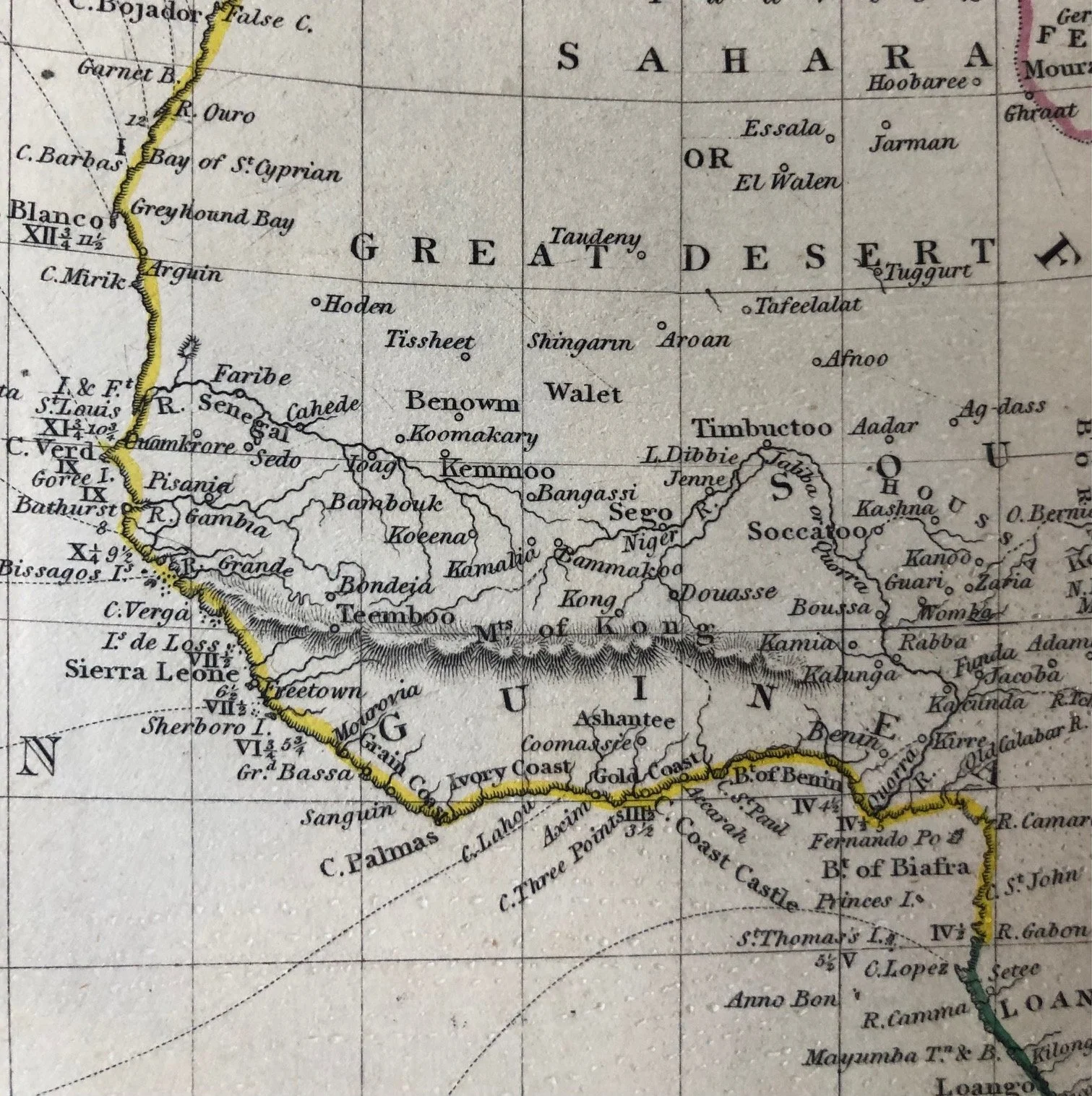
Spanning nearly the entire width of West Africa just north of the Equator, you can see a prominent, heavily shaded mountain range labeled Kong Mts.
First popularized by the geographer James Rennell in 1798, the "Mountains of Kong" were believed to be a massive continental spine that prevented the Niger River from flowing south.
This entirely fictional mountain range was copied from map to map for nearly a century. It remained a staple of African cartography until French explorer Louis-Gustave Binger finally proved in the late 1880s that the mountains did not exist, exposing one of the greatest geographical myths in history.
The Shadow of the Treaty of Tordesillas
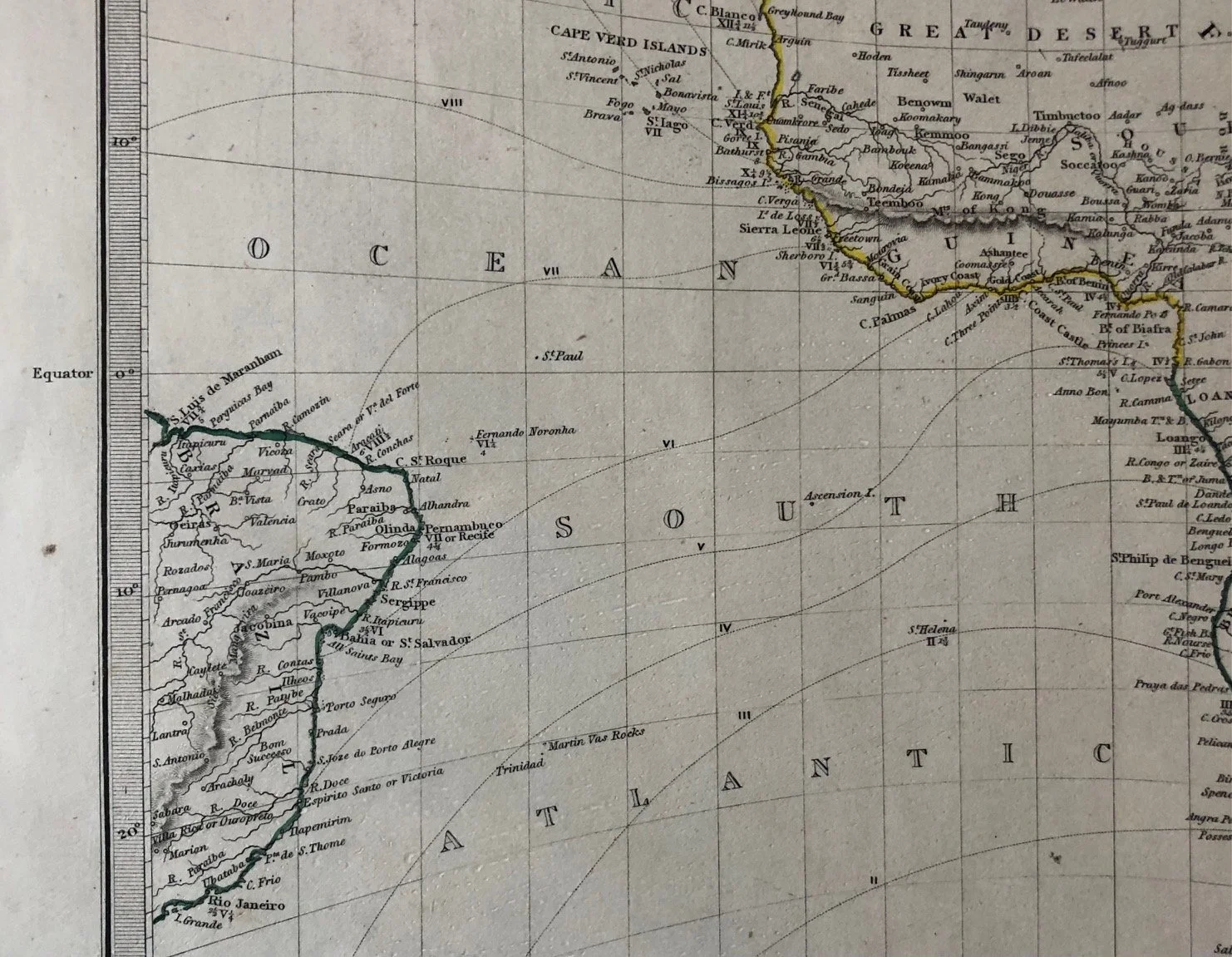
The deliberate inclusion of the eastern coast of South America (Brazil) alongside West Africa on a single sheet highlights the deep historical and economic ties of the Atlantic slave trade.
Geographically, this narrow stretch of the Atlantic recalls the Treaty of Tordesillas (1494), where Spain and Portugal drew a meridian line 370 leagues west of the Cape Verde Islands (which are clearly visible and numbered on this map).
That arbitrary line gave Portugal the rights to the eastern bulge of South America and the entire African coast, fundamentally shaping the linguistic, cultural, and colonial realities of both continents shown here.
It was also to the advantage of the Portuguese that they place South America closer to Africa, thus (fraudulently) taking advantage of meridian.
The Expanding Cape Colony
At the southern tip of the continent, the map delineates the Cape Colony.
Published during a transitional era when the British were aggressively expanding their grip beyond Cape Town, the map details the early colonial districts pushing toward the frontier.
Just north of the colony, the interior is filled with names like the Coranas (Korana) and Damaras, documenting a brief window in time when European knowledge of the southern interior was still confined largely to the coast and major river systems like the Orange River, right before the mass interior migrations altered the region's map forever.
Plate size: 320mm x 350mm
Sold Sept '26