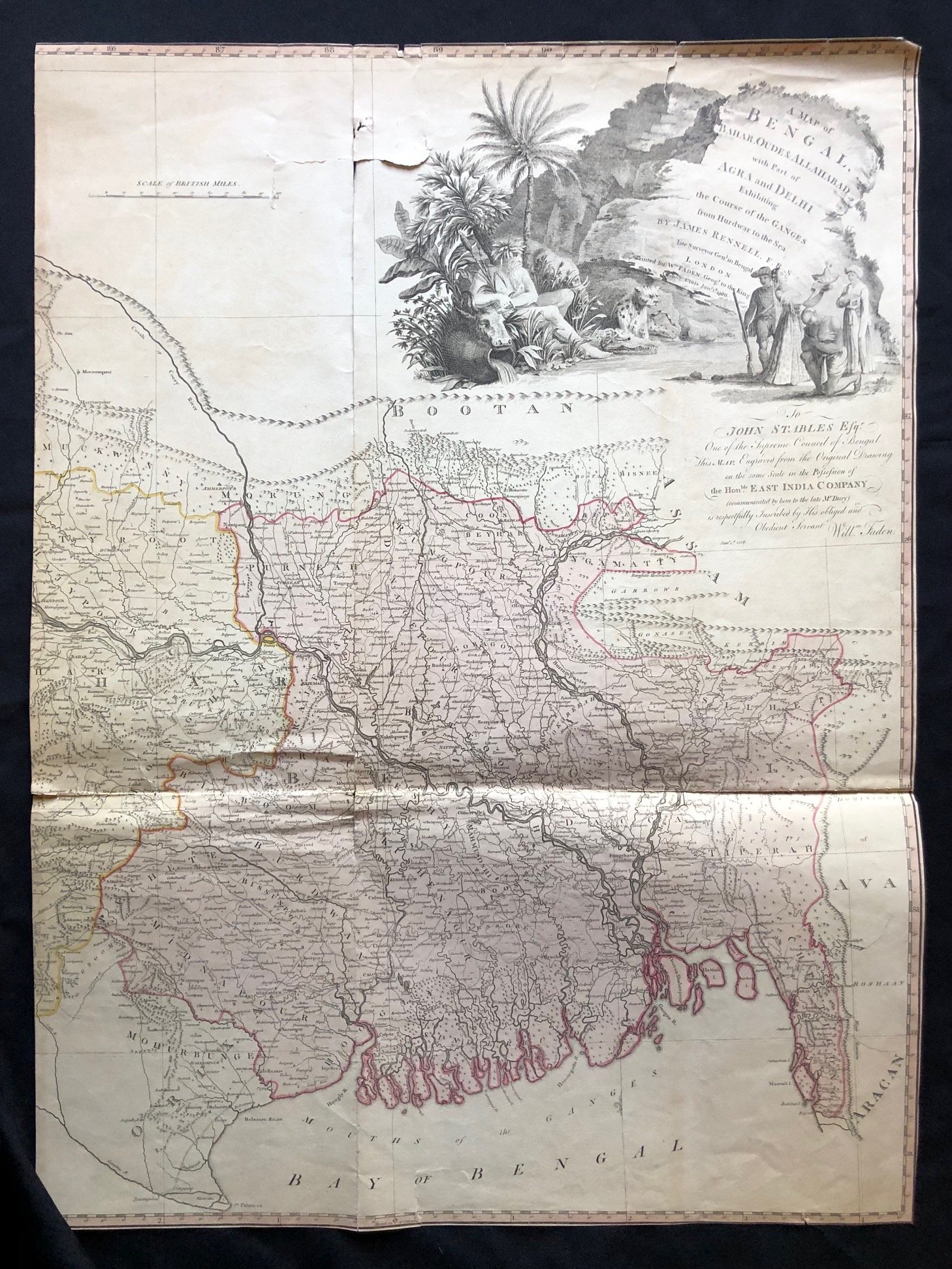
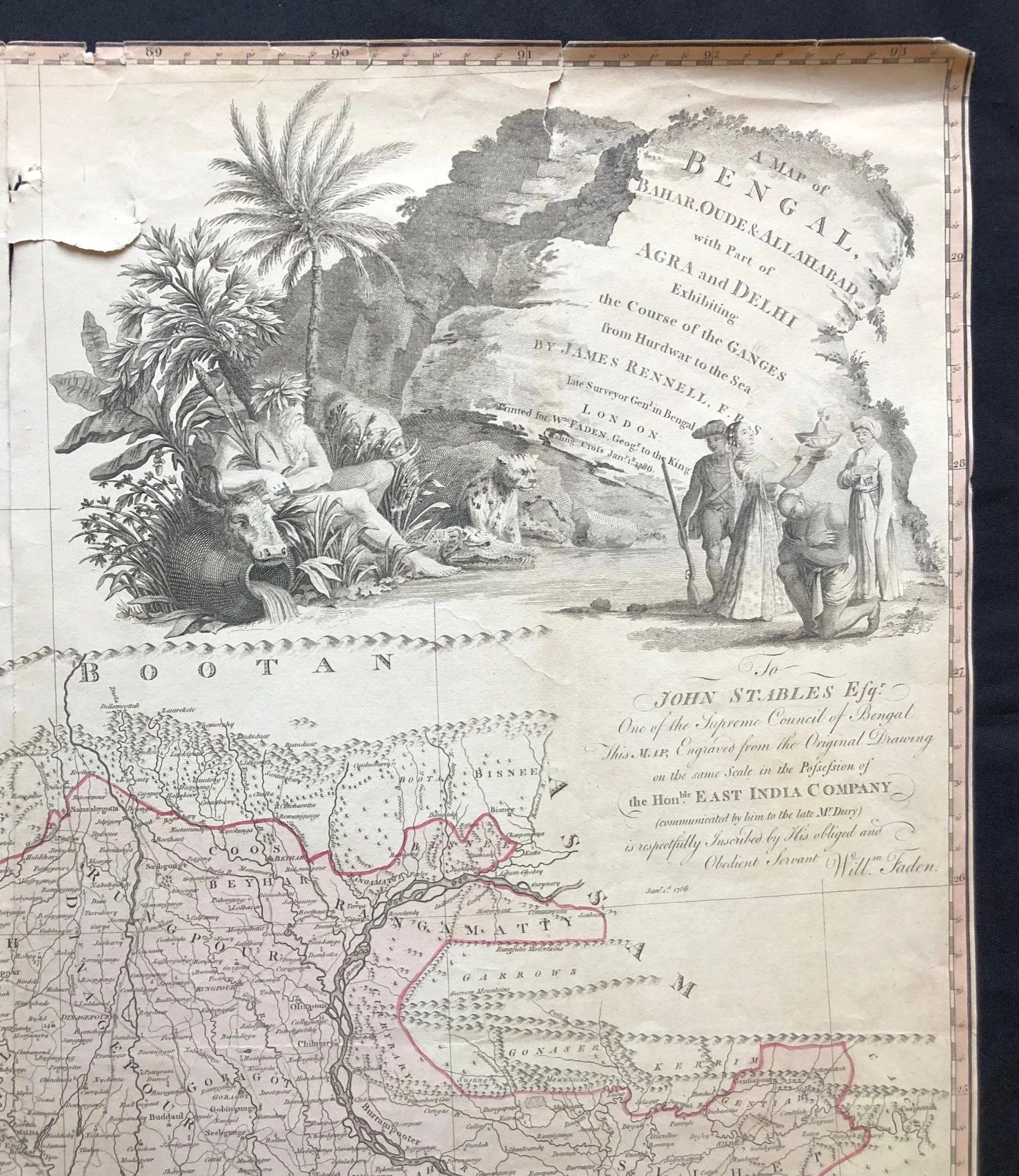
"A Map of Bengal, Bahar, Oude & Allahabad...". By James Rennell and published by William Faden (1786)
Created by James Rennell and published in London by William Faden on January 1, 1786. It is an iconic piece of imperial cartography that marks the birth of systematic modern surveying in India.
James Rennell: "The Father of Indian Geography"
James Rennell was a pioneer who was appointed by Lord Robert Clive as the very first Surveyor-General of Bengal in 1767. Before Rennell’s work, European maps of the Indian interior were notoriously inaccurate, often relying on guesswork or ancient accounts. Over several grueling years—during which he was once severely wounded in a skirmish—Rennell traveled across the delta to map the strategic river highways. This 1786 map represents the pinnacle of his foundational surveys, providing the British Empire with its first mathematically rigorous look at the subcontinent’s heartland.
The Imperial Propaganda of the Cartouche
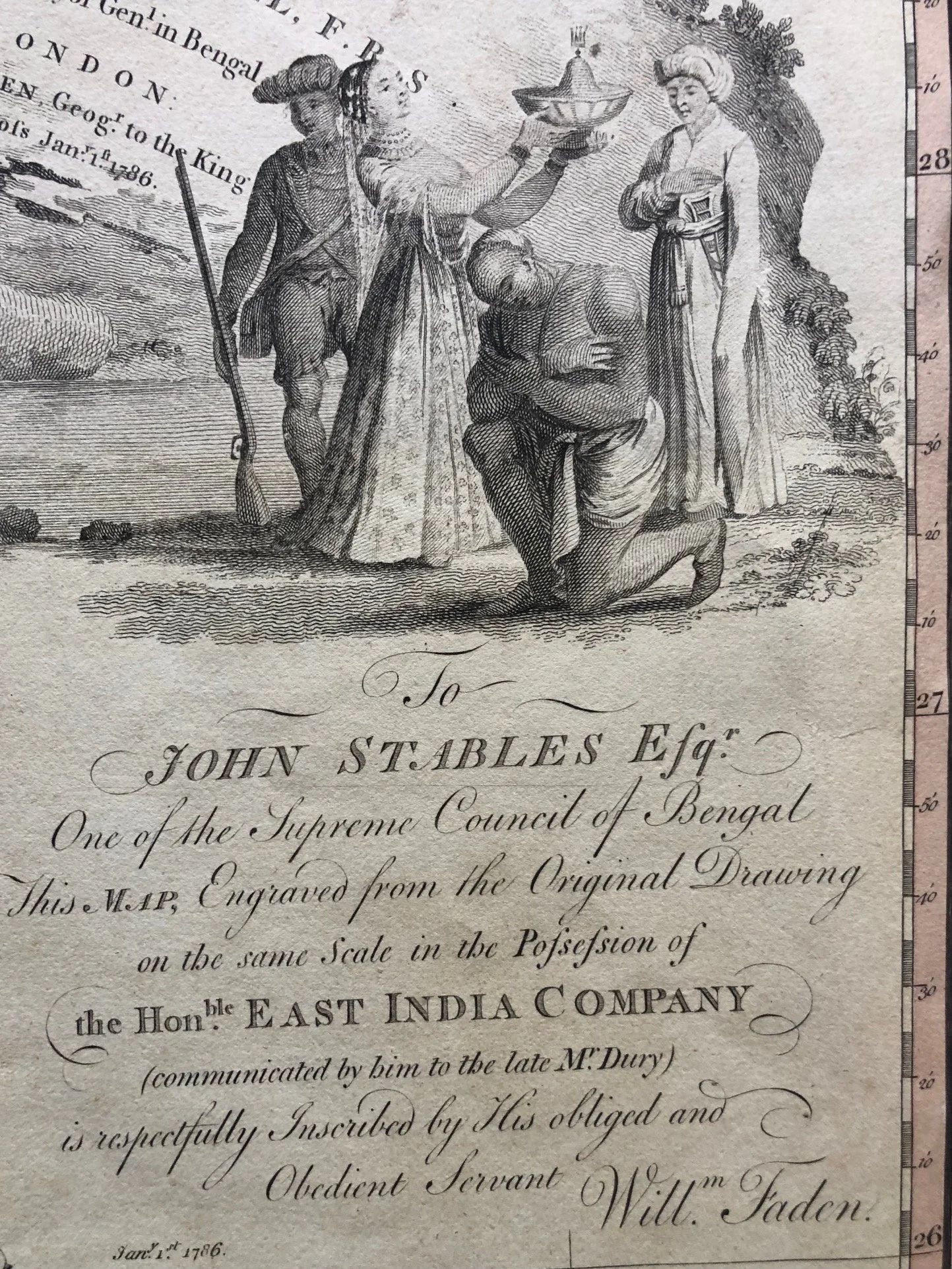
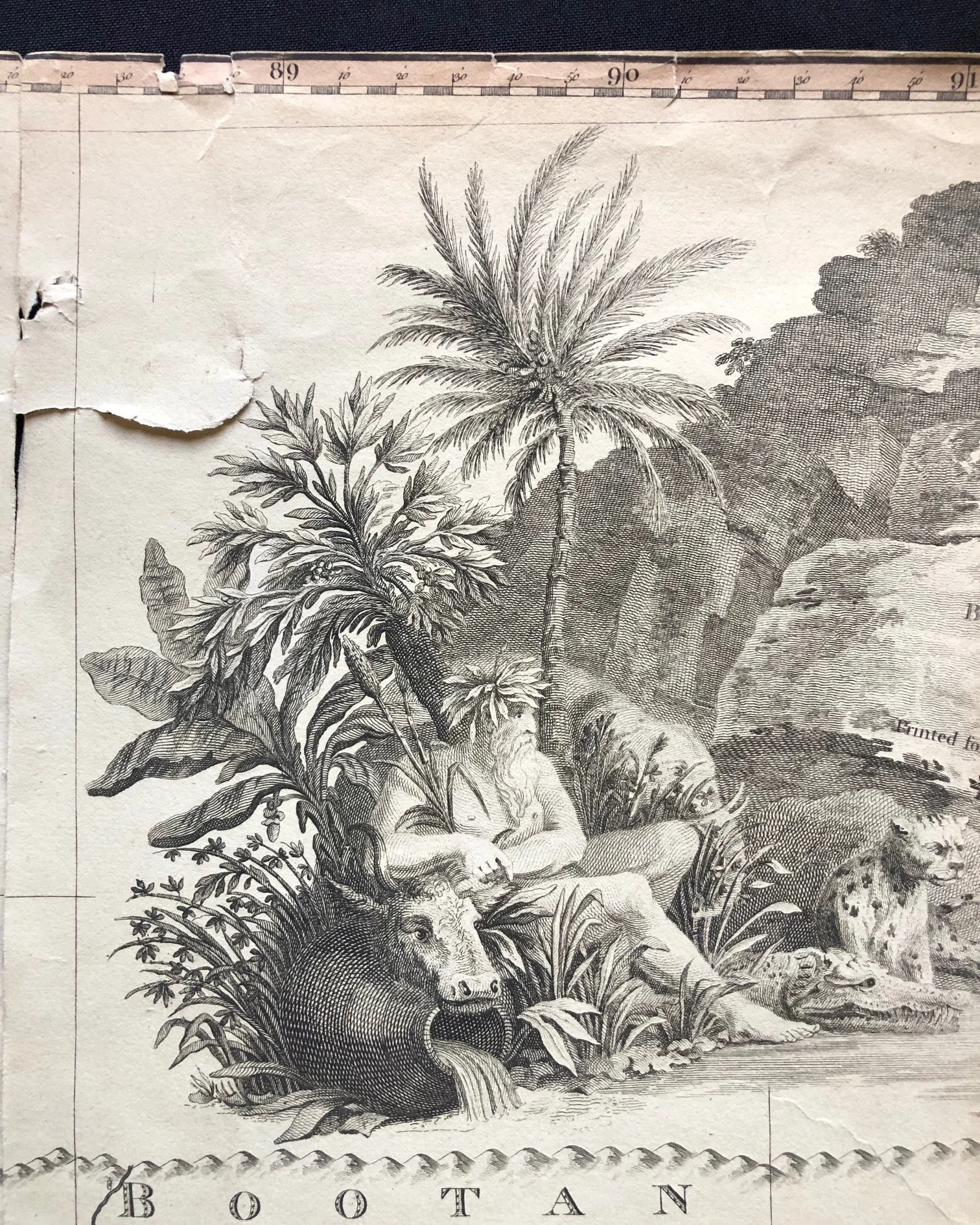
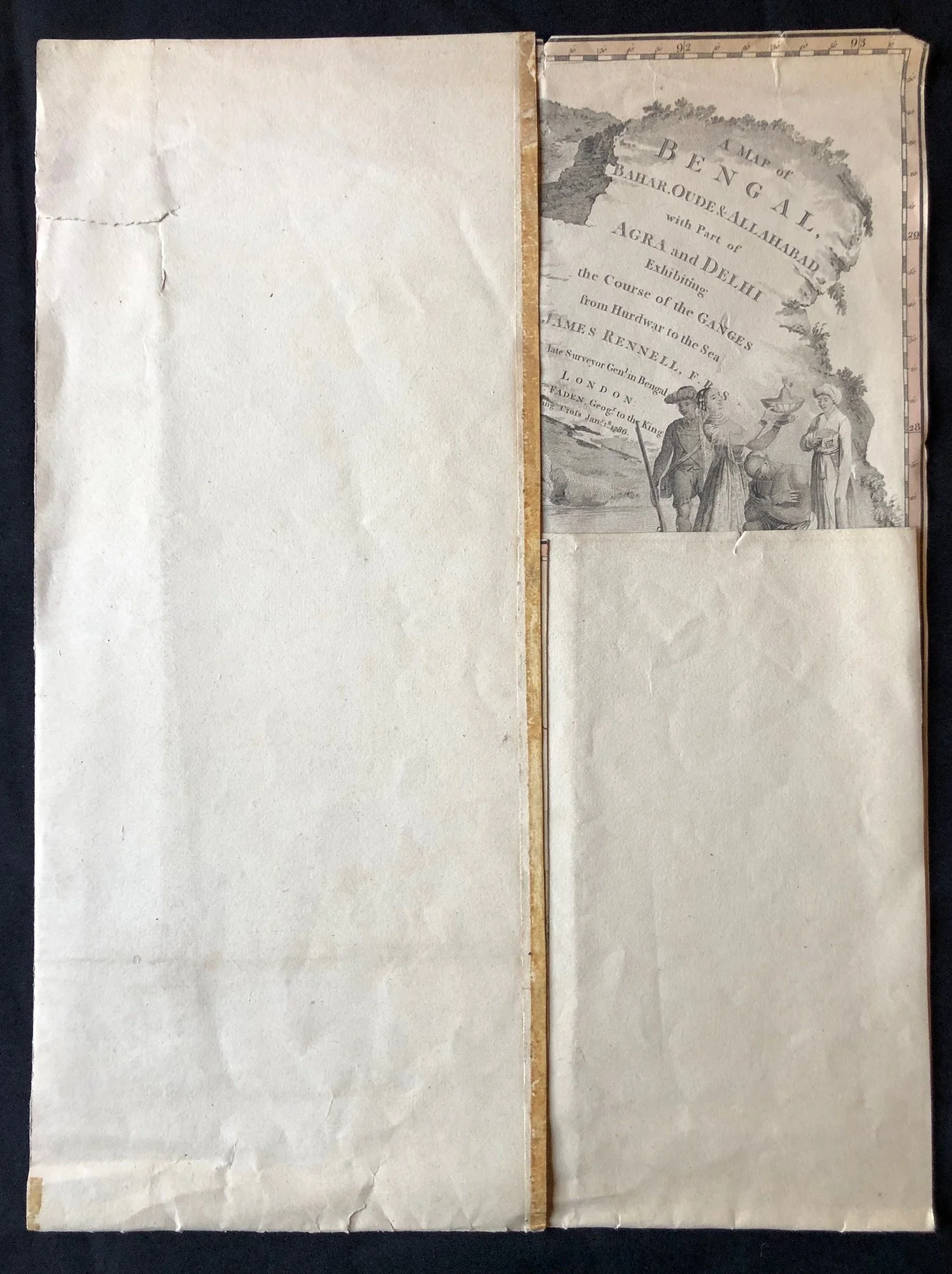
The elaborate pictorial cartouche detailed is a masterclass in 18th-century colonial allegory and propaganda:
The River God: On the left, the Ganges River is personified as a classical European-style river god sitting beneath a palm tree, leaning on an urn pouring out water, surrounded by local fauna like a crocodile and a leopard.
The Submission Scene: On the right, a half-naked Indian figure knees submissively, offering a sacred object or tributary bowl to an elevated European woman (representing Britannia or the East India Company). Behind her stands a British officer or redcoat holding a firearm, while a turbaned figure looks on. This imagery was intentionally designed to legitimize British dominance over Bengal to the public back in London, frames of conquest disguised as "order" and "commerce."
Cartography as an Instrument of Corporate Power
The dedication text reveals the map’s elite corporate origins. It is dedicated to John Stables, a high-ranking member of the Supreme Council of Bengal, and explicitly notes it was engraved from an original drawing in the possession of the Honorable East India Company (EIC).
For the EIC, this map was far more than a geographic reference; it was an indispensable administrative and tax tool. Following the Treaty of Allahabad, the Company gained the Diwani (the right to collect land revenues) over Bengal. Rennell’s precise mapping of villages, boundaries, and rivers allowed the Company to systematically calculate, enforce, and collect massive agricultural revenues.
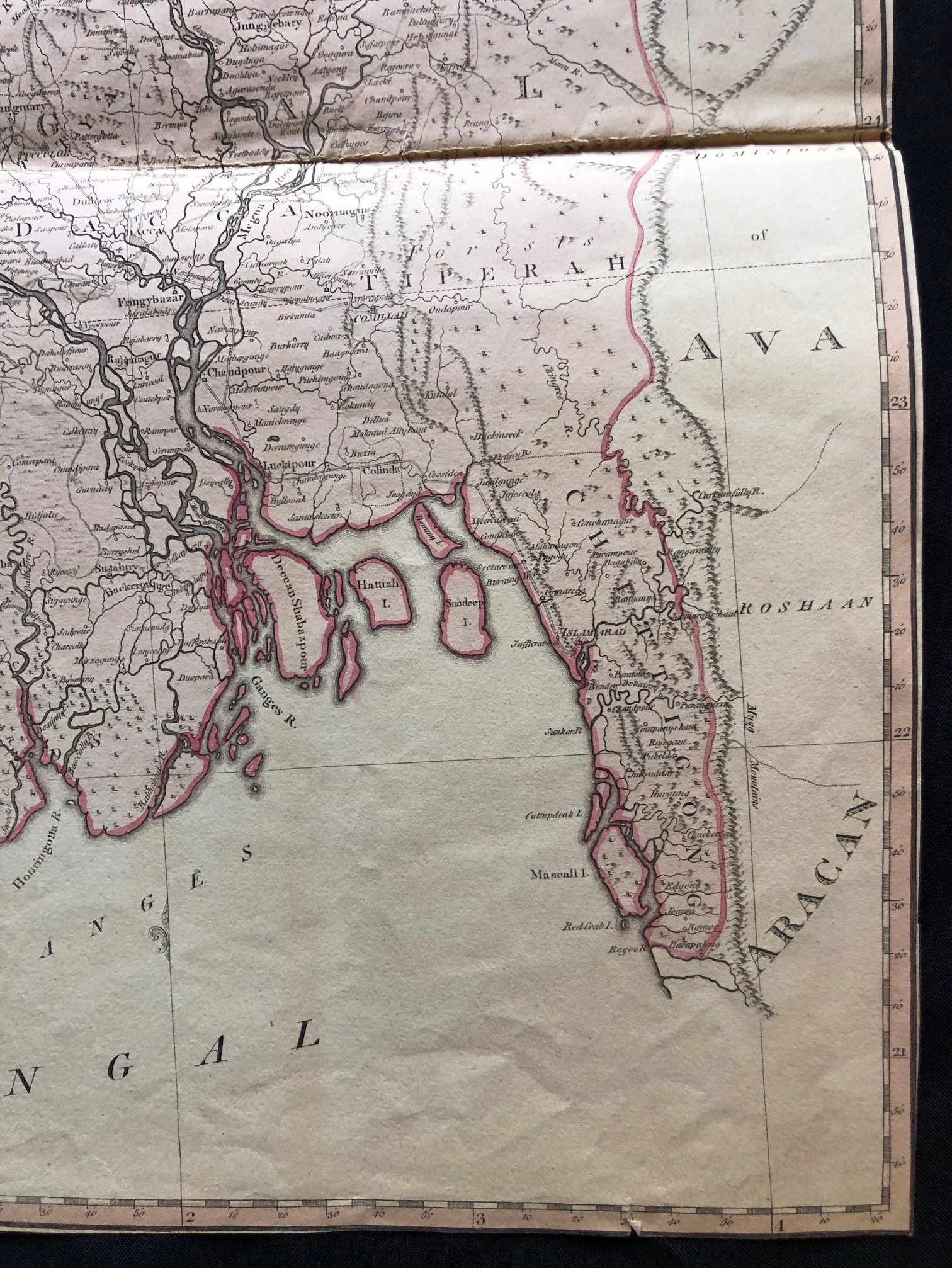
Navigating the Treacherous Ganges Delta
The geographic section illustrates the complex, shifting maze of the Sunderbans and the Ganges Delta, tracking down to the "Bay of Bengal." It maps the eastern frontier regions bordering Ava (Burma/Myanmar) and Aracan (Rakhine). For the British, mastering this specific water network was a massive military and logistical advantage, ensuring that EIC gunboats and cargo vessels loaded with silk, opium, and indigo could navigate safely from interior trading posts out to the global ocean.
540mm x 715mm
Part map only (Incomplete). Worn; faded and in need of repairs. Sold with all faults.
R2,000