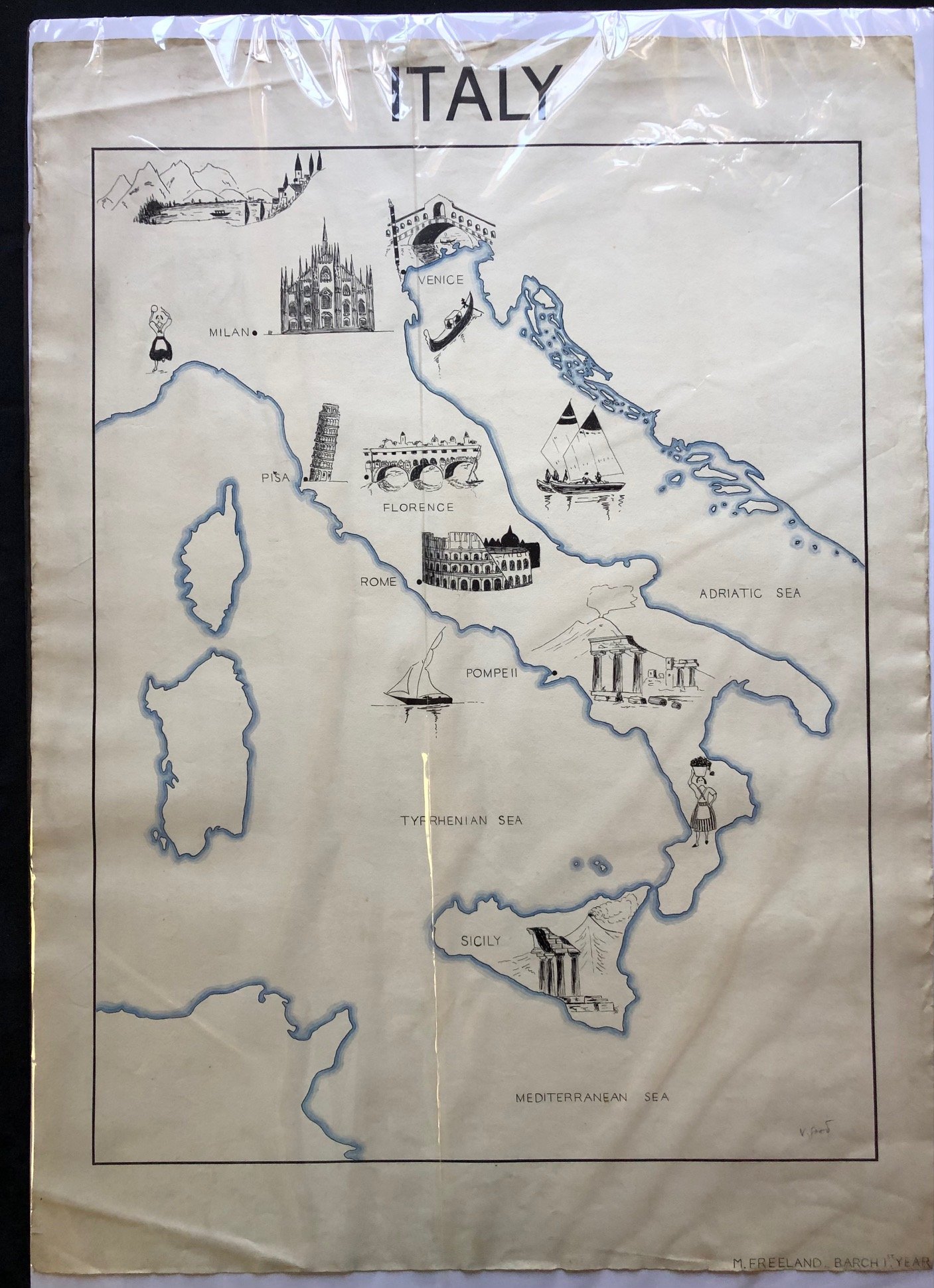
Italy by well-known Johannesburg architect, Malcolm Freeland
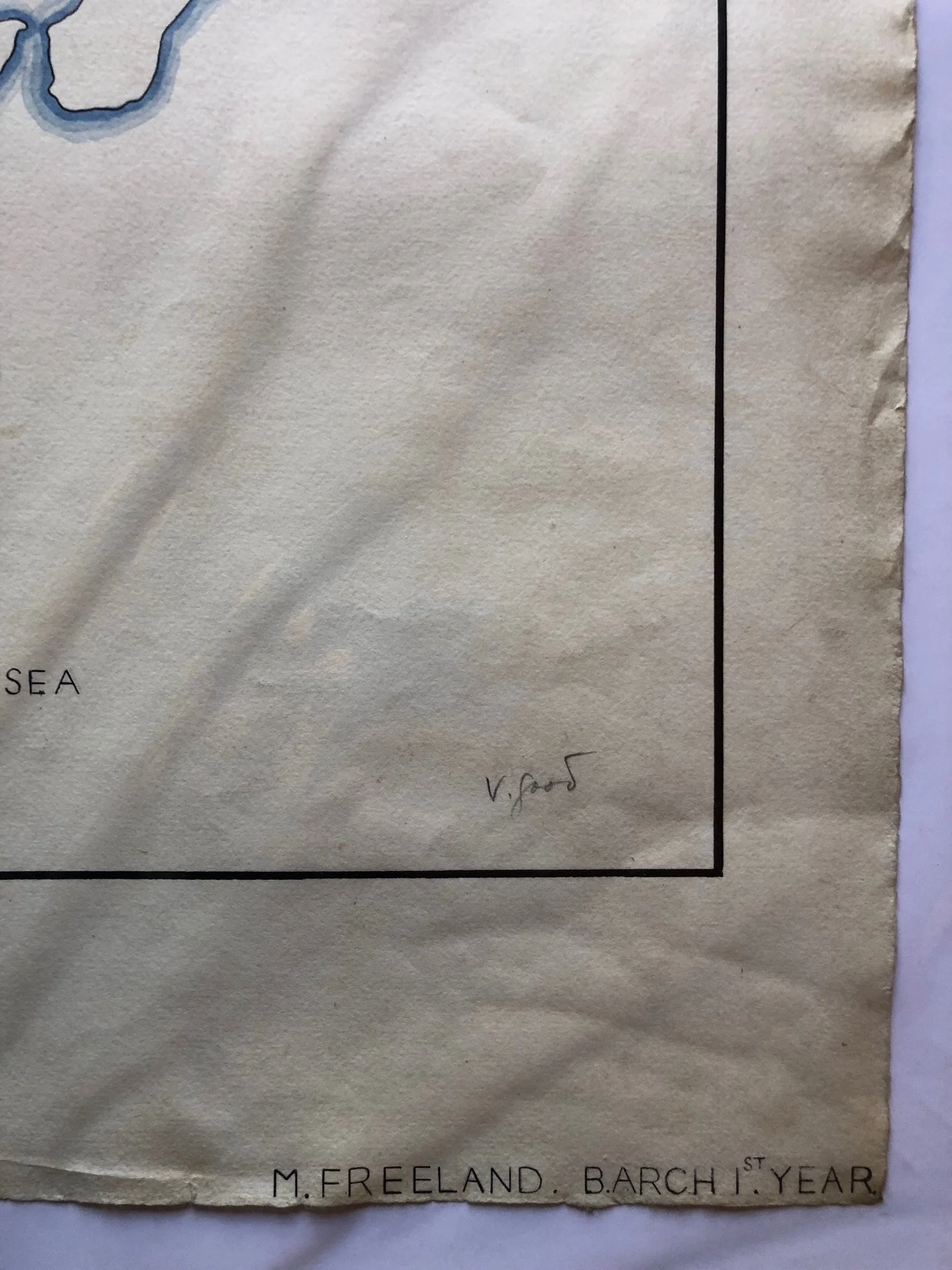
First year student map: "M. FREELAND. B.ARCH 1ST YEAR."
Education & Heritage roots: Born and passed away in the same Upper Houghton family home (1920–2020), Malcolm Freeland studied at St John's College and graduated with a B.Arch from Wits University in 1948.
Professional Career: After working in London, he served the Johannesburg City Council as an architect, town planner, and Aesthetics Officer. He held prestigious international credentials including ARIBA and FRSA.
Market Theatre Contribution: He played a key early role in the adaptive re-use project that converted the historic old Market Hall into Johannesburg's iconic Market Theatre.
Heritage Activism: As a dedicated member of the Parktown and Westcliff Heritage Trust, he vigorously defended old Johannesburg's built environment, conducted architectural tours, and contributed to research publications.
Community Spaces: He was instrumental in securing the municipal lease for the National Children's Theatre across two Parktown heritage houses.
Personal Interests: An eccentric gentleman of "old Joburg," Freeland was an amateur artist, theatre patron, and voracious collector of literature on art, architecture, and Italian travel.
The Mid-Century Grand Tour Exercise
In the early-to-mid 20th century, architectural education heavily emphasized the "Grand Tour" tradition—the historic practice where young architects, artists, and elites traveled through Europe (specifically Italy) to study classical proportions, ruins, and Renaissance masterworks. For a first-year Bachelor of Architecture (B.Arch),
Freeland must have been tasked with creating a highly detailed pictorial map of Italy's architectural landmarks was a standard academic exercise to familiarize themselves with the foundations of Western architecture.
A Masterclass in Traditional Drafting Techniques
Before the advent of computer-aided design (CAD), first-year architecture students spent months mastering manual graphic presentation. The map serves as a perfect portfolio piece of these rigorous discipline standards:
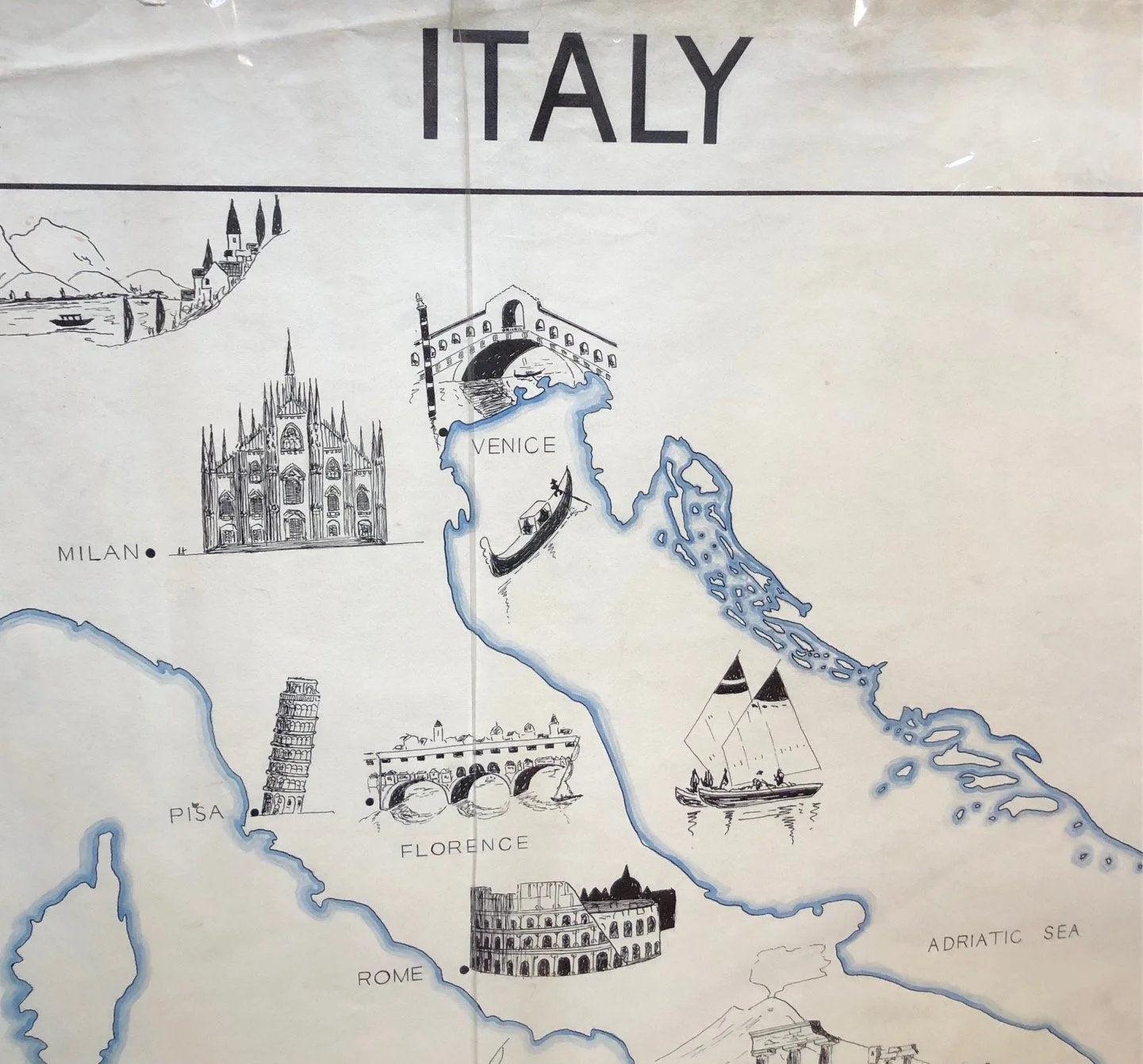
Architectural Lettering: The title "ITALY" and the city labels use precise, hand-drawn sans-serif lettering characteristic of mid-century modernist drafting styles.
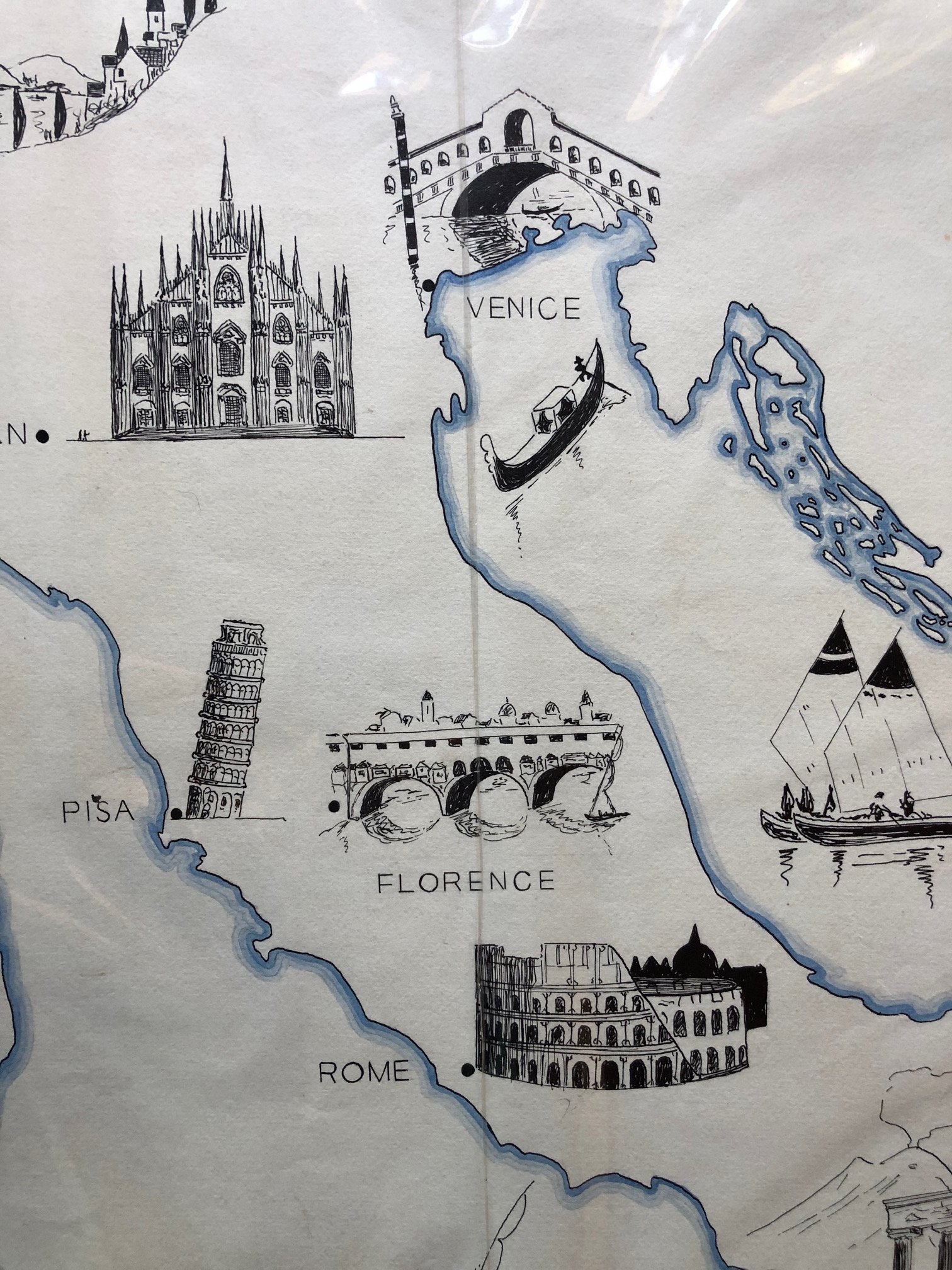
Line Weight & Hachuring: Notice how Freeland uses varying line weights to separate the coastline from the deep blue ink-wash gradient. The vignettes themselves—like the Milan Cathedral (Duomo), the Rialto Bridge in Venice, and the Colosseum in Rome—are executed using precise pen-and-ink stippling and cross-hatching to denote shade and texture.
The Pictorial Map Movement
The style of this drawing heavily mirrors the Pictorial Map Movement that boomed from the 1930s to the 1950s. Led by cartographers and illustrators who rejected cold, purely mathematical geography, this movement favored maps filled with narrative, history, and architectural icons. Freeland has perfectly captured that cultural zeitgeist, turning a geographic layout into a curated cultural syllabus of Italy—from the smoking peak of Mount Vesuvius over Pompeii to the classical Greek temples of Sicily.
575mm x 785mm
R2,500