Denis Santry - Sinn Féin and the German Empire (1947)
Written from "Slamat" on Hospital Road in Hill Crest, Natal, on October 27th, 1947, connecting a prominent South African political cartoonist to a crucial, dramatic moment in the 1918 Irish independence movement.
The "German Plot" of 1918
The writer describes an enclosed historic sheet given to him by an officer in the Monmouthshire Regiment (the "Monmouths"), who had custody of a group of Sinn Féin leaders when they "landed in England" and were "handed... over to the jail."
This refers to a massive historical flashpoint in May 1918 known as the "German Plot." The British administration in Ireland claimed to have discovered a treasonous conspiracy between Sinn Féin and the German Empire to launch a second armed uprising (following the 1916 Easter Rising). While largely manufactured or heavily exaggerated by the British to justify crushing the nationalist movement, it resulted in the overnight, sweeping arrest of over 100 top Irish leaders on May 17–18, 1918.
The sheet mentioned (not present here) in this note was signed by those legendary prisoners right as they arrived under armed guard at their place of internment in England.
A Who’s Who of Irish Revolutionaries
The letter explicitly names the signatures captured on that historic page, highlighting the staggering importance of the prisoners:
Éamon de Valera: Described in 1947 as the "now President of Éire." De Valera was the senior surviving commander of the 1916 Easter Rising, the political leader of Sinn Féin, and would become the defining political titan of 20th-century Ireland.
Arthur Griffith: Described by the writer as "the founder of the Sinn Féin movement, a very great man." Griffith was a brilliant journalist and politician who later served as the President of Dáil Éireann and led the Irish delegation that negotiated the 1921 Anglo-Irish Treaty. He died tragically of a cerebral hemorrhage in 1922 during the outbreak of the Irish Civil War.
Darrell Figgis: A "distinguished novelist" and fiery nationalist who famously helped orchestrate the Howth gun-running operation in 1914. A marginal note on the letter correctly adds the tragic, somber detail: "Both dead," pointing to the early, volatile deaths of both Griffith and Figgis (who died by suicide in 1925).
Dr. James Dillon: Identified here as the son of the veteran Irish Parliamentary Party leader, John Dillon.
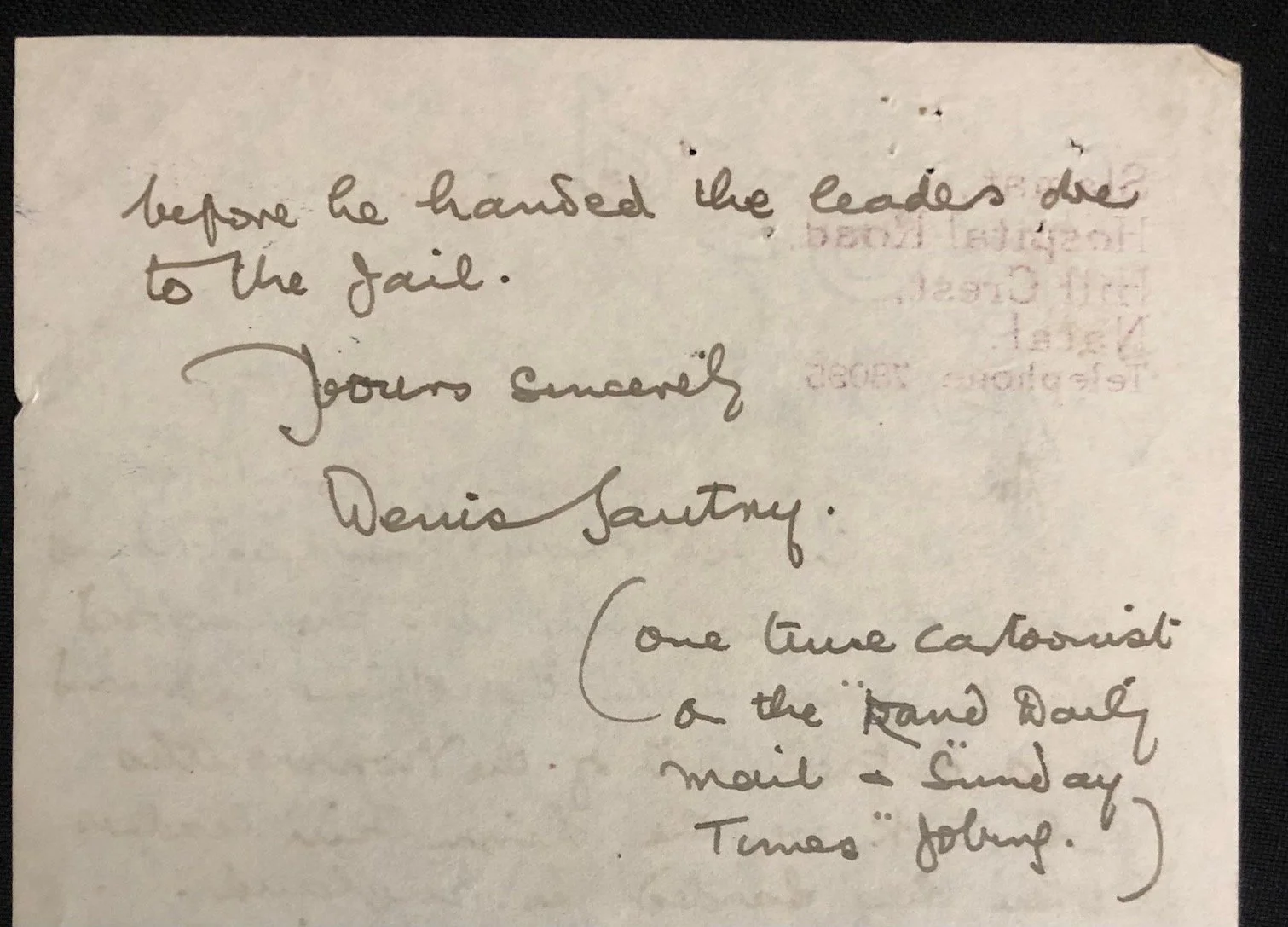
The signature belongs to Denis Santry, who helpfully annotates his own legacy:
"(One time cartoonist on the 'Rand Daily Mail' & 'Sunday Times' Joburg.)"
Santry was an immensely influential Irish-born architect, artist, and political cartoonist who left an indelible mark on South African media. Working under the pseudonym "Adam" in the early decades of the 20th century, his sharp, satirical drawings for the Rand Daily Mail and the Sunday Times in Johannesburg provided a biting commentary on South African politics, imperial relations, and the labor strikes of the Witwatersrand.
By 1947, Santry was retired and living in the KwaZulu-Natal hills, reading about a "Mr. Bennett" who had featured his own antique autograph collection in the previous day's Sunday Tribune. Recognizing a fellow custodian of history, Santry generously decided to gift him this extraordinary relic of Irish history.
Summary of the Text
For your catalog or research records, here is the full transcription:
Slamat,
Hospital Road,
Hill Crest,
Natal.
Telephone 78095. Oct 27th. 1947
Dear Mr Bennett,
An account of your "interesting collection" in yesterday's "Sunday Tribune" prompts me to send you the enclosed sheet given me by the officer in command of a detachment of the Monmouths who took over the Sinn Fein leaders when they landed in England.
The sheet has the signatures of de Valera, now President of Éire, [Bracketed: Darrell Figgis a distinguished novelist, Arthur Griffiths the founder of the Sinn Fein movement, a very great man / Marginal note: Both dead], and Dr Dillon (son of the old Irish Leader John)
If it is of any use to your autograph collection please keep it. If not — post it back to me.
The page of the Mirror was published the morning of their arrival in England and signed for my friend of the Monmouths
before he handed the leaders over to the jail.
Yours sincerely,
Denis Santry.
(One time cartoonist on the "Rand Daily Mail" & "Sunday Times" Joburg.)
Manuscript letter; pin holes; small tears and creased.
115mm x 180mm
R1,250