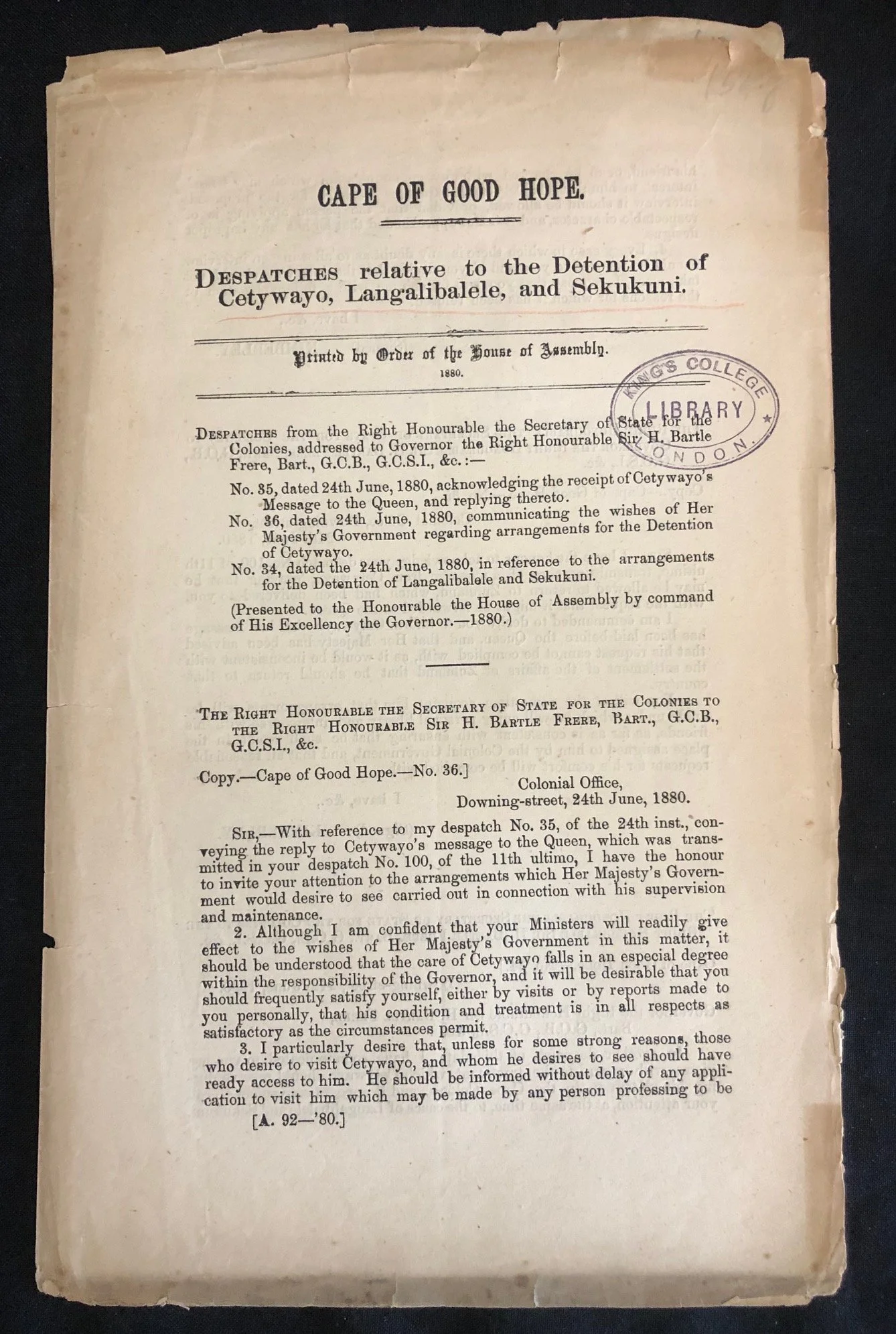
The Detention of Cetywayo, Langalibalele and Sekukuni (1880)
This 1880 Cape of Good Hope government blue-book captures a singular moment when the British Empire had simultaneously imprisoned the three most formidable independent traditional leaders of Southern Africa: King Cetshwayo kaMpande of the Zulu, Inkosi Langalibalele of the Hlubi, and Kgosi Sekhukhune of the Pedi.
Printed by order of the House of Assembly in 1880, these despatches between the Secretary of State for the Colonies (Lord Kimberley) and the Governor of the Cape (Sir Henry Bartle Frere) reveal the nervous, high-level administrative management of three "state prisoners" whose kingdoms had just been shattered to make way for British confederation.
A Triumvirate of Imperial Resistance
The title explicitly links three men who, up to this point, had fought completely separate wars against colonial encroachment. By 1880, the British had consolidated them into a single administrative headache:
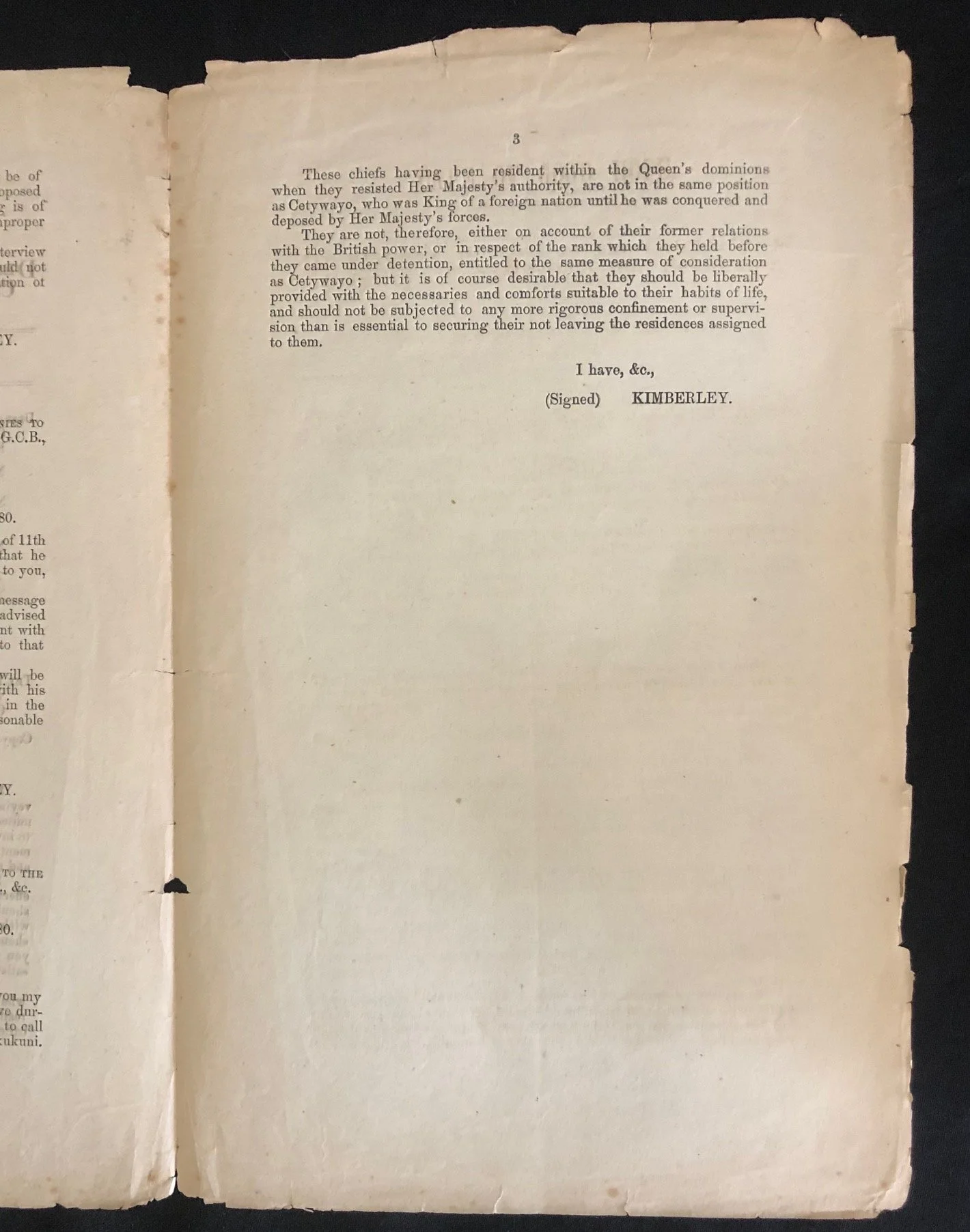
Langalibalele had been arrested in 1873 after a standoff over unregistered firearms in Natal. His trial was so widely criticized as a mockery of justice that the British government stepped in, stripping Natal of its immediate control over him and exiling him to the Cape's Robben Island.
Sekhukhune had brilliantly defended his mountain stronghold in the Transvaal against both the Boers and the British, only to be defeated in late 1879 by a massive force led by Sir Garnet Wolseley (heavily assisted by Swazi allies).
Cetshwayo was captured in the forests of Zululand in August 1879 following the Anglo-Zulu War—a conflict orchestrated by the very recipient of this letter, Sir Bartle Frere, who had manufactured a war to force the Zulu Kingdom into submission.
Cetshwayo’s Banned Homecoming
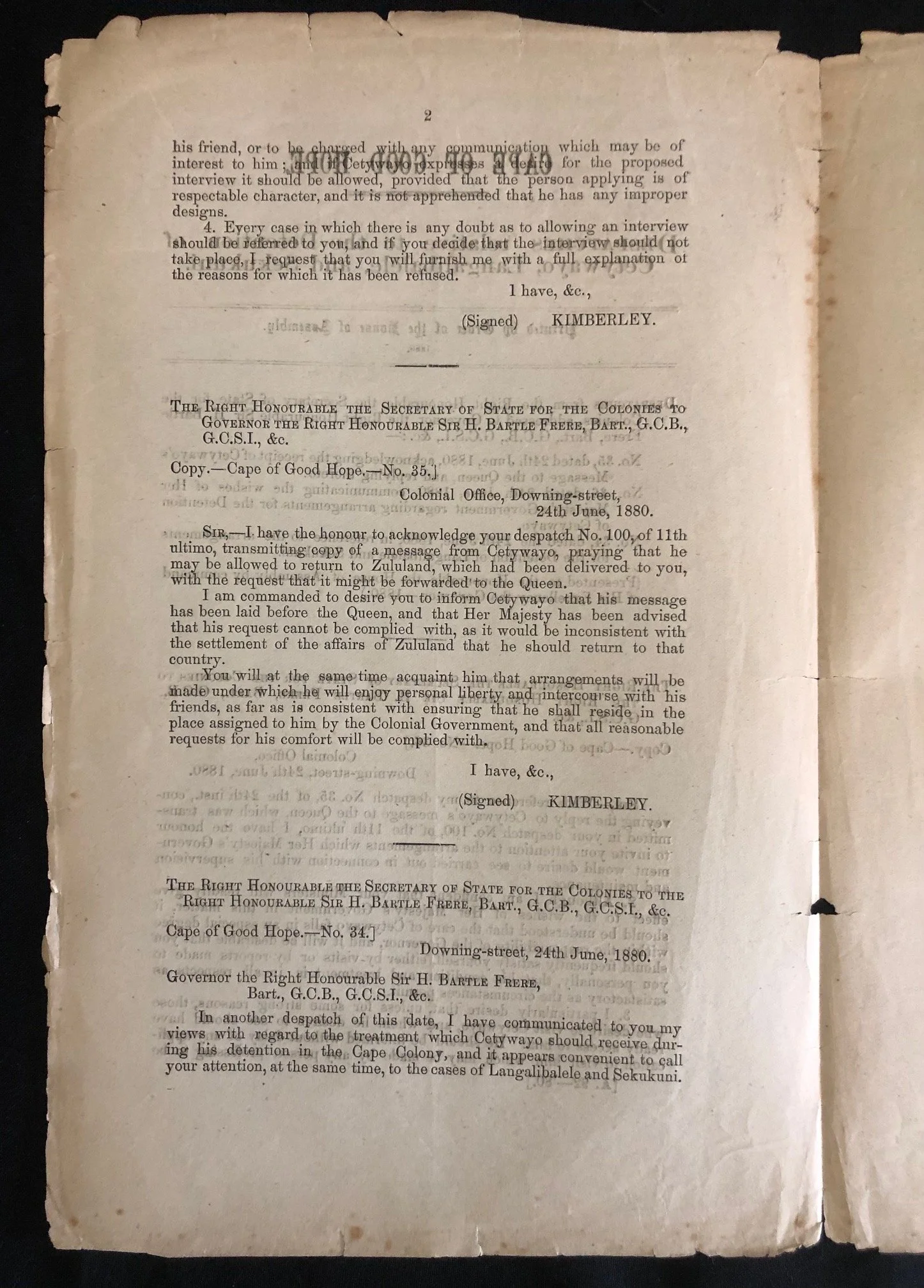
In (Despatch No. 35), Lord Kimberley references a direct appeal from the captured Zulu King:
"...transmitting copy of a message from Cetywayo, praying that he may be allowed to return to Zululand, which had been delivered to you, with the request that it might be forwarded to the Queen."
The British response is unyielding: Queen Victoria has been advised that returning Cetshwayo to his homeland "would be inconsistent with the settlement of the affairs of Zululand." Instead of executing or executing absolute secrecy on him, they opted to isolate him, keeping him under lock and key at Oude Molen farm near Cape Town. (Crucially, Cetshwayo’s diplomatic persistence did eventually pay off; he was allowed to travel to London in 1882 to plead his case directly to the Queen, resulting in a brief, volatile restoration).
The Irony of "Comfort" and "Access" under Custody
The document reads with the classic, polite euphemisms of Victorian bureaucracy. It insists that Cetshwayo be treated with care, ensuring that "those who desire to visit Cetywayo, and whom he desires to see should have ready access to him."
However, later the document reveals the strict security paranoia beneath the hospitality. Kimberley notes that visitors must be of "respectable character" and free of "improper designs." If there is any doubt, the visit must be blocked and a full explanation sent back to London. The British were terrified that European sympathizers (like Bishop John Colenso) or Zulu royalists would use these visits to orchestrate political resistance or legal challenges to the annexation of Zululand.
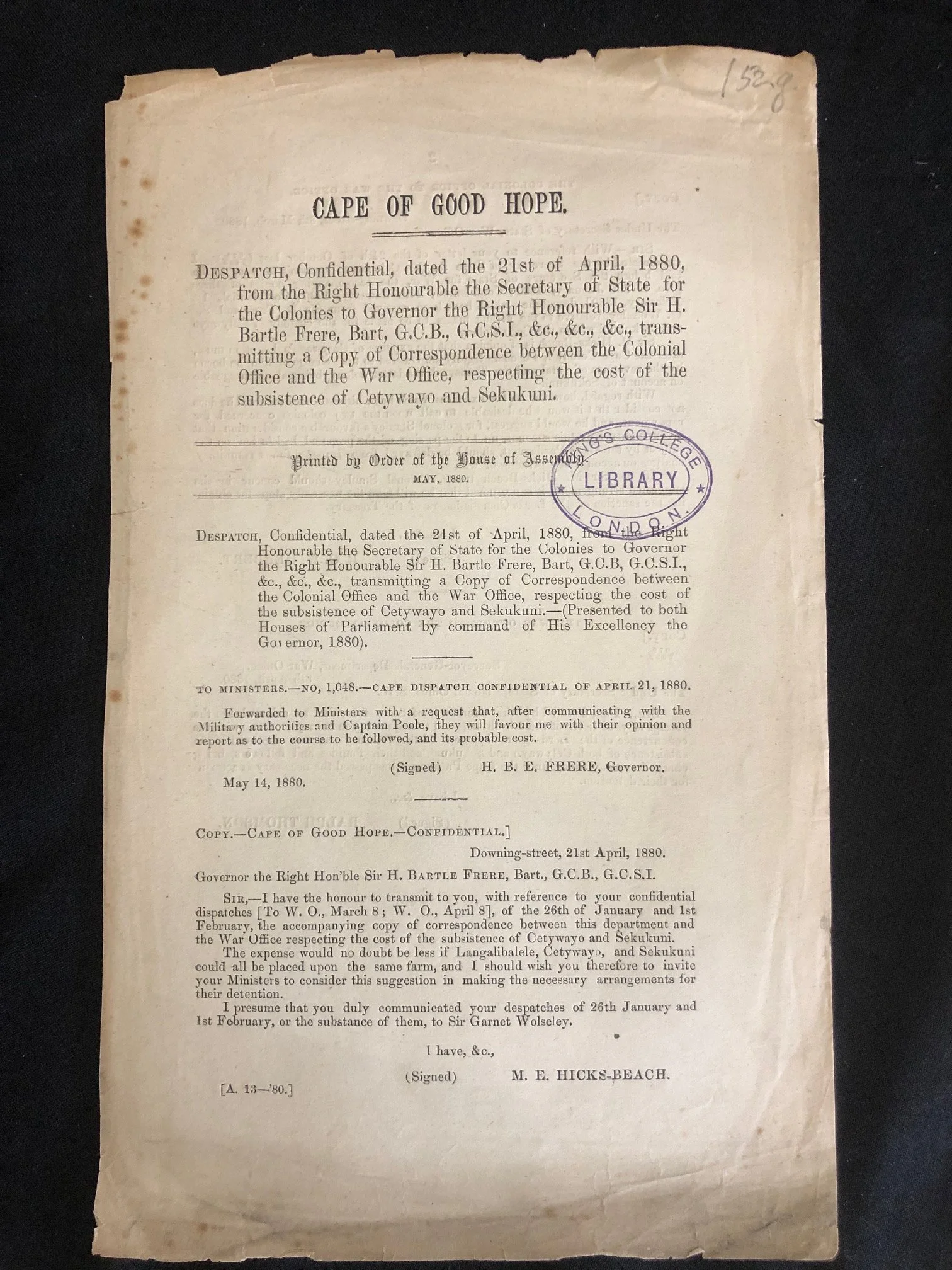
Provenance: The King's College Stamp
The cover page bears the prominent oval library stamp of King's College London. This means this specific copy was sent from the colonies straight back to the heart of metropolitan London for academic, political, or legal scrutiny during the height of the late-19th-century "Scramble for Africa."
4 pages + 2 pages of a separate page. All are foxed; creased and stained.
205mm x 330mm
R2,000