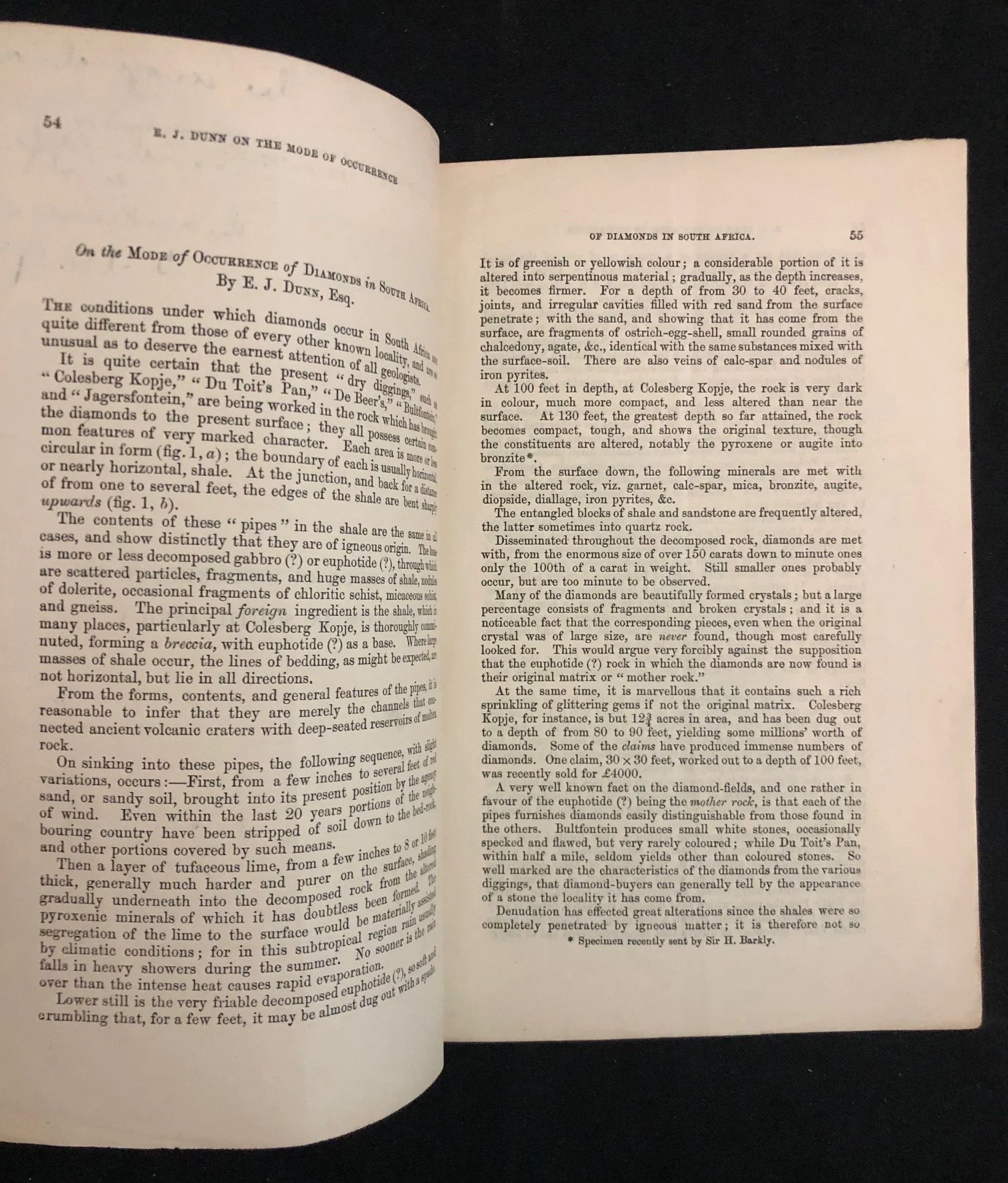
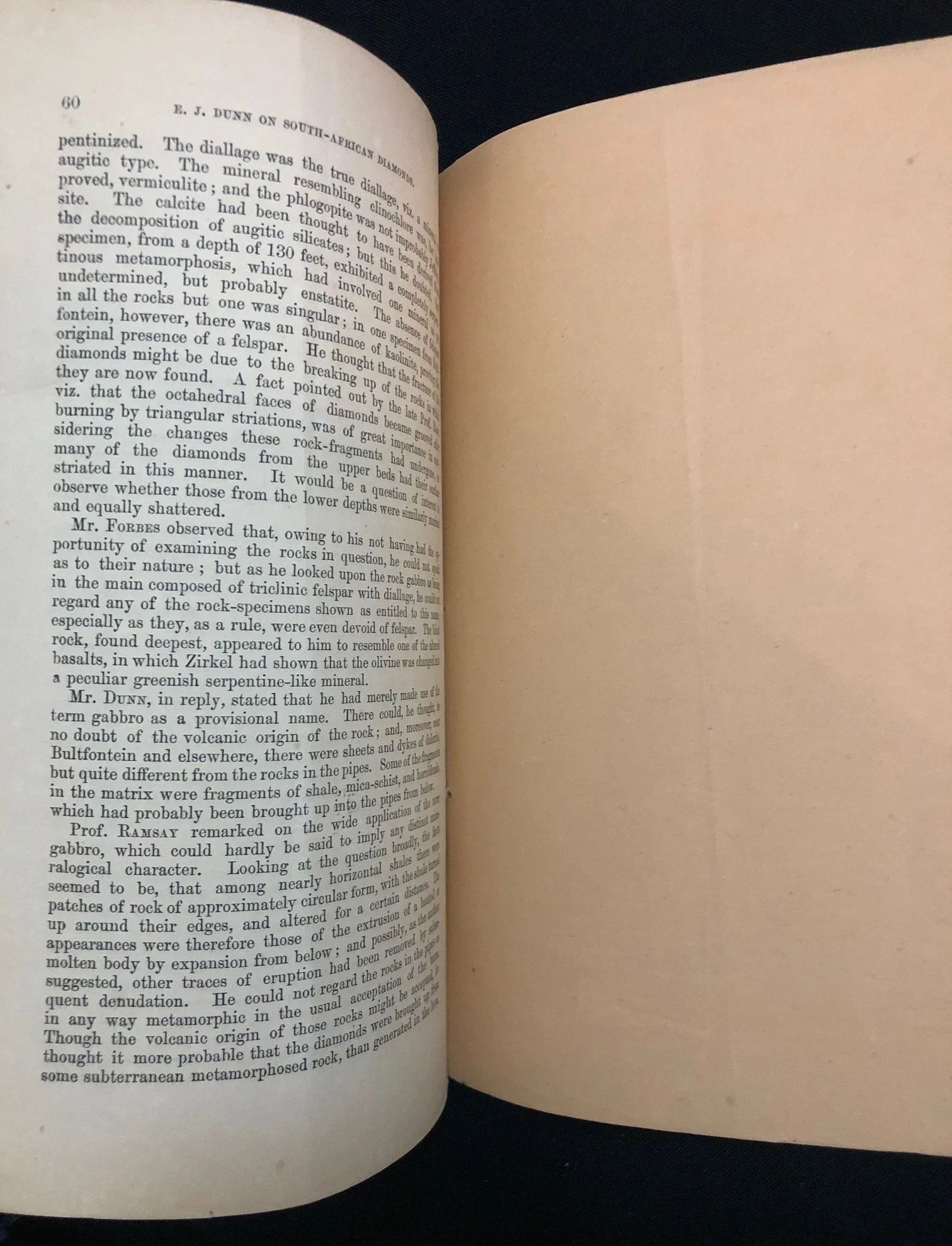
Edward John Dunn’s paper, On the Mode of Occurrence of Diamonds in South Africa, Inscribed (1874)
Edward John Dunn’s 1874 paper, On the Mode of Occurrence of Diamonds in South Africa (published in the Quarterly Journal of the Geological Society), represents a watershed moment in geological science and mining history.
First Correct Volcanic Pipe Theory: Dunn was among the very first geologists to correctly theorize that the diamond-bearing deposits at Kimberley (such as Colesberg Kopje/the Big Hole, Du Toit's Pan, and Bultfontein) were non-eruptive, deep-seated volcanic pipes or "necked ancient volcanic craters" connecting deep reservoirs of molten rock to the surface.
Precursor to "Kimberlite": At the time of this publication (1874), the exact rock matrix had not yet been formally named. Dunn tentatively identified the decomposed diamond-bearing host rock as "gabbro" or "euphotide." It was not until 1887 that Henry Carvill Lewis formally coined the term kimberlite for this igneous rock, building directly on the groundwork laid by Dunn's early field mapping and petrological descriptions.
Association with Sir Henry Barkly: The footnote on page 55 notes a specimen sent by "Sir H. Barkly." Sir Henry Barkly was the Governor of the Cape Colony (1870–1877) and an avid patron of natural sciences, actively facilitating geological reports during the initial, chaotic rush of the Griqualand West diamond fields.
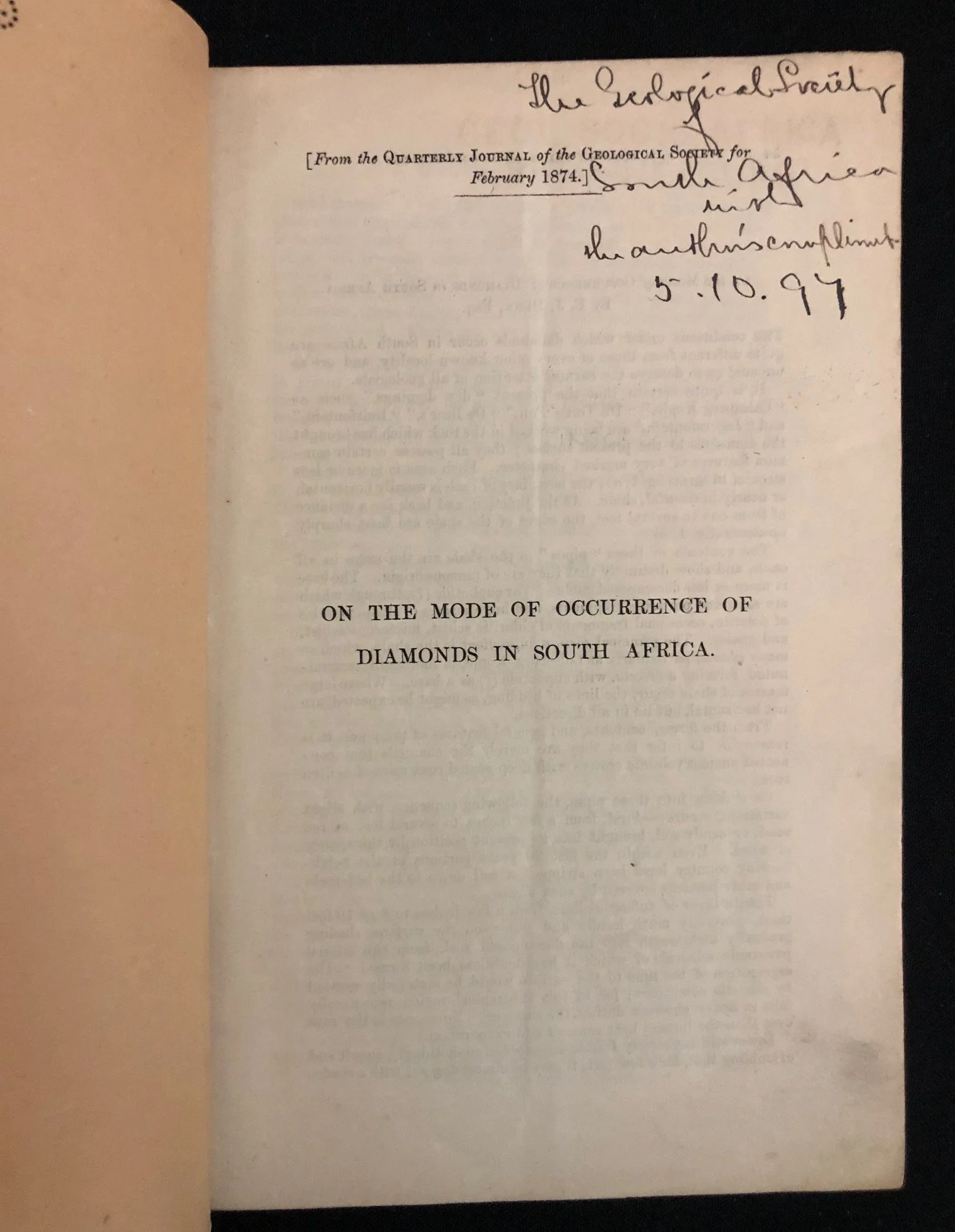
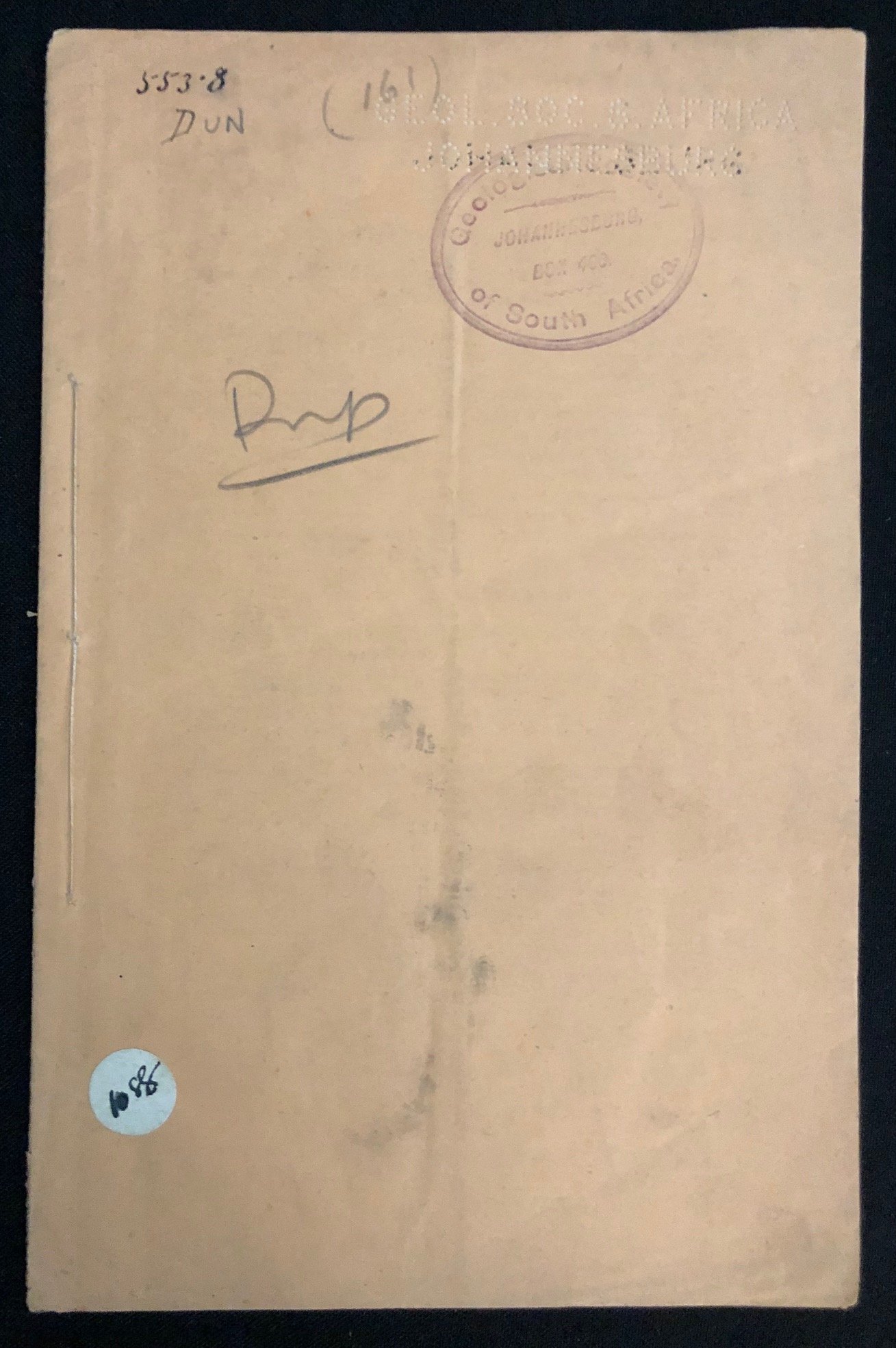
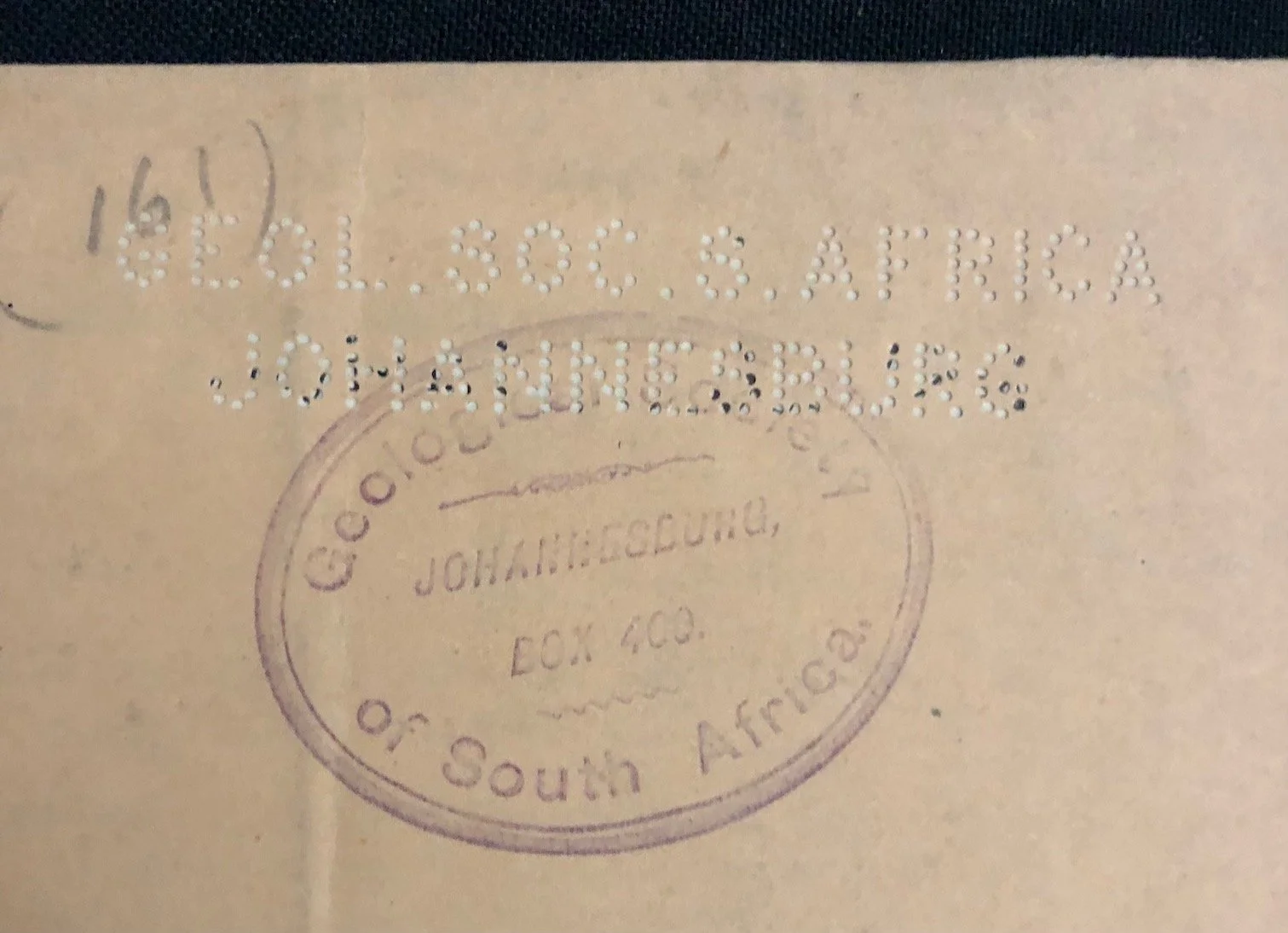
Provenance & Presentation Inscription: The title page bears the hand-written inscription "The Geological Society of South Africa with the author's compliments 5.10.97", alongside the blind stamp and ink stamp of the Geological Society of South Africa (Johannesburg, Box 400). Dunn presented this offprint directly to the GSSA in October 1897—just two years after the Society was officially founded in Johannesburg in 1895—making this copy a piece of institutional South African geological heritage.
Ex library copy, with stamps and perforations etc.
60 pages; complete; inscribed in 1897; paper wrappers.
140mm x 220mm
R2,500 Sold Sept ‘26