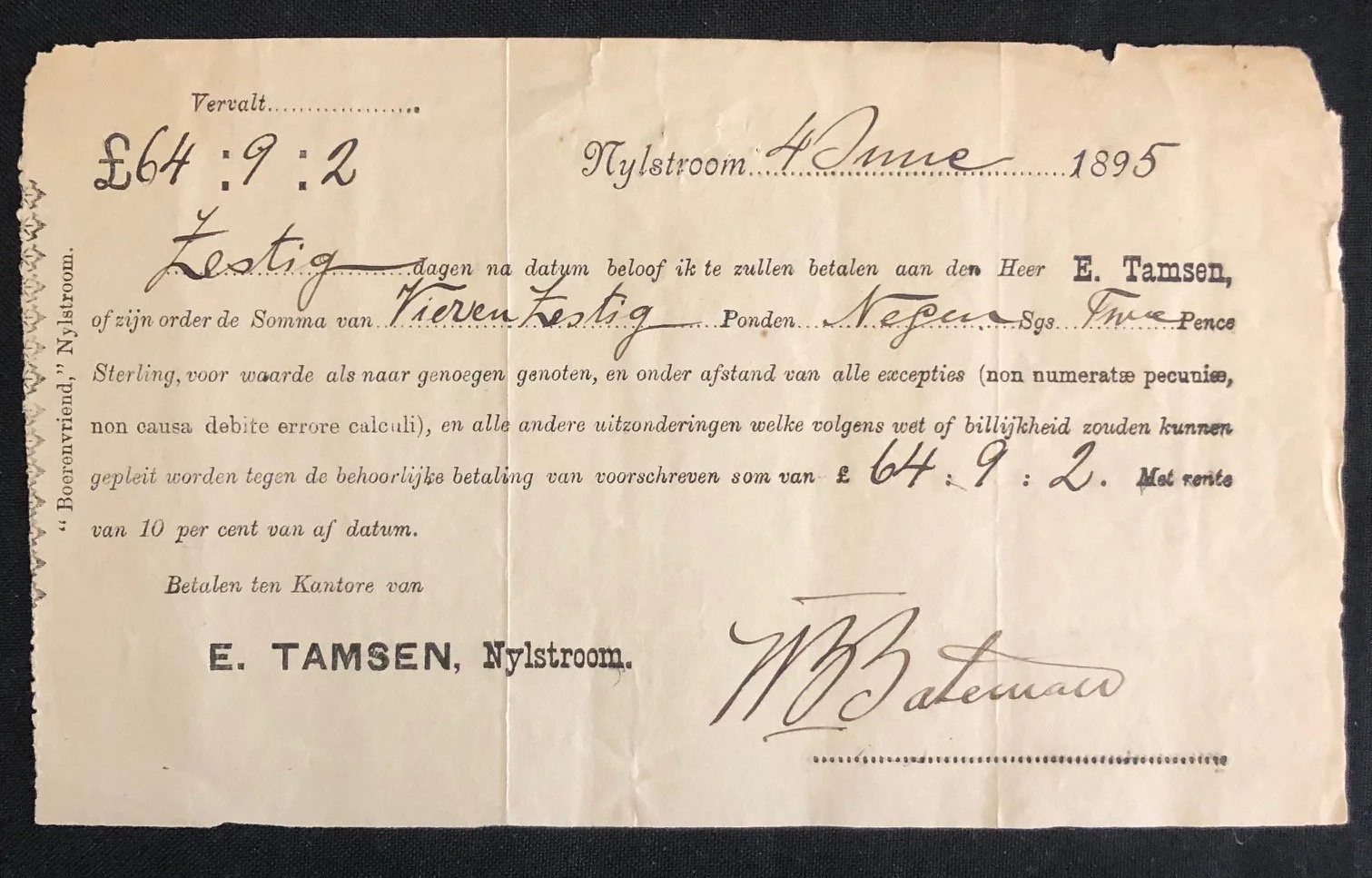
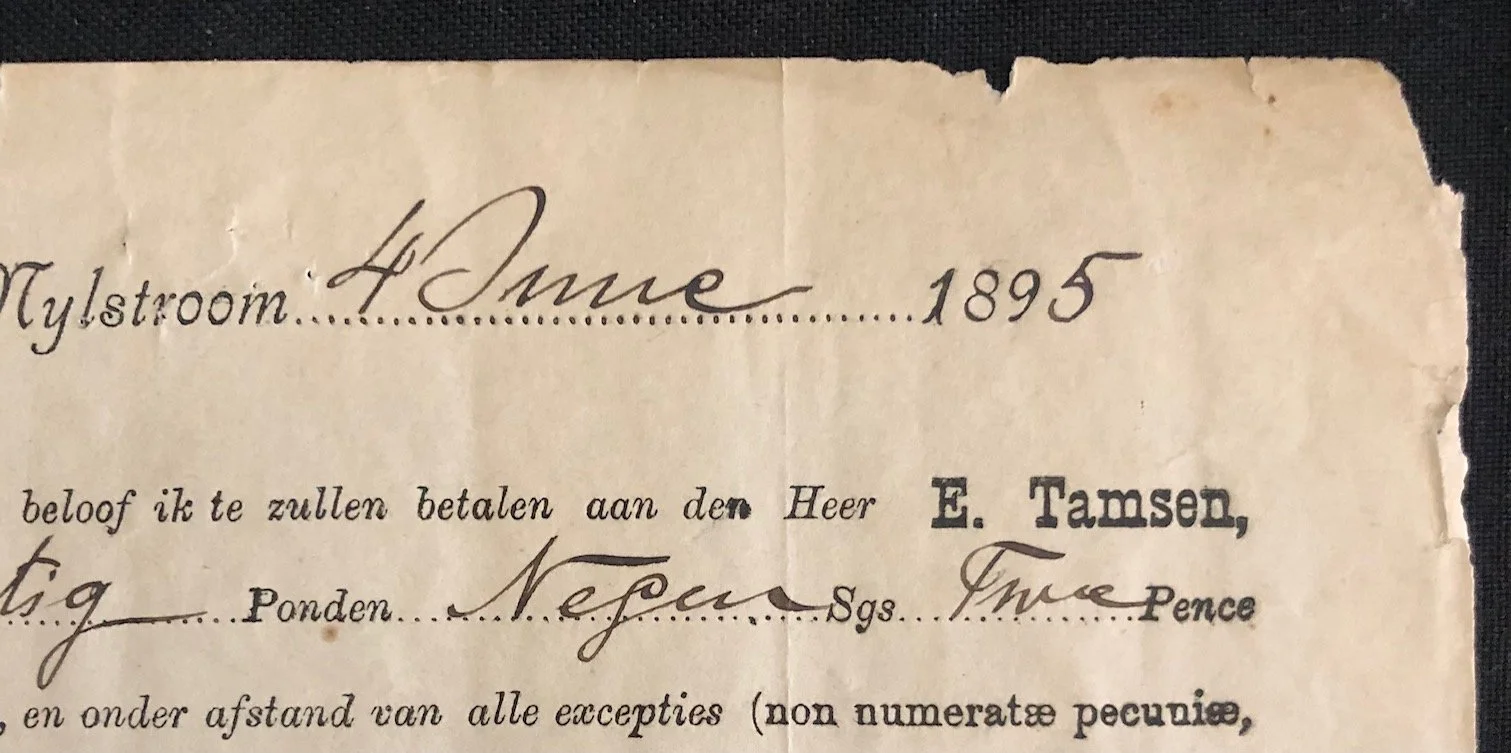
Promissory Note made out to Emil Tamsen, the "Father of Transvaal Philately" (1895)
This promissory note from June 1895, carries a wonderful connection to the early history of the South African Republic (ZAR) and a legendary figure in international philately.
Emil Tamsen, the "Father of Transvaal Philately"
The document is made out to "den Heer E. Tamsen" (Mr. E. Tamsen) of Nylstroom (now Modimolle). This is Emil Carl Christiaan Tamsen (1862–1957), a highly prominent pioneering trader, freemason, and one of the most famous stamp collectors in South African history.
The Nylstroom Pioneer: When Tamsen moved to the Waterberg region in 1883, Nylstroom consisted of roughly 25 families. He set up a successful transport and trading business, later becoming the town's mayor in 1905.
The Philatelic Legend: Tamsen leveraged his remote location and his personal friendships with President Paul Kruger and Postmaster General Friederich Jeppe to build a world-class stamp empire. He was granted unique access to new Transvaal issues and even bought out the contents of the ZAR's dead letter office to hunt for rare surcharges. Between 1899 and 1905, he sold over £7,000 worth of stamps at London auctions (millions in today's terms)—all managed from the remote Transvaal veldt. In 1921, he was honored as an original signatory to the prestigious Roll of Distinguished Philatelists in Great Britain.
Roman-Dutch Legal Safeguards
The text is written in late 19th-century Dutch, the official language of the ZAR, and contains standard but fascinating legal boilerplate safeguarding the transaction under Roman-Dutch law. It explicitly states that the borrower waives specific legal exceptions:
Non numeratae pecuniae: A defense where a debtor could claim they signed the note but never actually received the underlying money.
Non causa debiti errore calculi: A defense claiming there was no real underlying debt or that a calculation error occurred.
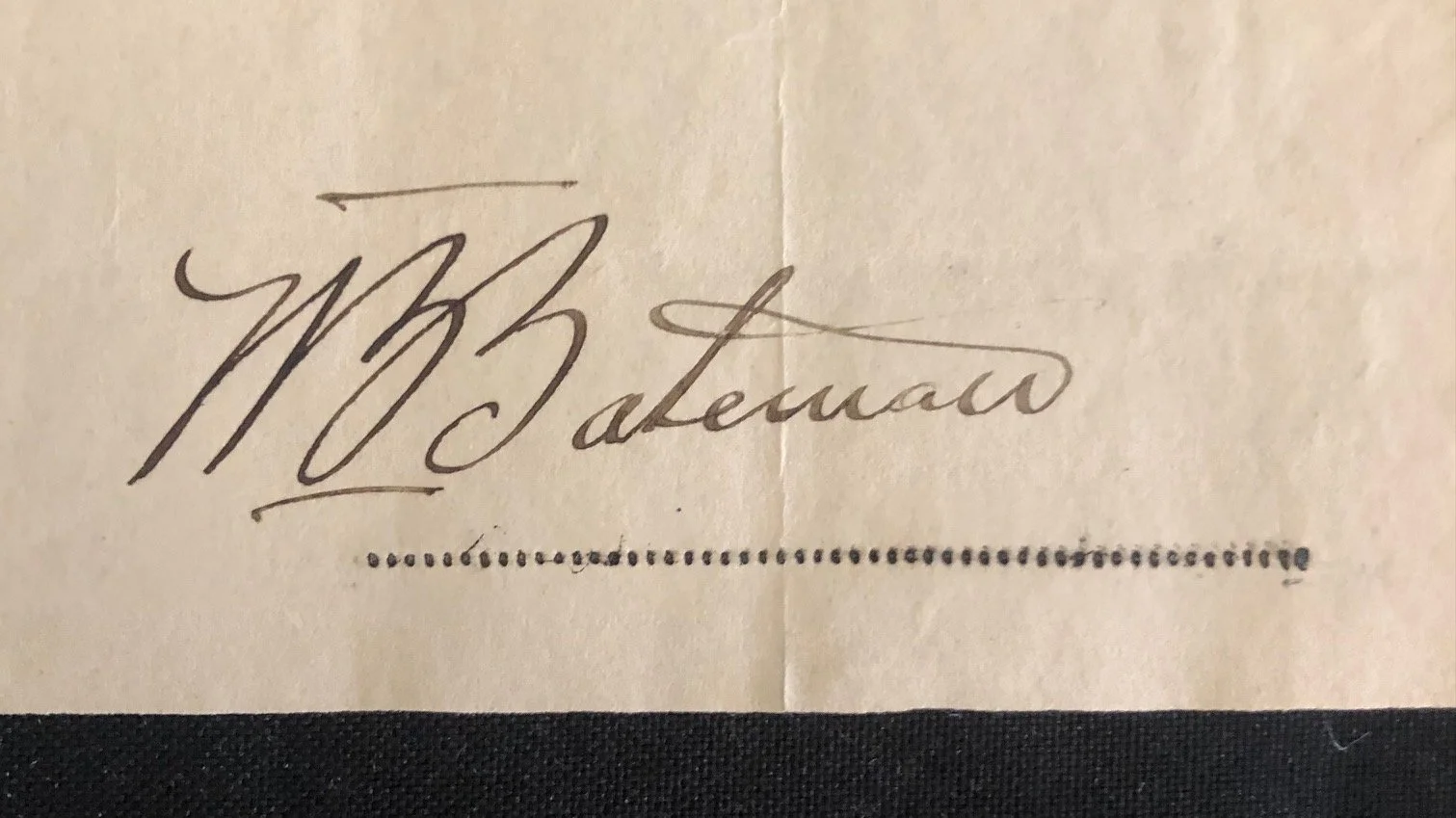
By explicitly waiving these ("onder afstand van alle excepties..."), the signer, W. B. Bateman, locked himself into the debt without any room for technical legal backpedaling.
Local Printing Ephemera
On the far-left margin, you can see the printer's credit: "Boerenvriend," Nylstroom.
De Boerenvriend was a local newspaper and printing press operating in the district. Finding small-town commercial printing ephemera from the Northern Transvaal dating prior to the Anglo-Boer War (1899–1902) is quite rare, as many local printing offices were disrupted, destroyed, or co-opted for military notices during the conflict.
195mm x 115mm
Torn at the edges; creased.
R1,000