"A Chart of the Coasts of Spain and Portugal...", drawn by the prominent geographer Louis Stanislas d'Arcy de la Rochette and published in London by William Faden on June 28, 1780.


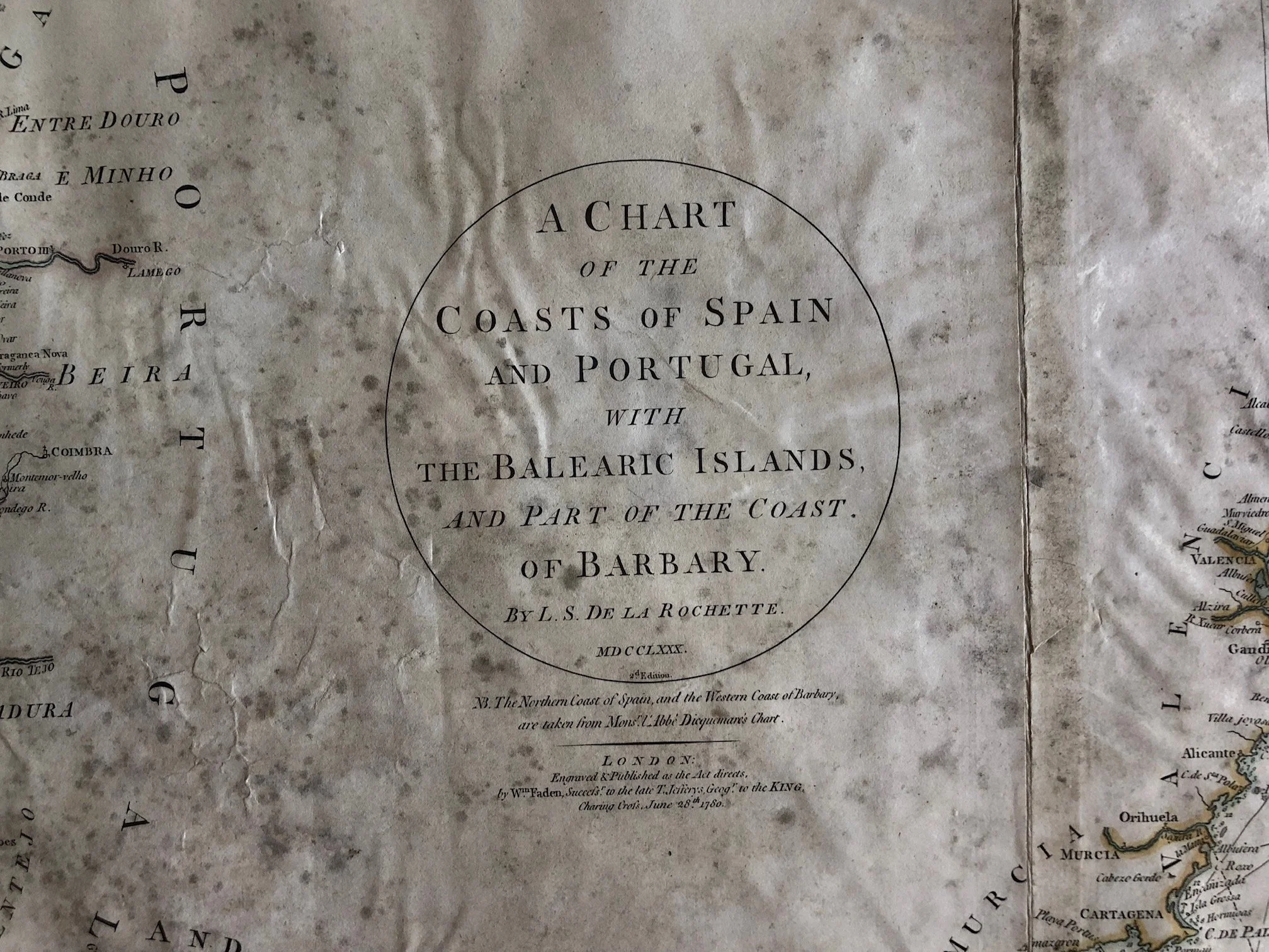
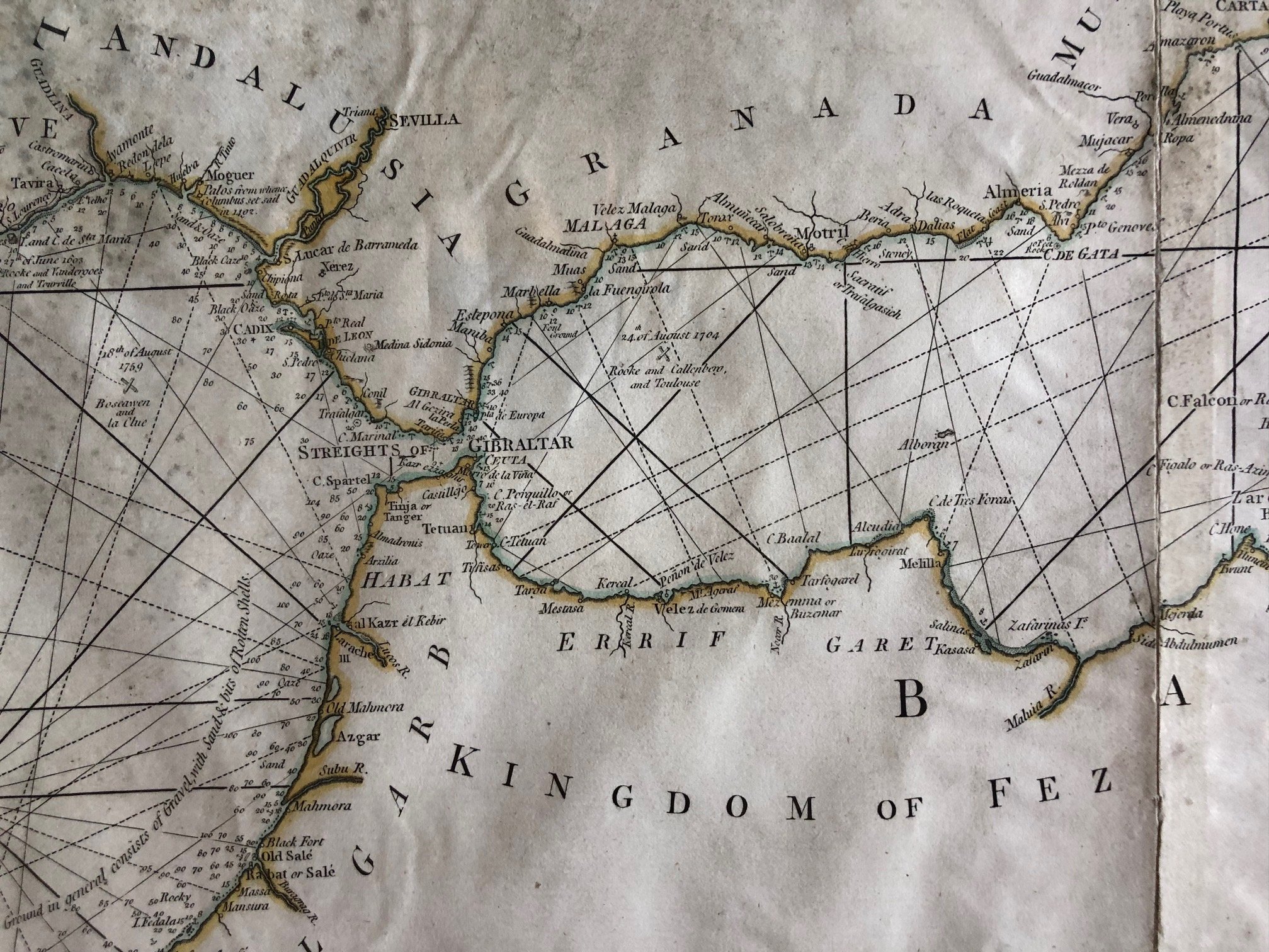

This sea chart has been extensively restored; rebacked; tears repaired etc. There are mildew stains. The map has been washed and so the mildew is no longer active. Selling this map in this condition because some customers don’t mind, hence the low price. Sold with all faults.
Published During a Critical Naval Crisis (The American Revolutionary War)
The publication date of June 28, 1780, is highly significant. At this moment, Great Britain was fighting the American Revolutionary War, and both France and Spain had entered the conflict as allies of the Americans against the British.
Just a few months prior, in January 1780, the British Royal Navy had clashed with the Spanish fleet at the Battle of Cape St. Vincent along the Portuguese coast. Furthermore, the historic Great Siege of Gibraltar (the strategic bottleneck visible at the bottom was actively underway. British naval captains desperately needed highly accurate charts of these exact enemy waters to break the Spanish blockades and supply the garrison at Gibraltar.
Scientific Collaboration Amidst Global Warfare
A fascinating detail appears just below the cartouche:
"NB. The Northern Coast of Spain, and the Western Coast of Barbary are taken from Mons.r L'Abbe Dicquemare's Chart."
Abbé Jacques-François Dicquemare was a celebrated French naturalist and astronomer. Even though Great Britain and France were locked in a bitter global war in 1780, this note reveals how Enlightenment-era cartographers and scientists continuously shared data across enemy lines. Hydrographic accuracy was seen as a universal scientific pursuit that transcended national warfare—a concept often referred to as the "Republic of Letters."
A Practical Tool of the Sea
Unlike decorative land maps designed for libraries, this is a functional sea chart (hydrographic chart). The network of intersecting straight lines stretching across the Atlantic and Mediterranean waters are rhumb lines (or loxodromes). Navigators used these lines, radiating from central compass points, to plot a constant true bearing with their mariner's compass. Faden’s chart represents the absolute peak of 18th-century British chart-making technology, stripping away artistic land illustrations to focus purely on coastal shelf depths, hazardous sandbanks, and safe harbor approaches.
800mm x 590mm
Sold with all faults.
R2,500