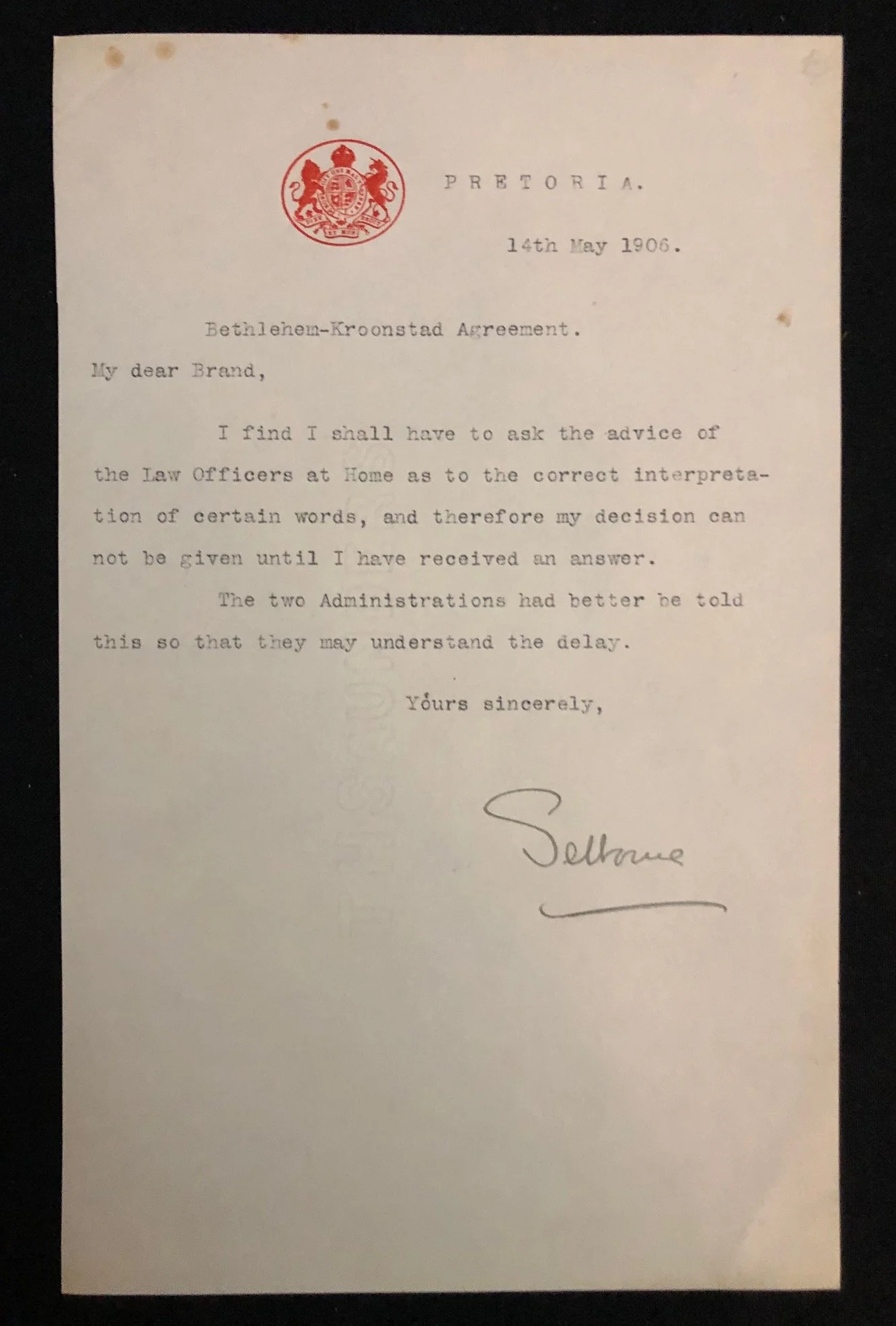
Letter RE Railways after The Boer War. From William Palmer, 2nd Earl of Selborne to Henry Brand (later 1st Baron Brand). "Milner’s Kindergarten." (1906).
This letter is a remarkably well-preserved piece of early 20th-century South African history. It captures a moment of administrative and economic transition in the aftermath of the Second Boer War (1899–1902).
The Sender "Selborne": The letter is signed by William Palmer, 2nd Earl of Selborne. Lord Selborne was appointed by the British government as the High Commissioner for South Africa and Governor of the Transvaal and Orange River colonies, serving from 1905 to 1910. He succeeded Lord Milner and was tasked with the massive job of rebuilding the war-torn region and guiding the colonies toward self-governance.
The Recipient "My dear Brand": This is Robert Henry Brand (later 1st Baron Brand). Brand was a vital member of a group known historically as "Milner’s Kindergarten." This was a circle of exceptionally bright, young Oxford graduates recruited to reconstruct the civil service and economy in South Africa after the war. Brand specialized in railway administration and financial structures.
Historical Context: The "Bethlehem-Kroonstad Agreement"
The subject line reads "Bethlehem-Kroonstad Agreement." Following the Boer War, British authorities prioritized infrastructure to knit the divided colonies back together and revitalize the economy. One of the most critical strategies was expanding the railway network.
The Geography: Bethlehem and Kroonstad are prominent towns in what was then the Orange River Colony (now the Free State province).
The Project: In 1905, construction began on a vital railway line connecting Bethlehem to Kroonstad to link the agricultural heartlands and mining interests, connecting them eventually to the ports in Natal (Durban) and the Cape.
The Dispute: Building railways across freshly conquered, semi-autonomous colonial borders sparked heavy political and financial friction between different local administrations. The "Agreement" mentioned here was likely a contract or treaty regarding the shared funding, tariff structures, or operational rights of this specific rail line.
The Bureaucratic Legal Drama
In the letter, Lord Selborne writes:
"I find I shall have to ask the advice of the Law Officers at Home as to the correct interpretation of certain words..."
"At Home" is a classic British colonial turn of phrase meaning London. Despite being the High Commissioner on the ground in Pretoria, Selborne's executive powers were bound by imperial law.
The letter reveals a classic bureaucratic standstill: a dispute over contractual semantics was significant enough that Selborne felt compelled to pause everything and ship the legal text back to Great Britain for an official ruling by imperial lawyers.
He notes that the "two Administrations" (likely referring to the governments of the Transvaal Colony and the Orange River Colony, which jointly managed the Central South African Railways) need to be notified of the delay.
Summary of Significance
This artifact is a fascinating snapshot of imperial micro-management. It shows how a seemingly local railway infrastructure project in South Africa's Free State required legal intervention from the highest echelons of the British Empire in London. Furthermore, it captures personal, behind-the-scenes communication between two architects of modern South Africa, Lord Selborne and Robert Brand, just four years before these separate colonies were unified into the Union of South Africa in 1910.
157mm x 255mm
R4,000